  1. Home
  2. Emerging Tech
  3. News

Did there used to be liquid water on Mars? New images give clues

Add as a preferred source on Google

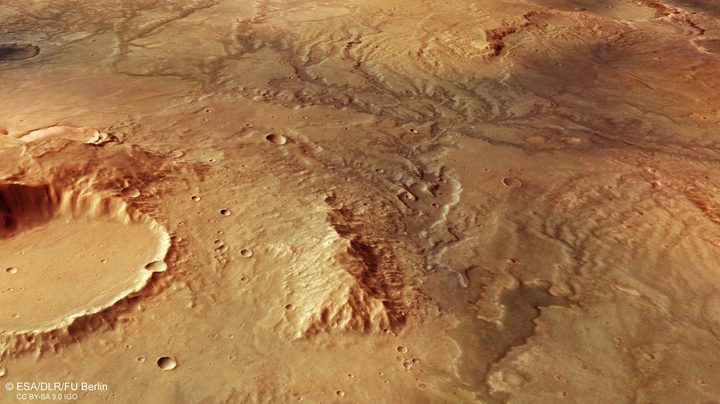
This image from ESA’s Mars Express shows a valley network on Mars. This oblique perspective view was generated using a digital terrain model and Mars Express data gathered on November 19, 2018. ESA / DLR / FU Berlin / CC BY-SA 3.0 IGO

Although it’s now well known that there is frozen water on Mars, scientists are not yet certain whether liquid water exists on the planet. Researchers have discovered what may be liquid water hidden under an ice cap and have speculated the water could theoretically be warmed by underground volcanoes, but the presence of liquid water is far from certain. However, Mars may be cold and dry now, but evidence suggests in the distant past the conditions on the planet were very different.

Recommended Videos

The European Space Agency (ESA)’s Mars Express orbiter has captured images of a region of branching valleys and trenches which suggest that liquid water once flowed on the surface. The topography of the region in the southern highlands of Mars, near the Huygens impact crater, suggests that water flowed downhill from the north towards the south, creating valleys of up to 1.2 miles (2 km) across and 656 feet (200 m) deep.
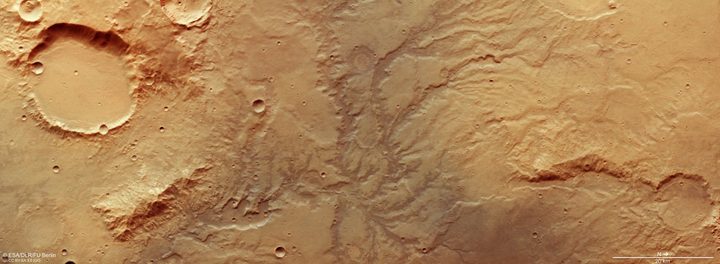
This image from ESA’s Mars Express shows a network of dried-up valleys on Mars, and comprises data gathered on November 19, 2018. North is to the right. ESA / DLR / FU Berlin / CC BY-SA 3.0 IGO

Researchers believe that billions of years ago Mars had a thick, dense atmosphere which locked in heat and kept the surface of the planet insulated enough for liquid water to flow. Mars’ atmosphere was gradually lost over the years due to changes in its magnetic field, and the planet’s surface became colder. Additionally, the volcanic activity within the planet may have changed too, reducing the heat generated from beneath the surface, making it so cold that water on the surface would freeze. This is part of the reason that Mars became inhospitable to life.

“Today, it is thought that climate change took place on Mars about 3.7 to 3.8 billion years ago, when environmental conditions changed from a somewhat neutral, potentially life-sustaining and sporadically humid environment to a much more acidic, dry, cold environment that is hostile to life,” Dr. Ralf Jaumann, a researcher in the DLR Institute of Planetary Research and principal investigator of Mars Express’ High Resolution Stereo Camera, explained in a statement.

“This climate change transformed our neighboring planet from being a one with temporary rivers and lakes that was, so to speak, ‘full of hope’ as regards the possible emergence and development of life, into a one that was just dry and salty.”

Georgina Torbet
Georgina has been the space writer at Digital Trends space writer for six years, covering human space exploration, planetary…
The best new ChatGPT feature is one most people will never use
Logo, Emblem, Symbol

For years, the biggest conversation around AI has been what these tools can do. They can browse the web, analyze documents, connect to your apps, conduct research, and increasingly act on your behalf. But as AI systems become more capable, another question has become harder to ignore: what happens when an AI assistant is tricked into handing over information it shouldn’t?

OpenAI’s new Lockdown Mode is its latest answer to that problem. Available across all ChatGPT account types, Lockdown Mode is an optional security setting designed for people and organizations handling sensitive information. The trade-off is that you get stronger protection against certain forms of data theft, but you lose access to some of ChatGPT’s most powerful features.

Read more
An app that lets anyone control a robot from their phone, no coding required
Sounds cool, right? Forget doomscrolling, now your phone can operate a robot arm instead
Representative Image

A team of researchers at Georgia Tech has developed a new smartphone-based system that could dramatically simplify how people interact with robots. Called COBALT, the platform allows users with little to no computing experience to remotely control robot arms from virtually anywhere in the world using just a phone and an internet connection.

The project, developed at Georgia Tech’s People, AI & Robotics (PAIR) Lab, transforms smartphones into motion controllers for robotic arms. Users simply move their phones in different directions, and the robot mirrors those movements in real time. Basic tasks such as grabbing, moving, and releasing objects can be performed through simple on-screen controls, making the experience feel more like playing a mobile game than operating industrial machinery.

Read more
Coursera wants users to learn through shorter, faster content
Coursera wants online learning to feel more like TikTok
Coursera

Online learning platform Coursera is taking a page straight out of TikTok’s playbook. The company has launched a new AI-powered feed designed to serve short-form educational content in a scrollable, personalized format, signaling a major shift in how digital learning platforms may try to keep users engaged.

The feature introduces bite-sized video lessons, clips, and explainers curated through artificial intelligence based on a user’s interests, learning habits, career goals, and previous course activity. Instead of committing to hour-long lectures or full certification programs upfront, users can now discover short educational snippets designed to make learning feel more casual, accessible, and addictive.

Read more