When you were at school, you likely learned about the Earth’s water cycle: how water evaporates from the surface of oceans and lakes when they are warmed by the Sun, rising into the atmosphere and settling as clouds, then falling back to Earth as rain. But now scientists have discovered a very different sort of water cycle that could be operating on Mars.
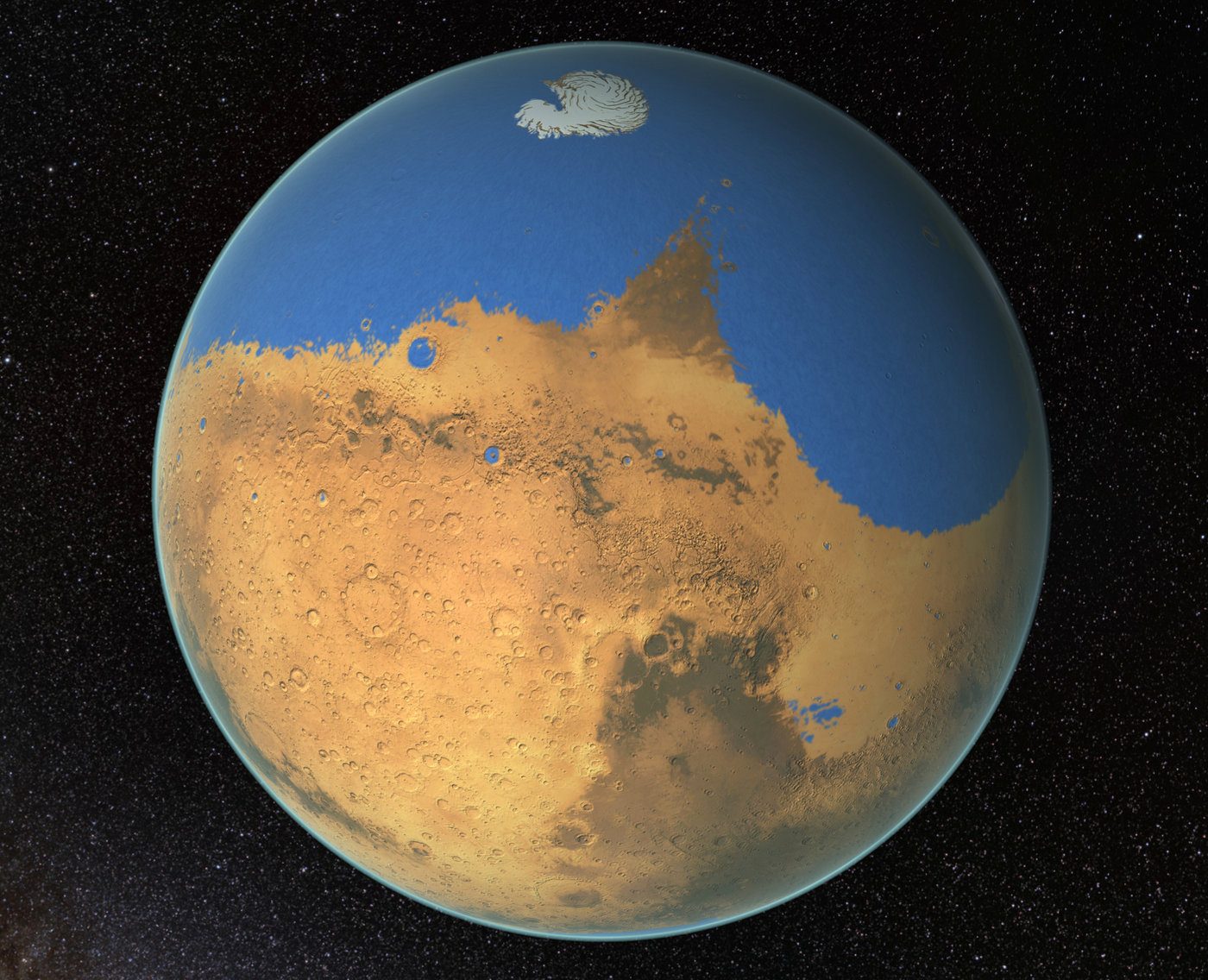
Billions of years ago, Mars used to have water on its surface. But over time, this water was lost until only a small amount of frozen water remained on the surface and a small amount of water vapor existed in the atmosphere.
Now scientists at the Moscow Institute of Physics and Technology and the Max Planck Institute for Solar System Research have created a computer simulation which shows how water vapor moves through the Martian atmosphere, and which could explain why Mars lost its water over time while Earth did not.
The start of the Martian water cycle happens only every two Earth years during summer on Mars’s southern hemisphere. During this brief period, water vapor can rise from the lower atmosphere to the upper atmosphere, from where it is carried by winds to the planet’s North Pole. At the pole, some of this water is split by the Sun’s ultraviolet radiation into hydrogen and hydroxyl radicals, and the hydrogen escapes into space. The rest of the water sinks back down into the lower atmosphere near the poles.
The system works because the middle layer of the atmosphere, which is normally ice cold, becomes permeable to water in certain locations and at certain times of year. This is due to the way that Mars orbits around the Sun, in a highly elliptical orbit which brings it much closer to the Sun at some times than at others. During summer in the southern hemisphere, the planet is 42 million kilometers (26 million miles) closer to the Sun that when it is at its further point, making the area considerably warmer.
“When it is summer in the southern hemisphere, at certain times of day water vapor can rise locally with warmer air masses and reach the upper atmosphere,” Paul Hartogh of the Max Planck Institute for Solar System Research explained in a statement. “Apparently, the Martian atmosphere is more permeable to water vapor than that of the Earth. The new seasonal water cycle that has been found contributes massively to Mars’ continuing loss of water.”
The findings are published in the journal Geophysical Research Letters.