

AMD is continuing its assault against stiff competition in 2019. Following a monstrous invasion in the CPU space with its Ryzen 3000 processors, the company is now clawing back GPU market share against both Intel and Nvidia, selling more graphics cards than Nvidia in the second quarter of 2019. Intel was still the biggest GPU seller, factoring in its onboard graphics solutions, but for the first time in five years, AMD was the second-most popular graphics manufacturer over the past few months.
For a number of years, Nvidia has been the graphics performance king, offering the kind of graphics card power that AMD just couldn’t hope to match, even with its hotter and heftier solutions. That paradigm is just as present in the latter half of 2019, but with its inexpensive 500-series Polaris graphics cards and hot new midrange competition in the form of the RX 5700 and 5700 XT, AMD has an attractive portfolio of capable 1080p and 1440p graphics hardware. It can’t match Nvidia at the most powerful (and expensive) end of the spectrum, but that doesn’t appear to matter.
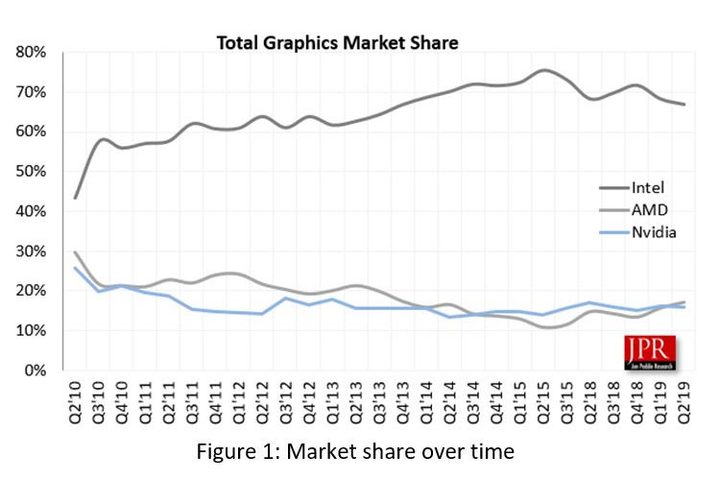
The sales numbers come from John Peddie research (via Toms Hardware), which showed that in the second quarter of 2019, AMD commanded a 17.2 percent share of graphics card sales. That’s a 2.4 percent increase over last year. In comparison, Nvidia had 16 percent of the graphics card sales during that period, dropping 1 percent from last year.
Intel is still the king of the pile, with just shy of 67 percent of all GPU sales in the second quarter, but AMD pulled some of that back with its dedicated graphics cards and its new-generation of 3000-series APUs, like the 3200G and 3400G.
Overall sales are said to have fallen year-over-year by around 10 percent, but AMD has not only maintained its sales, but grown them. This marks the first time in five years that AMD has sold more graphics cards than Nvidia. The last time that happened, the 290X was the best GPU you could buy. That’s how long it’s been.
It’s arguably even more impressive because AMD doesn’t actually have as fleshed-out a product stack as Nvidia. Its 5700 and 5700 XT compete favorably with the RTX 2060 Super and 2070, but it doesn’t have anything to compete with the 2080 Super or 2080 Ti. Its more affordable options, like the RX 580 and Vega 56, are excellent low-to-midrange choices for gamers at $300 and under, but they’re more than two years old at this point. Comparatively, Nvidia has new graphics cards, from the GTX 1650 to the RTX 2080 Ti, that are all less than a year old.
While Nvidia has talked a big game when it comes to its RTX Turing, it’s been clear for some time that the sales didn’t take off quite like it hoped. Ray tracing games are still few in number, and it was forced into a pricing war with AMD by the impressive bang for the buck offered by the new Navi RX 5700 and 5700 XT.
None of this means that Nvidia is done, or that AMD is now the king of graphics cards. It still needs to bring a high-end GPU to the table — we’ll be waiting for the big Navi card in 2020 for that — and Intel’s Xe is likely to shake up the market even more next year. But this is good news for AMD and, arguably, great for buyers too. Competition means better products at better prices, and after Nvidia’s big price hike with its new-gen cards in 2018, that’s exactly what we’re starting to see.


