
It seems to be a favorite pastime of my fellow tech journalists to bemoan Apple’s steadfast refusal to equip its MacBooks with touchscreen displays.
Since Apple has come out and essentially said “for God’s sake, no, we’re not making a touchscreen MacBook, you blithering idiots,” (I’m paraphrasing, of course), this idea seems to have reinvented itself in the form of a touchscreen keyboard. This would, err, “bless” the MacBook with two screens, one for looking at and one for pushing and poking. And if you keep up with the world of tech news, it seems as though Apple likes this idea.
Combined with the news of Microsoft’s dual-screen Surface Neo, it seems more likely than ever. But trust me, it’s not a good idea.
Prepare yourselves
According to Patently Apple, Apple is working on a virtual keyboard that uses haptic feedback and electrostatic sensations to mimic a hardware keyboard. The former would simulate key presses in the same way as the Force Touch trackpad, while the latter would provide differing levels of resistance as you move your finger across a key to indicate where the center and edges are.
It all sounds like a clever way to replicate a real keyboard — so why not use actual keys? Well, as Steve Jobs said when he introduced the first iPhone, the problem with physical keys is they’re there if you need them or not; a touchscreen can display anything. It all makes sense. But I’m worried.
While the patent illustrations depict the virtual keyboard on an iPad, the patent outlines that such a keyboard could be used on other devices, including MacBooks. Although this invention would probably make its debut on Apple’s tablets (iPad users are used to typing on glass, after all), if it’s successful it may well make its way across to the Mac.
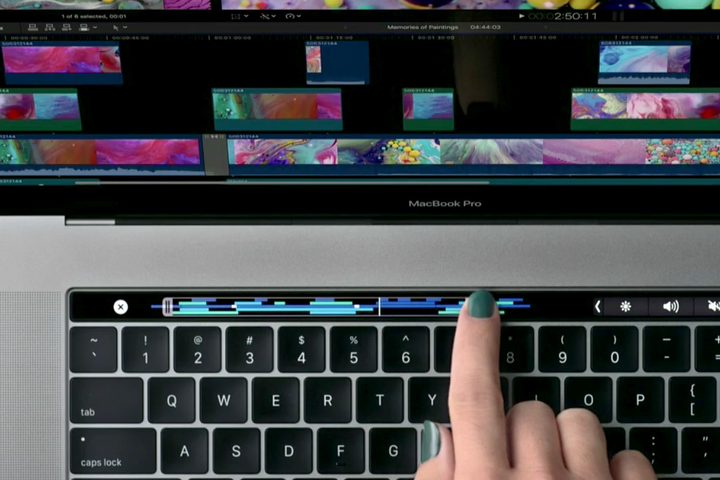
And that’s the problem. If you hate Apple’s current butterfly keyboard in its MacBooks, you’re going to loathe this virtual one. It’ll have all the super-low travel that makes the butterfly keyboard singularly unsatisfying to type on, while adding in the cold, sterile feeling of typing on glass.
But hey, at least it’s less likely to get dust under the keycaps. It’d also fulfil Apple’s dark fantasy of making the MacBook as thin as physically possible, so I guess Jony Ive will be happy, up there in his floating mountain-top retreat made entirely out of glass.
Following Microsoft’s lead
The idea of a MacBook with a virtual keyboard brings to mind a device from one of Apple’s great rivals — Microsoft’s all-new Surface Neo. This combines two small touchscreen panels into a single hinged device, although the jury’s still out on whether it’s the first second tech device to be inspired by Keanu Reeves.
But what makes it stand out from the idea of a touchscreen MacBook is its flexibility. Microsoft has thought to include an optional physical keyboard with the Neo; when you use the keyboard, one of the touchscreens adapts to complement it rather than shoulder the burden of being a keyboard itself. With the keyboard situated at the bottom of the touchscreen panel, the top section becomes a sort of large-scale Touch Bar. Move the keyboard up and you get a virtual trackpad.
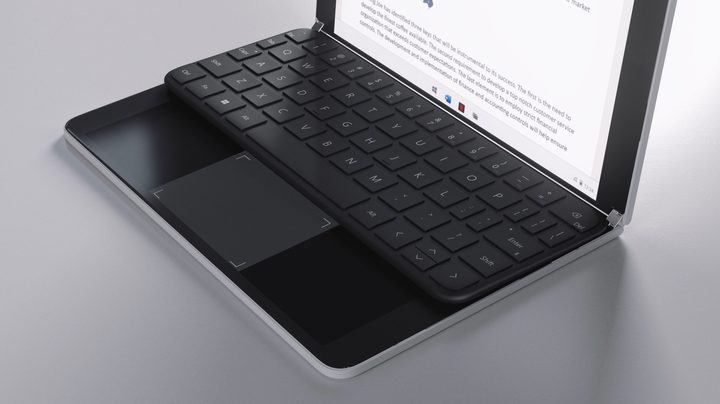
That kind of adaptability is something that Apple will need to incorporate if it kits out future MacBooks with touchscreen keyboards. Replacing the physical keys with one giant display should enable it to do that. The problem of typing on glass remains, though.
The comparison with Microsoft brings up another potential stumbling block for Apple. The company has always worked very hard to convince people to switch over from PCs to Macs. That’s one of the reasons the Mac mini doesn’t come with a keyboard and mouse. It was designed partly for Windows switchers who would already have those peripherals.
The Surface Neo doesn’t have a sure-fire chance of success, either.
Now imagine you’re considering making the leap from Windows to MacOS and you’re presented with an all-glass touchscreen keyboard. That’s going to feel bewilderingly different to what you’re used to. Even the butterfly keyboard takes a while to get used to if you’re coming from a PC keyboard, and the problem is compounded if, like me, you use a mechanical keyboard all day and night.
The Surface Neo doesn’t have a sure-fire chance of success, either. It’s a radically new concept that hasn’t really been tried out in any meaningful way before. Sure, Microsoft has made 2-in-1 laptops for years with varying degrees of success, but the Surface Neo is very different. A different form, a different operating system, and very different use cases.
But Microsoft seems to be aware of this risk and has tried to ease the transition by giving you the option of a physical keyboard. Apple tends to take a very different approach to new tech, going all-in and never looking back (RIP headphone jack). When Apple feels it’s ready, it’ll dive headfirst into the virtual keyboard world, no half measures, and damned be the consequences.
Perhaps it’ll be awesome
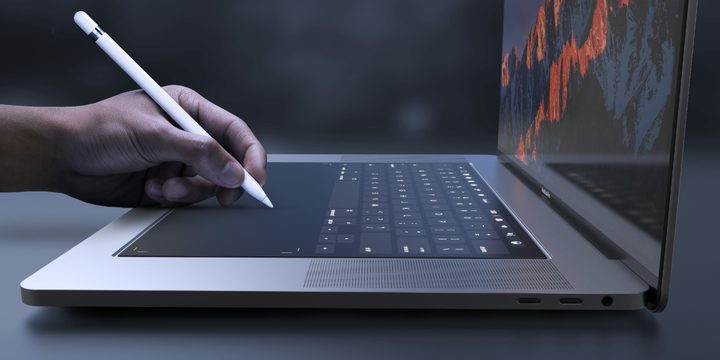
That actually gives me a small amount of solace. Because Apple never releases a product until it’s absolutely ready, it’s unlikely we’re going to see touchscreen MacBook keyboards any time soon. Just look at AirPower: Apple canceled it outright rather than risking it becoming a flaming ball of death upon release. Probably the right decision, in hindsight.
But that does mean that when Apple is ready, virtual keyboards will be sprung on us with no warning and no remorse, just like when it killed USB-A ports, and the Ethernet port, and the headphone jack, and FireWire, and the CD drive, and the floppy disk, and a million other technologies that seemed established at the time. I just hope we’re ready.
Of course, I could be wrong on this whole thing. The Force Touch trackpad has no moving parts and it’s marvelous — it’s by far the best trackpad on the market. If I was to trust any company to do something as out there as a virtual haptic keyboard and get it right, it’d be Apple. Maybe I should just stop being such a grumpy old man and embrace the touchscreen Mac.
Maybe it’ll be incredible and perfect and shoot rainbows. Or maybe it’ll make the butterfly keyboard seem wondrous in comparison.
Since we’re talking about MacBooks, our best move would be to provide you with all Black Friday MacBook deals, so that you can leverage the Black Friday discounts.


