
Today, Sonos took the wraps off the $799 Sonos Arc, the company’s first Dolby Atmos-capable wireless soundbar that replaces both the aging Playbar as well as the much more recent Sonos Playbase in the company’s home theater lineup.

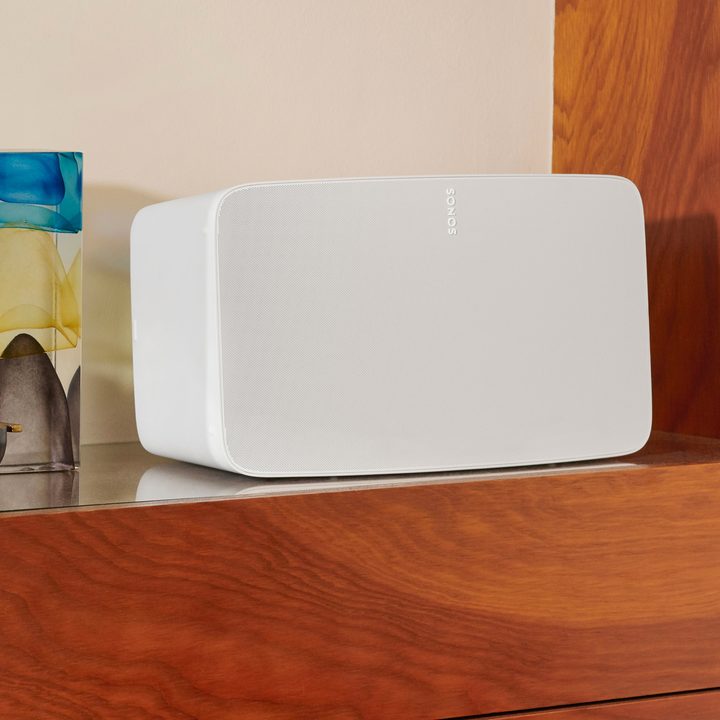
Sonos also unveiled updated versions of the Sonos Sub, now in its third generation, and the Play:5, which has been re-named Sonos Five. Both the Sub and Five get refreshed internal processors and wireless modules, but the drivers and amps (and prices, $699 and $499 respectively) remain untouched. The Sonos Five has been given a small exterior cosmetic change: The grille is now color-matched to the body, bringing the speaker in line with the design of the Sonos One, One SL, and Sonos Move.
The Arc, along with the refreshed Sub and Five, will be available for pre-order on May 6 on Sonos.com, and available globally starting June 10. They will only work with Sonos’ next-generation software platform known as “S2,” which will launch on June 8. The S2 platform includes support for higher resolution audio, has an improved design, and offers the ability to create saved room groups.
Digital Trends asked Sonos about the decision to discontinue the Playbase after only three years. We were told that a move among buyers toward larger TVs was the primary reason.
All about the Arc
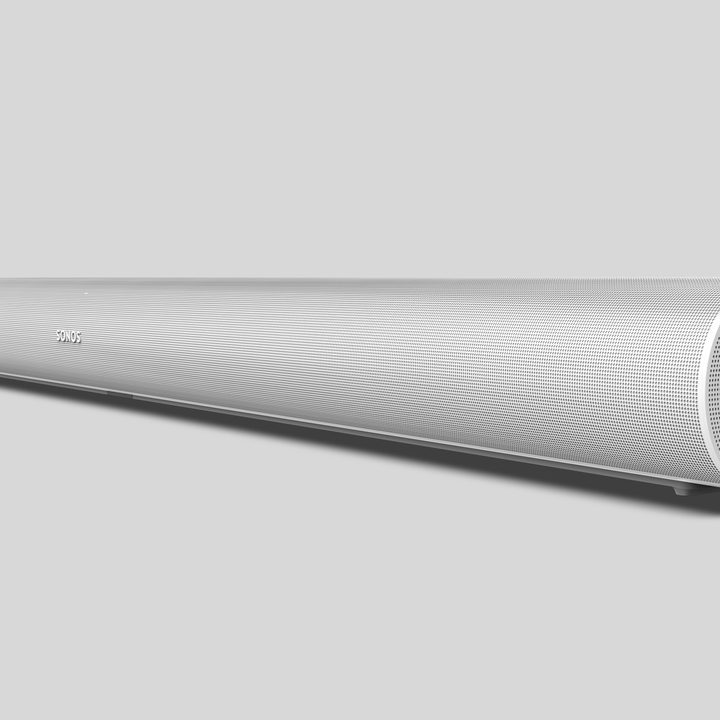
At 45-inches long and 3.4-inches tall, the Sonos Arc is both longer and taller than the Playbar, though it’s slightly shallower at just 4.5-inches deep. It features 11 drivers powered by 11 dedicated Class-D amplifiers, including 8 elliptical woofers and three tweeters. To achieve the Dolby Atmos 3D-audio effect, two of those woofers are up-firing and angled to bounce sound off the ceiling and back to the listener. Unlike many other Dolby Atmos soundbars, which place the up-firing speakers near the ends, the Arc’s height-channel speakers are mounted closer to the middle. Side-mounted drivers let the Arc reflect sound off the sides of the room for a more convincing surround-sound experience.
In theory, the Arc could support other 3D sound formats like DTS:X, however, at the moment, no plans exist to add them.

The Arc can be used on its own for a 5.0 or 5.2 home theater setup or paired with a Sonos Sub for a full 5.1.2 experience. Unfortunately, there’s no subwoofer line-out, so the Sonos Sub is your only option for low-frequency bass. There’s also the option of adding any matched pair of Sonos speakers — including the Ikea Symfonisk series — as surround satellites. When surrounds are used, the Arc automatically diverts surround channel audio to those speakers.
To tune the Arc for your specific room, you’ll use the Sonos Trueplay feature which uses an iOS device’s microphone to measure how sound moves around a space. Trueplay has always been iOS-only; Sonos says that huge variations of microphone sensitivity within the Android ecosystem make it impossible to get an accurate reading from these devices. But while Trueplay was a nice-to-have on the company’s other speakers, it will be much more important for the Arc. Sonos points out that Trueplay settings are stored on the Arc itself, so if you don’t own an iOS device, you could ask a friend who has one to let you borrow it for the one-time Trueplay tuning.

Sonos claims the Arc will then use its own adaptive audio algorithms to keep its sound optimized for each type of audio whether it’s a movie soundtrack or your personal music collection. A separate sensor lets the software know when the Arc is wall-mounted which triggers an automatic recalibration of the EQ.
Sonos fans may be thrilled that the company has delivered a soundbar that’s compatible with the latest audio formats, but they’ll probably be less excited by Sonos’ decision to keep the Arc an audio-only device. Just like the Sonos Beam and the Sonos Playbase, the Arc connects to a TV over HDMI ARC (or eARC) but it does not have an HDMI-in port for passing video signals to a TV.
This decision means that people will have one fewer HDMI ports on their TVs available for connected devices, and there’s no way to take advantage of the one-cable simplicity that HDMI ARC was meant to offer.
When connected to a TV that has HDMI eARC, the Sonos Arc can process Dolby TrueHD, the lossless, uncompressed, 24-bit version of Dolby Audio. For Dolby Atmos purists, this will be an important capability, but being able to take advantage of it will depend on your TV’s Dolby passthrough specs, as well as the capabilities of your chosen smart TV app, e.g., Netflix. Sonos acknowledged that its S2 software platform is the key to the Arc’s 24-bit audio capabilities, but demurred when asked if this meant support for 24-bit formats like hi-res FLAC would be also be added, though it conceded the S2 platform made it technically feasible.
The Arc will be available in both matte black and matte white, and an optional wall mount bracket provides an invisible way to place it directly under a wall-mounted TV. The now-standard touch controls for play/pause, volume, and track-skipping sit atop the Arc, while the LED status light’s intensity is now automatically adjusted by an ambient light sensor so that it doesn’t present a visual distraction when watching TV in a darkened room.
The Arc is also a full-fledged smart speaker, using a four far-field mic array to pick up voice commands for either Alexa or Google Assistant, which you can select in the Sonos app. Rounding out the Arc’s smarts is AirPlay 2, a feature that Sonos has been including on all of its recent wireless products.
So, how does the Arc perform? We’ll be getting a review model in for testing shortly and we’ll have our full impressions for you before its general release in June.


