
Toyota calls the Prius “the car that changed an industry,” and that’s not a far-fetched statement. Although hybrid technology has been around for over a century, the original Prius is responsible for democratizing it.
Well into its fourth generation, the 2021 Prius is still the poster child of the hybrid car segment in many markets, but the range is now broken down into two models. Called Prius, the first is a regular hybrid, meaning the electric motor makes it more efficient but it can’t power the car on its own. Named Prius Prime, the second is a plug-in hybrid, so it can be plugged in and its electric motor is powerful enough to move the car on its own for relatively short distances.
Tech features
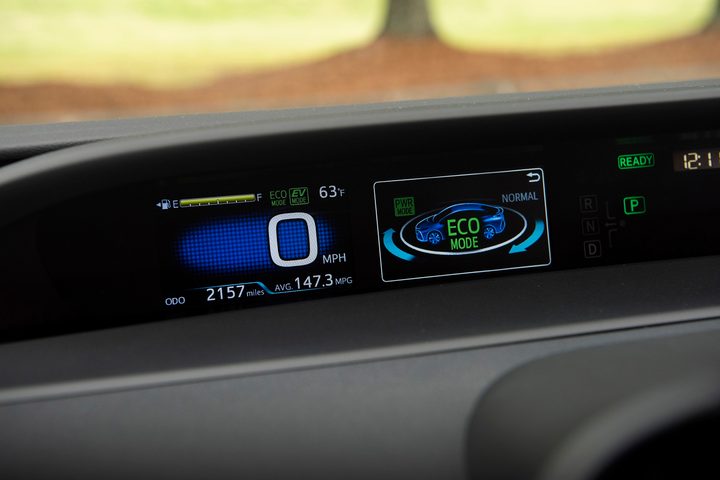
We associate the Prius with powertrain technology, not in-car technology, but it scores well in the two departments. Both models come standard with a digital instrument cluster, a 7-inch touchscreen that displays the infotainment system, Apple CarPlay, Android Auto (finally!) and Amazon Alexa compatibility, and a six-speaker sound system.
Upmarket trim levels benefit from more features, like a Qi wireless device charger and an 11.6-inch touchscreen with navigation, a JBL sound system, or both depending on the variant. Motorists can also add niceties like a HomeLink transceiver and a color head-up display (HUD) at an extra cost, or by selecting more expensive trim levels.
Performance and fuel economy
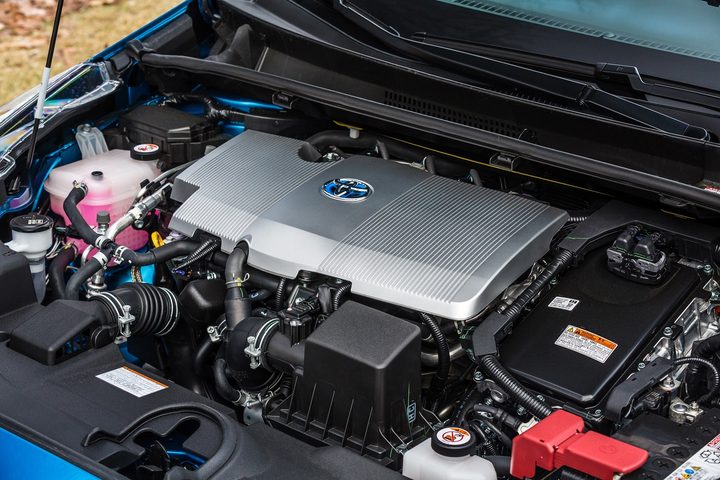
In its simplest configuration, the Prius is powered by a hybrid system made up of a 1.8-liter, four-cylinder engine, an electric motor, a small lithium-ion battery pack, and a continuously variable transmission (CVT) that spins the front wheels. Its 121-horsepower drivetrain returns 58 mpg in the city, 53 mpg on the highway, and 56 mpg combined when it powers the base L Eco trim, but those figures drop to 54, 50, and 52, respectively, when motorists select one of the more expensive trims. They’re better equipped, inevitably heavier, and consequently less efficient.
Added for the 2020 model year, all-wheel drive brings more changes than merely an additional pair of driven wheels. Toyota added a second electric motor over the rear axle, and it replaced the lithium-ion battery pack with a nickel-metal hybride unit. The trade-off is that fuel economy numbers fall to 52, 48, and 50, respectively.
Zero to 60? Top speed? Come on, it’s a Prius. Put it this way: It’s zippy enough to commute in.
The 121-horsepower plug-in hybrid drivetrain that powers the Prius Prime consists of a 1.8-liter four-cylinder engine and an electric motor that draws power from an 8.8-kilowatt-hour lithium-ion battery pack. Combined, the two power sources give the Prime a very usable 640-mile range, which is far higher than any electric car currently on the market. It returns 55 mpg in the city, 53 mpg on the highway, and 54 mpg combined. Alternatively, with the four-cylinder turned off it’s capable of driving on electricity alone for up to 25 miles at speeds of up to 84 mph.
Charging the battery pack takes two hours and 10 minutes when plugging it into a 240-volt outlet, or five and a half hours when using a 120-volt outlet. The motor also harvests energy generated while braking, though this has a minimal effect on range. And, the Prime is exclusively available with front-wheel drive as well as a continuously variable transmission (CVT), so it will quickly get pushed off your shopping list if you’re after all-wheel drive.
Interior and exterior design


- 1. 2020 Toyota Prius
- 2. 2020 Toyota Prius Prime
Beauty is in the eye of the beholder, and weighing the pros and cons of the Prius’ extroverted design would be venturing into a minefield. What’s important to remember is that Toyota styled the Prius and the Prius Prime differently to help motorists tell them apart. Both have the same silhouette and neither can be mistaken for anything else. They’re largely identical inside, meaning the instrument cluster is a digital unit positioned right in the middle of the dashboard, and the infotainment system is displayed on a color screen on the center stack.
All variants of the Prius offer space for five passengers, though the person sitting in the middle of the second row should plan for shoulder rubbing. Trunk space checks in at 27.4 cubic feet for the L Eco, XLE, and Limited models, 24.6 cubic feet for the LE, LE AWD-e, and XLE AWD-e trims, and 19.8 cubes for the plug-in hybrid Prime.
2021 brings a 2020 Edition model that commemorates the nameplate’s 20th anniversary in the U.S. Limited to 2,020 units, it stands out with black exterior trim, specific emblems, a body-colored rear spoiler, and 17-inch alloy wheels among other visual add-ons. Motorists can choose two colors named supersonic red and wind chill pearl, respectively, and every 2020 Edition model is based on the front-wheel drive XLE trim.
Safety


- 1. 2020 Toyota Prius
- 2. 2020 Toyota Prius Prime
Safety comes standard regardless of which Prius variant you choose. Both come with eight airbags, a pre-collision system with low-light pedestrian detection, cyclist detection, a lane departure warning system with steering assist, automatic high beams, road sign detection, adaptive cruise control, roadside assistance, and collision notification. Buyers who move up in the trim level hierarchy unlock features like the aforementioned HUD, parking sensors, and a blind spot monitoring system.
Pricing


- 1. 2020 Toyota Prius
- 2. 2020 Toyota Prius Prime
Toyota charges $24,525 for the most affordable version of the Prius, a trim level called L Eco. The range also includes LE, XLE, and Limited plus a pair of all-wheel-drive models named LE AWD-e and XLE AWD-e, respectively. Plan on spending $27,135 for all-wheel drive and $32,650 for the range-topping Limited model. And, keep in mind none of the aforementioned figures include a mandatory $955 destination charge.
Electrification remains expensive, so the plug-in Prius Prime inevitably costs more than the plug-less Prius. The entry-level LE model starts at $28,220, the midrange XLE costs $30,000, and the Limited is priced at $34,000. Here again, buyers need to factor in a destination charge (which is like shipping and handling for cars).


