  1. Home
  2. Computing
  3. News

World’s first 2nm chip could quadruple battery life with a quarter of the energy

Add as a preferred source on Google

IBM Unveils World's First 2 Nanometer Chip Technology

IBM unveiled the world’s first 2nm chip technology on Thursday, setting a new bar for the semiconductor industry. The new design can fit up to 50 billion transistors on a chip the size of a fingernail, which Darío Gil, SVP and Director of IBM Research, says is  “essential to the entire semiconductor and IT industry.” IBM claims the new design can achieve 45% high performance and 75% lower energy use compared to chips using a 7nm process.

Recommended Videos

In real-world use, that could mean quadrupling cell phone battery life, requiring a charge only every four days, speeding up object detection in self-driving cars, and improving the speed and efficiency of laptops. IBM was able to achieve this new process by utilizing Gate-All-Around (GAA) stacked nanosheets, helping push beyond the typical FinFET manufacturing process.
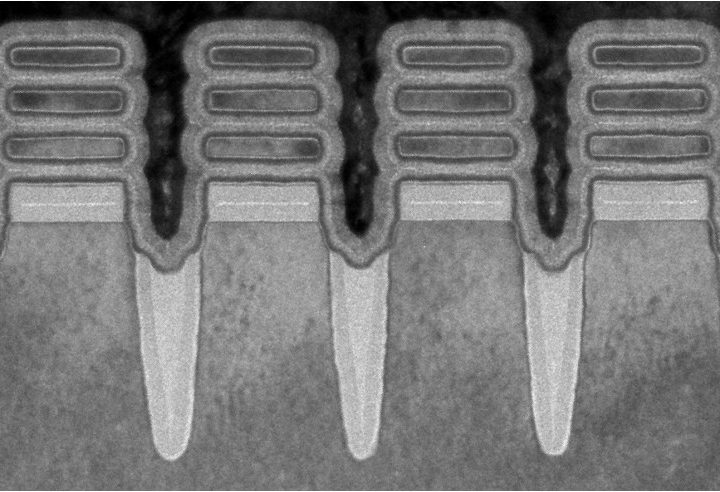
2nm technology as seen using transmission electron microscopy. 2nm is smaller than the width of a single strand of human DNA. Courtesy of IBM. Image used with permission by copyright holder

2nm is a new low (in a good way) for the semiconductor industry. Manufacturer TSMC offers a 5nm process currently and is currently researching 2nm production, and Samsung showed off a 3nm chip earlier this year. Unlike TSMC and Samsung, though, IBM doesn’t manufacture anything. This “breakthrough” comes from IBM’s Albany Nanotech Complex in Albany, NY, where the company researches future semiconductor technology.

That said, IBM has a few strategic partnerships. In 2014, the company signed a 10-year manufacturing agreement with the New York-based GlobalFoundries. More recently, IBM announced partnerships with Samsung and Intel. Although the new design will benefit the semiconductor industry as a whole, it could help bolster U.S. manufacturing, especially as Intel tries to expand its production capacity.
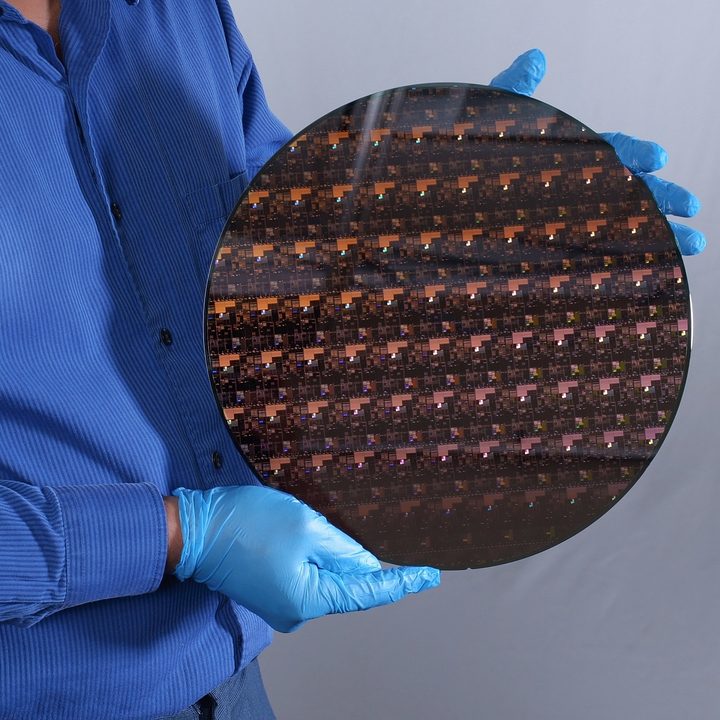
A 2nm wafer fabricated at IBM Research’s Albany facility. The wafer contains hundreds of individual chips. Courtesy of IBM Image used with permission by copyright holder

From IBM’s view, the collaborative effort is what made this achievement possible. “It is the product of IBM’s approach of taking on hard tech challenges and a demonstration of how breakthroughs can result from sustained investments and a collaborative R&D ecosystem approach,” Gil said.

You shouldn’t expect to see chips using the 2nm process anytime soon, however. The energy-efficient design will likely make its way into manufacturing plants and data centers first. First, maybe, but not soon. IBM’s achievement still comes amid a disastrous global semiconductor shortage that may not fully recover until 2023.

Jacob Roach
Former Lead Reporter, PC Hardware
Jacob Roach is the lead reporter for PC hardware at Digital Trends. In addition to covering the latest PC components, from…
Microsoft is finally fixing the most annoying thing about Windows 11
Windows 11 Laptop

For many Windows users, the taskbar in Windows 11 has always felt strangely restrictive. Microsoft redesigned the interface with a cleaner, more modern look, but in the process removed several customization options people had been using for years. One of the biggest complaints? The inability to freely move the taskbar around the screen. Now, Microsoft finally seems ready to loosen things up.

The company has started testing a major overhaul of the taskbar and Start menu for Windows 11 Insiders in its Experimental channel. And honestly, this feels like Microsoft acknowledging that users want their PCs to feel personal again.

Read more
Asus has a sleek gaming mini PC to offer, but the price will make you pinch yourself
This tiny gaming powerhouse costs more than many full desktop setups
mini PC

Asus has launched the 2026 ROG NUC 16, a compact gaming PC built for people who want a powerful setup without making room for a full desktop tower. It can sit vertically or horizontally on a desk, and there is also a Moonlight White version for buyers who want something a little cleaner-looking. The problem is the price.

In China, the refreshed ROG NUC 16 is listed at a starting price of CNY 29,999, which is around $4,405. The white version costs CNY 31,999, or about $4,699. Asus has not confirmed global pricing or availability yet, but international prices are likely to be in the same range, or possibly go even higher.

Read more
This is the coolest laptop power bank I have ever seen, and I’d wait to see if it actually ships
Krafted Edge solves the most annoying thing about laptop power banks, the fact that they never fit anywhere, and then oversells itself with battery life claims that don't quite add up.
Computer, Electronics, Laptop

I’ve seen a lot of power banks, from the chunky rectangular bricks, round puck-shaped ones, and the flat ones that sit awkwardly next to a laptop in a bag, but none of them has ever looked like this.

The Krafted Edge is a 20,000 mAh power bank built into an aluminum slab measuring 27 x 19 x 1.28 cm, which is almost exactly the footprint of a closed laptop, and that’s intentional.

Read more