
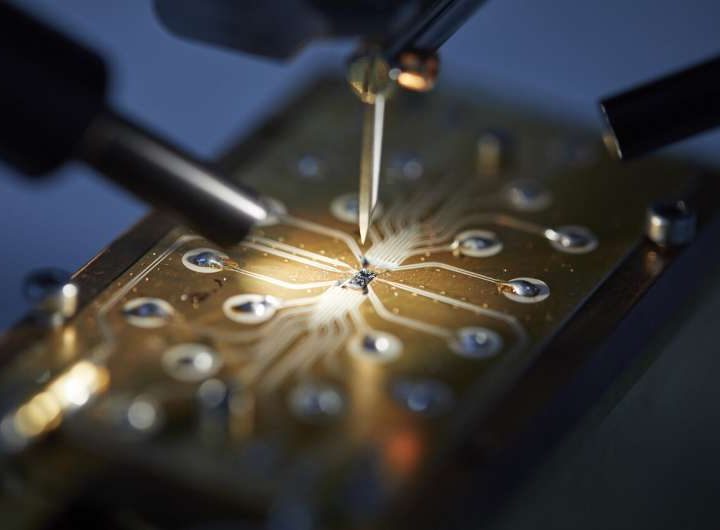
The promise of quantum computing is incredible, allowing huge leaps in the speed and efficiency of computation. However, even though the idea has been around for decades, putting the concept into practice is a massive engineering challenge. Now, researchers from the University of South Wales Sydney say they have made a leap forward and found the “missing jigsaw piece” to improve the architecture of quantum computing chips.
The problem with current approaches to quantum computing, which uses quantum bits called qubits, is that the qubits are controlled using wires which take up space on the chip and generate heat.
“Up until this point, controlling electron spin qubits relied on us delivering microwave magnetic fields by putting a current through a wire right beside the qubit,” explained lead author Dr. Jarryd Pla in a statement. “This poses some real challenges if we want to scale up to the millions of qubits that a quantum computer will need to solve globally significant problems, such as the design of new vaccines.”
Pla’s team came up with the idea to generate a magnetic field above the chip instead of using wires. “First, we removed the wire next to the qubits and then came up with a novel way to deliver microwave-frequency magnetic control fields across the entire system. So in principle, we could deliver control fields to up to four million qubits,” Pla said. “There are two key innovations here. The first is that we don’t have to put in a lot of power to get a strong driving field for the qubits, which crucially means we don’t generate much heat. The second is that the field is very uniform across the chip so that millions of qubits all experience the same level of control.”
The team developed a prototype of the technology and successfully tested it using qubits. “We were overjoyed when the experiment proved successful,” said college Professor Andrew Dzurak. “This problem of how to control millions of qubits had been worrying me for a long time since it was a major roadblock to building a full-scale quantum computer.”
With this roadblock overcome, the next step is to use this development to create simpler silicon quantum processors. The researchers say this will make it easier to produce devices with more qubits in the future. “While there are engineering challenges to resolve before processors with a million qubits can be made, we are excited by the fact that we now have a way to control them,” said Pla.
The research is published in the journal Science Advances.


