  1. Home
  2. Space
  3. News

Supercomputer simulates the entire universe, from Big Bang to now

Add as a preferred source on Google

An international team of researchers has produced the most accurate simulation of the universe to date, using supercomputers to model the entire history of the universe from the Big Bang to the present day.

The project, named SIBELIUS-DARK, created a simulation that reaches out 600 million light-years from Earth, including 130 billion simulated particles. It was created using the DiRAC COSmology MAchine (COSMA) supercomputer from Durham University.
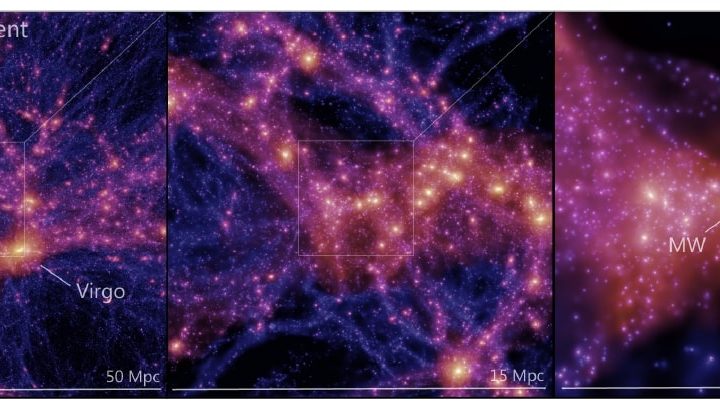
Simulation of the Milky Way galaxy and the Andromeda galaxy (known as M31).
At the very center of the simulation (and our own Universe) is the Milky Way galaxy, and our nearest massive neighbor, the Andromeda galaxy (known as M31). Dr Stuart McAlpine

The simulation can help answer questions in cosmology, as well as visualize phenomena like dark matter by seeing the way it clumps into regions called halos. “The simulations simply reveal the consequences of the laws of physics acting on the dark matter and cosmic gas throughout the 13.7 billion years that our universe has been around,” explained one of the authors, Carlos Frenk of Durham University, in a statement.

Recommended Videos

The researchers worked on the simulation by using algorithms that reproduced our local area of the universe, centered on Earth, spreading out to cover our Milky Way and also nearby galaxies like the Andromeda galaxy. This was based on a model called the Cold Dark Matter model, which is a standard model in cosmology.

“The fact that we have been able to reproduce these familiar structures provides impressive support for the standard Cold Dark Matter model and tells us that we are on the right track to understand the evolution of the entire Universe,” said Frenk. Co-author Matthieu Schaller from Leiden University concurred, adding: “This project is truly ground-breaking. These simulations demonstrate that the standard Cold Dark Matter Model can produce all the galaxies we see in our neighbourhood. This is a very important test for the model to pass.”

The researchers now want to use the model to test cosmological models further, hoping to understand more about how the universe came to be the way it is. “By simulating our Universe, as we see it, we are one step closer to understanding the nature of our cosmos,” said lead author Stuart McAlpine of the University of Helsinki. This project provides an important bridge between decades of theory and astronomical observations.”

The research is published in the journal Monthly Notices of the Royal Astronomical Society.

Georgina Torbet
Georgina has been the space writer at Digital Trends space writer for six years, covering human space exploration, planetary…
Astronauts reportedly took shelter after work on Russia’s leaky ISS module triggered concerns
The ISS really picked a stressful time to start leaking again
The International Space Station.

Astronauts aboard the International Space Station reportedly took precautionary shelter measures after maintenance work on a long-troubled Russian module raised fresh safety concerns about air leaks aboard the orbiting laboratory.

According to reports, the incident involved Russia’s Zvezda service module, which has experienced recurring air leak problems for several years. During repair work and pressure tests connected to the leak investigation, astronauts were instructed to isolate themselves in safer sections of the ISS as engineers monitored the station’s integrity and pressure stability.

Read more
Blue Origin’s massive New Glenn rocket explodes in a fiery blaze during tests
The incident leaves NASA's Moon Base ambitions and Amazon's Kuiper constellation without their primary launch vehicle at the worst possible moment.
Explosion, Fire, Nuclear Explosion

Blue Origin's New Glenn rocket exploded during a static fire test at Launch Complex 36 in Cape Canaveral, Florida. The incident took place on the night of May 28, 2026. 

The explosion was captured on a live stream by NASASpaceflight.com and footage of the explosion spread rapidly across X. The Space Launch Complex 45 has confirmed in an official statement (shared by Spaceflight Now on X) that all personnel have been accounted for and there have been no injuries or fatalities.

Read more
Orbot Robotics’ space robot has four arms, but its Goro physique has a purpose
This four-armed robot could make routine space-station work easier for astronauts
Robot with four arms

Helios is a new four-armed robot from Zurich-based Orbit Robotics, and at first glance, it reminded me of Goro from Mortal Kombat. But unlike the prince from Outworld, Helios is not built for combat. It is designed to help astronauts on space stations with the repetitive, time-consuming work that keeps life in space running.

Orbit Robotics says that in microgravity, legs are not much help. Instead of walking or standing, Helios needs to move through tight station interiors, hold itself steady, and handle cargo, tools, or equipment. Its four-arm design turns extra limbs into both mobility aids and working hands.

Read more