Apple has just announced the new M1 Ultra chip as part of its Apple Peek Performance spring event. Joining the family of successful Apple silicon, the chip ushers in a new generation of computing performance.
M1 Ultra combines two M1 Max chips and is larger than the M1 Max or the M1 Pro. Apple promises extreme levels of performance from the latest iteration of its silicon. How does the new M1 Ultra match up against other Apple chips? Let’s compare the three in an M1 Ultra vs. M1 Max vs. M1 Pro showdown.

Pricing and availability
The M1 Ultra chip has only just been announced, but we already know the device in which it will make its first appearance: The Mac Studio. Apple doesn’t sell its proprietary M1 chips by themselves, so below we’ll list the devices that run on the M1 Max, M1 Pro, and, soon, M1 Ultra.
Apple M1 Max and Pro
- 14-inch MacBook Pro 2021 — starting from $1,999
- 16-inch MacBook Pro 2021 — starting from $2,499
- Upcoming Mac Studio (M1 Max) — $1,999
Apple M1 Ultra
- Upcoming Mac Studio (M1 Ultra) — $3,999
Mac Studio is a new product that Apple announced during the spring event, and it will come in two variants: A cheaper option with the M1 Max chip and a more expensive option with the M1 Ultra. The Studio is essentially a bigger Mac Mini, doesn’t come with a monitor, and is said to offer “outrageous performance” once it comes out.
While the 2021 MacBook Pros have been out for a while, the Mac Studio is a new product for Apple. Pre-orders are already open, and the desktop officially becomes available March 18.
Specs
Both of the current chips Apple has on offer, the M1 Max and the M1 Pro, sit safely atop any list of the best processors found in a laptop — but the M1 Ultra has a good chance of dethroning them.
The M1 Max, M1 Pro, and M1 Ultra are all so-called system-on-a-chip (SoCs) that offer the CPU, GPU, and RAM in a single chip. All three are built on TSMC’s 5nm process node, but the M1 Ultra combines two chips into one processor.
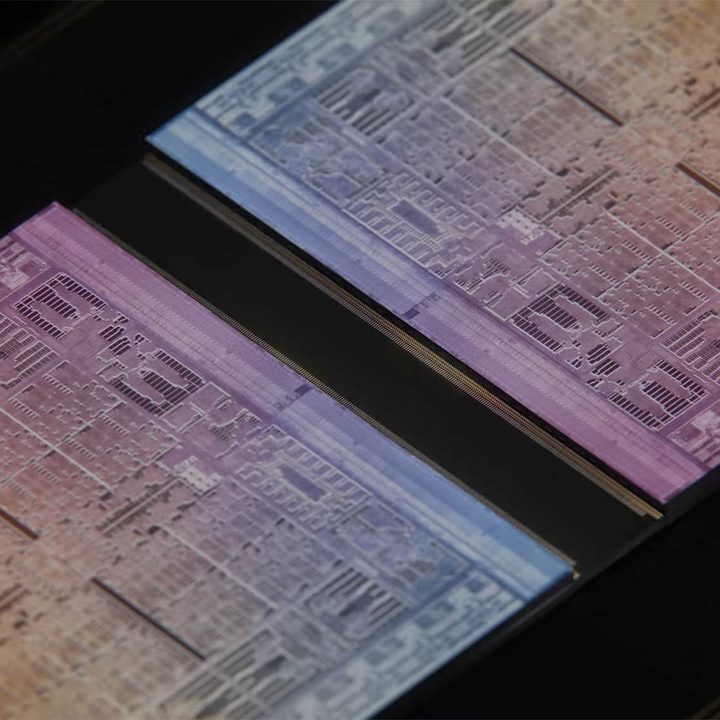
The new M1 Ultra chip is larger than M1 Max, which is to be expected considering that it brings two full M1 Max chips connected via die-to-die technology that Apple has named “UltraFusion.” The chip is going to feature the most transistors offered in any personal computer chip. With 114 billion transistors, which is seven times more than the basic M1 chip, the Ultra is undoubtedly going to be a powerful and fast processor.
The M1 Ultra houses a 20-core CPU built based on hybrid architecture, meaning that 16 of the cores are of the high-performance variety, and four are high-efficiency. It also has a 64-core GPU. According to Apple, the GPU in the M1 Ultra is only going to use a third of the power of most graphics cards, highlighting how Apple silicon is all about the right balance of efficiency and raw power. Apple states that the chip offers top-notch, industry-leading performance per watt in the 5nm process node.

The chip also features 800GB/s of memory bandwidth, 2.5TB/s low-latency interprocessor bandwidth, and in total, more than four times the bandwidth of “leading multi-chip technology.” It offers HEVC, ProRes encoding and decoding, ProRes RAW support with two video decode engines, four video encode engines, and four encode/decode engines, as well as hardware-accelerated H.264. M1 Ultra supports up to 128GB of unified memory.
Considering that Apple built the M1 Ultra on two interconnected M1 Max dies, it’s easy to declare a winner in this competition. The M1 Max and Pro both have 10 cores each, eight of which are the high-performance Firestorm cores and two efficiency-based Icestorm cores.
The chips vary in terms of graphics. The M1 Pro has up to 16 GPU cores, while the M1 Max brings that number up to 32 cores. Once again, we are seeing that the M1 Ultra doubles the specifications offered by the M1 Max chip.
The M1 Pro chip supports up to 32GB RAM while the M1 Max goes up to 64GB, which is half the RAM supported by the new M1 Ultra chip.
Performance
While the M1 Ultra is still unreleased, we’ve had plenty of time to get a good look at the performance offered by the M1 Max and M1 Pro chips in the latest MacBook Pro laptops. The chips have performed excellently, matching up against the best processors from Intel and AMD, and often winning. Apple’s own silicon has proven to be very successful in terms of power efficiency, battery life, and sheer performance. The chips are a visible step up over previous Intel-based Macs, and more importantly, the M1 Max and the M1 Pro improve upon the basic M1 in every way possible.
We tested the M1 Pro chip ourselves, and then followed up with a review of the M1 Max to compare to the Pro. The multi-core score in Cinebench R23 was among the best laptop scores in our database at the time, and it was only bested by the Asus ROG Strix G15, which is a full-fledged gaming laptop. The MacBook Pros are thin, light, and not exactly gaming-oriented — although they pull their weight in gaming the most of any current Apple device.
Compared to the M1, both the Pro and the Max hit new heights in benchmarks, doubling all of the metrics offered by the M1 chip. The M1 Max chip also excels in terms of GPU performance thanks to its beefy 32 GPU-core count. The M1 Max can also be found in a cut-down version with 24 GPU cores, priced at $200 less, which obviously drops down in performance.
In our tests of the M1 Max, the chip was put to the test in video editing and in gaming. It outperformed the M1 Pro chip by 16% in terms of the overall score, which means that it also managed to beat every other laptop we’ve ever tested. It also held its own ground in gaming, but most people don’t buy Apple products strictly for gaming.
Unsurprisingly, Apple is trying to bring improvements with each new iteration of its chip, but the M1 Ultra might be the biggest upgrade yet. We have no benchmarks yet, and we will update this once they appear, but considering that it brings a raw hardware upgrade offering twice the power of M1 Max, there is likely going to be a substantial performance gain.
Mac Studio, which is where Apple is debuting the M1 Ultra chip, is going to be up to 90% faster than a Mac Pro equipped with an Intel Xeon processor, and almost four times faster than an iMac. Apple also promises huge graphics upgrades, with the M1 Ultra allegedly being able to match the performance of the “most powerful discrete GPU” while only consuming a third of the power.
We will have to wait to see which of the best graphics cards are going to be bested by the M1 Ultra chip once the first benchmarks roll out.
Ports
The M1 Max and M1 Pro chips offer up to four Thunderbolt ports on the MacBook Pro. This adds up to as many as four external displays and is a massive step up over the basic version of the M1 chip. The M1 Max-based MacBook Pro also comes with an HDMI port, an SD card slot, a MagSafe 3 port, and support for DisplayPort technology.
Unsurprisingly, the M1 Ultra offers upgrades in this department, too. Apple has teased that the upcoming Mac Studio will have six Thunderbolt 4 ports, two USB Type-A connectors, an SD card reader, an HDMI port, and a 10 Gigabit Ethernet connection. However, it doesn’t seem to feature a MagSafe port.

There is no question about the winner
Yes, it’s true that the real performance of the staggeringly powerful M1 Ultra chip will only be judged once the Mac Studio is thoroughly benchmarked. However, it’s hard not to declare a winner right here and now.
The M1 Pro is an improvement over the M1, and the M1 Max beats it in every way possible. With UltraFusion combining two M1 Max chips into the M1 Ultra, Apple’s new processor is likely to hit new heights on benchmarks and deliver new levels of performance. It’s hard to tell just by how much the M1 Ultra will outperform the Max, but it’s almost bound to happen.
However, that doesn’t necessarily mean that everyone should want the $3,999 Mac Studio right away. Apple’s latest device is going to be a product for professionals, and not everyone will need to utilize the full power of the M1 Ultra chip. In those cases, sticking to the M1 Max, be it in the MacBook Pro or in the cheaper Mac Studio, is recommended. Still, in terms of sheer power alone, the M1 Ultra is a clear winner.