
If you ever thought Meta Verified was anything other than a money grab, this should change your mind.
An unexpected thing happened on Instagram over the weekend. In hindsight, it shouldn’t have been unexpected. I’ve been using Insta since it finally became available on Android in April 2012, and for me, it’s mostly been an enjoyable experience. (That said, I’m spending more time with Glass and Vero, but that’s another thing for another time.) I’ve had a relatively high-profile job since those days, and Instagram has been a fun place to let folks have a peek into the day-to-day.
But I’ve never been what I’d consider an “influencer” (and, good lord, I hate that term) on the ‘gram. It’s possible a middle-aged white dude whose hair isn’t what it once was just isn’t as easy on the eye. And that’s OK because it’s true. I sleep just fine, thanks. All that to say that I’ve never been “verified” on Instagram or anything. No biggie — though lately I’ve thought it might be nice if only to help out with my photography side hustle.
So when Instagram shot me a notification for Meta Verified this weekend, I had to stop and think about it for a couple of minutes. And I ultimately decided it was ridiculous.
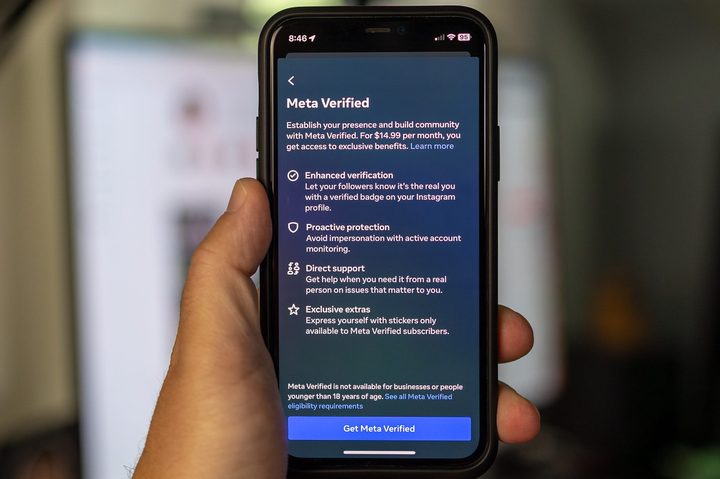
Let’s back up: Meta Verified is a scheme by which you pay Meta (the umbrella company over Facebook and Instagram) $15 a month and get “exclusive benefits.” Those include:
- Enhanced verification to “let your followers know it’s the real you with a verified badge on your Instagram profile”
- Proactive protection to “avoid impersonation with active account monitoring”
- Direct support to “get help when you need it from a real person on issues that matter to you”
- And exclusive extras for things like “stickers only available to Meta Verified subscribers”
Let’s take those in order.
The idea of having to pay to prove who you are is, simply, dumb. While I’m all for a quick visual to let folks know that an account is “official” or whatever (and I’m “verified” on Twitter through Digital Trends and absolutely am not going to pay anything there, am verified on Mastodon by my own accord, and was deemed worthy of a checkmark on Google+ back when it was a thing), you shouldn’t have to pay for it. Verification should just be a service that’s offered if you want to prove that you are who you say you are.
And, yes, there are plenty of circumstances in which an account maybe should be required to verify itself. Celebrity is one. Political or corporate representation is another.
That leads to the second feature of Meta Verified — the “proactive protection” with “active account monitoring.” I’m admittedly torn on this. On one hand, that very much sounds like something that maybe Meta should just offer on principle. On the other hand, it’s probably very expensive to do at scale. Maybe something in-between — like what Google does with its Advanced Protection Program — could be worked out. Better security is in everyone’s interest.
As for direct support — this one is unequivocally important, and also extremely difficult. A wise PR flack once explained how the biggest expense for his company wasn’t the products being produced — it was the customer support that followed. You simply can’t rig up a hotline for billions of people in dozens of countries to call in every time they can’t get into their account. It just doesn’t scale. But you should be able to escalate things quickly and easily if it’s a difference between someone getting into your account and you just losing your password. Should you have to pay for that?
I couldn’t care less about exclusive stickers. That’s a non-starter.
But none of that is what gave me pause when I first saw the Meta Verified notification asking me to fork over $90 a year. That’s not a whole lot of money, and I’m actually tempted to do it for a few months just to see if there’s any increase in subscribers or at least a decrease in the number of accounts using Insta as a platform to promote their OnlyFans subscriptions. (In case it wasn’t painfully obvious that the algorithm knows I’m a middle-aged guy, there’s your proof.)
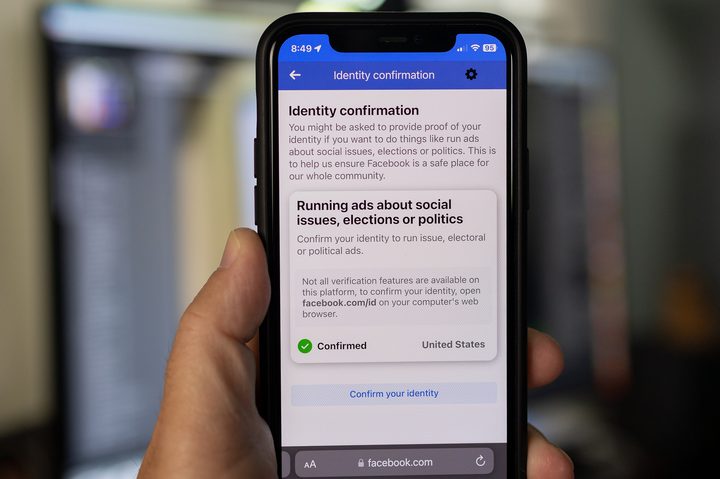
But here’s the thing: Meta already knows damn well who I am. I’ve had to actively prove that through a slightly byzantine process that required Meta to mail me a code — as in snail mail, in a physical mailbox — and also send in a scan of my driver’s license or passport. That was all so I could work with posts as part of a couple of local political campaigns I helped out on in 2018 and 2020. Election integrity is extremely important to me, and I’m actually somewhat impressed by how easy Facebook makes it to see who’s running ads, as well as the content of those ads. (That it’ll still take money for all sorts of untrue nonsense is a separate problem.)
That brings me back to the following question: Should I pay Facebook and Instagram $15 a month — again $90 a year — to prove that I am who I am to a company and to a public who already know full well who I am and what I’m up to?
After all, if I’m required to do exactly that so I can spend even more money on advertising, maybe those things — the checkmark, the extra support, and the extra account protection — must be included? My account usage perhaps is more niche than what’s intended for Meta Verified. And if that’s the case, so be it.
But let’s not be confused about what Meta Verified is for. It’s a cash grab with what likely is minimal benefit. It’s not any sort of scheme for transparency and accountability. That already exists. For free.


