  1. Home
  2. Computing
  3. News

Intel’s most powerful CPUs may not launch until 2024

Add as a preferred source on Google
Intel Core i9-13900K held between fingertips.
Jacob Roach / Digital Trends

Intel’s next two generations of desktop CPUs are both exciting and confusing. Luckily, new information has come to light around what to expect.

The report comes from German publication Igor’s Lab, which claims to have seen Intel’s internal performance projections for these next two generations of chips. The report also affirms some of the details in Intel’s desktop road map, including that the 14th-gen fall release will be a Raptor Lake Refresh rather than true Meteor Lake desktop chips. It also says the 15th-gen Arrow Lake is anticipated to launch in 2024.

Recommended Videos

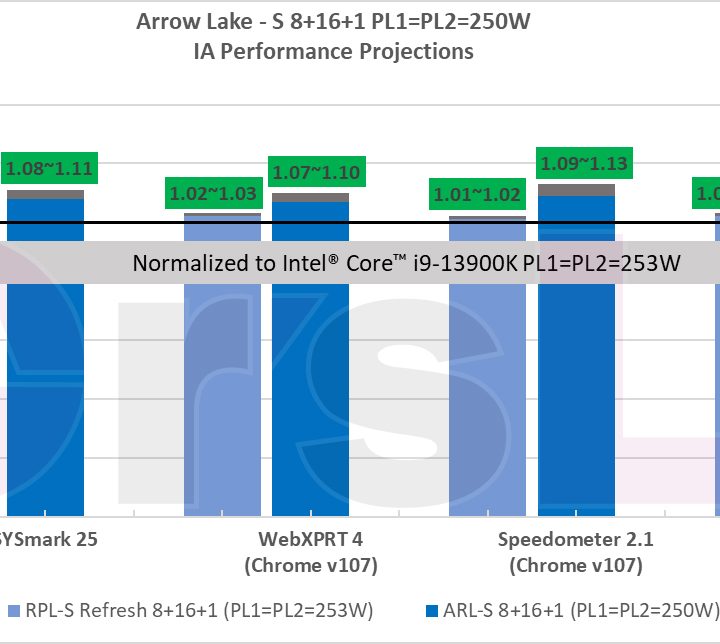
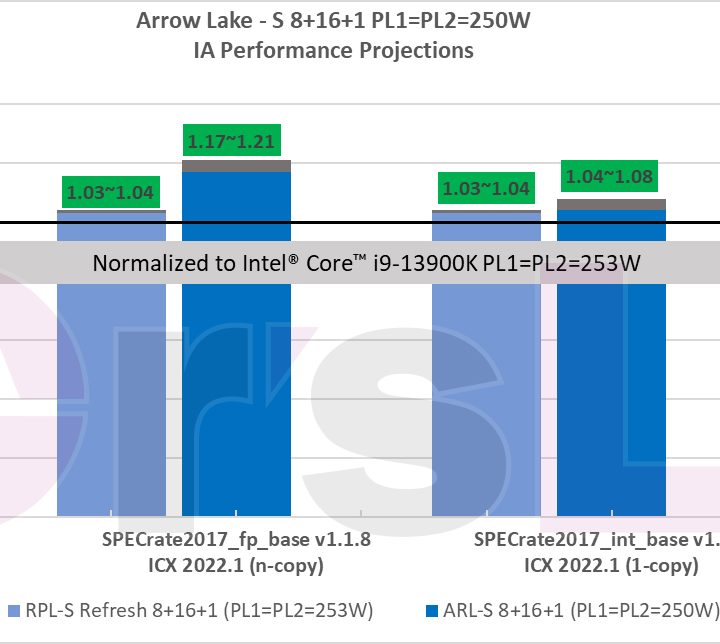
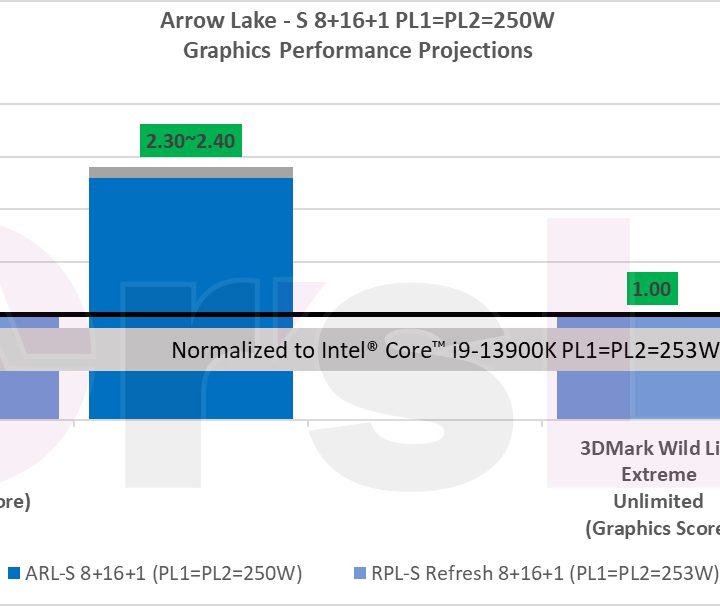
To ensure a fair comparison, Intel has used the current-gen Core i9-13900K for normalization with corresponding models of Raptor Lake Refresh and Arrow Lake. It is important to note that these numbers are just an estimate and will potentially differ from the final performance numbers of the upcoming CPUs.

All three processors share the same configuration, with eight performance cores and 16 efficiency cores. The numbers also suggest that Arrow Lake will consume almost the same power as Raptor Lake. The PL1 and PL2 for Raptor Lake and Raptor Lake refresh is set to 253 watts, while Arrow Lake is set to 250W.
Intel 14th-gen and 15th-gen performance projections slide
Image credits: Igor’s Lab Image used with permission by copyright holder

The first graph suggests that Raptor Lake Refresh will offer a performance increase between 1% to 3%, which will be primarily due to increased clock speeds that are expected to go as high as 6GHz. Arrow Lake, on the other hand, delivers a 7% to 20% performance increase, where the highest improvements are set to be in multi-core operations.
Intel 14th-gen and 15th-gen performance projections slide 2
Image credits: Igor’s Lab Image used with permission by copyright holder

The next slide focuses on the SPEC CPU benchmark package that contains standardized, CPU-intensive suites for measuring and comparing compute-intensive performances. This ensures a comparative measurement of compute-intensive performance across broad a spectrum of hardware using workloads derived from real user applications. Here, Raptor Lake Refresh experences a gain of 1% to 4%, depending on the application. Arrow Lake gains performance ranging from 3% to 21%, which is a significant jump, specifically in the floating-point runs.
Intel 14th-gen and 15th-gen iGPU performance projections slide
Image credits: Igor’s Lab Image used with permission by copyright holder

The last graph gives us information about the integrated graphics. Raptor Lake Refresh uses the same HD 700 series GPU as the Core i9-13900K, with 32 EUs and clock speeds of up to 1.65GHz. Since both are using the same configuration, the performance is also similar. However, Arrow Lake will be using the new Xe LP graphics, and will also be the first desktop CPU where the integrated GPU is mounted using Foveros packaging that stacks chipsets vertically. While there is no confirmation around the number of EUs or the clock speeds, the slide suggests an impressive increase of 220% to 240% compared to the 100% of Raptor Lake.

Arrow Lake is also expected to arrive with a new socket that is rumored to be LGA1851. While the dimensions of the socket are expected to be similar to the LGA1700, it will have 9% more pins. Thus, Intel should introduce motherboards with 800-series chipsets. As for cooler manufacturers, they might need to introduce new mounting hardware once again. Of course, none of this information is final and could change at the last minute.

Kunal Khullar
Kunal Khullar is a computing writer at Digital Trends who contributes to various topics, including CPUs, GPUs, monitors, and…
Photoshop is being eaten by the prompt box
AI image tools are making editing feel less like software and more like a conversation, but the conversation is not always cooperative.
Person, Animal, Insect

Coming back from a recent trip, I found myself sorting through a pile of photos that needed a little cleanup. Nothing dramatic. A distracting object here, an awkward background detail there. My first thought was Photoshop, but the full version requires a subscription, and I'm neither skilled enough to justify paying for it nor in need of everything it offers.

Mobile editing apps weren't much more appealing. I have fat fingers, and there's a special kind of frustration that comes from trying to make a precise adjustment on a phone screen only to tap the wrong thing three times in a row.

Read more
Acer reveals Veriton compact PC to tackle the Mac mini with AMD Ryzen and plenty of AI mojo
Acer's Veriton RA110 brings AMD Ryzen AI Max+ 395 performance, 128GB of RAM, and local 200-billion-parameter AI model support to a compact desktop.
Electronics, Hardware, Computer Hardware

The Mac mini has had a comfortable run as the go-to compact desktop for professionals who want serious performance in a small form factor and an affordable price. 

Acer is making a direct play in that space with the Veriton RA110 AI Mini Workstation, a compact desktop that runs on AMD's Ryzen AI Max+ 395 processor, aimed at the same desk-bound professional who wants power without the tower.

Read more
Acer’s Swift Air 14 is a peppy MacBook Neo rival with some cool upgrades and a $699 ask
Computer, Electronics, Laptop

The race to build the next great affordable laptop is heating up, and Acer thinks it has a strong contender. The company today unveiled the Swift Air 14, a thin-and-light Windows laptop that combines a premium design, AI-ready hardware, and impressive battery claims for a starting price of just $699.

At a time when even mainstream laptops are creeping toward four-figure price tags, Acer’s latest machine feels refreshingly straightforward. It’s aimed at students, remote workers, and anyone who wants a laptop that looks and feels expensive without draining their bank account. The Swift Air 14 is powered by Intel’s new Core Series 3 processors and delivers up to 19 hours of battery life. That’s the sort of endurance that could realistically get many users through a full workday and beyond without scrambling for a charger.

Read more