A great puzzle game can make you feel like a genius. Genre classics like Portal hinge on the immense satisfaction that comes from cracking a complicated solution. That can be a tricky puzzle in itself, as developers need to be careful to not make challenges so obtuse that they send players searching for guides after too much head-scratching. Games that pull it off, however, leave players a special kind of intellectual prize that’s more rewarding than a digital trophy.
That was the guiding philosophy in 2014’s standout The Talos Principle, and it seems to carry through to its sequel. After playing a sizable chunk of the upcoming puzzle-adventure game (five hours; roughly a quarter of the final game), The Talos Principle 2 is already shaping up to be a worthy successor. Not only does it have a larger scope with much more philosophical waxing, but it doubles down on its predecessor’s inventively designed puzzles too — I already feel like a mad genius.
Bring on the puzzles
In its opening moments, The Talos Principle 2 seems exactly the same as its predecessor. I’m dropped into a desert and sent into puzzle chambers, where I jam electronic doors and place boxes on switches. Completing a puzzle gives me a tetromino piece that I slot into doors to unlock new areas. That’s only a cheeky tutorial, though. I’m quickly pulled out of a simulation machine to discover I’m a robot living in a futuristic society populated by intelligent machines.
While the first game was a lonely experience that relied on lore logs to weave its background story, the sequel puts narrative in the forefront. I spend a chapter simply walking around the hub city chatting with robots and learning about their society. I even get access to a social media site filled with philosophical conversations between bots (if the first game’s heady chatter turned you off, be warned that the sequel cranks it up even more). When a party to celebrate the city’s 1000th robot goes awry, I’m shipped off on an expedition to investigate a mysterious pyramid. To get inside, I’ll need to activate a series of towers in different areas.
And of course, that means solving a lot of puzzles.
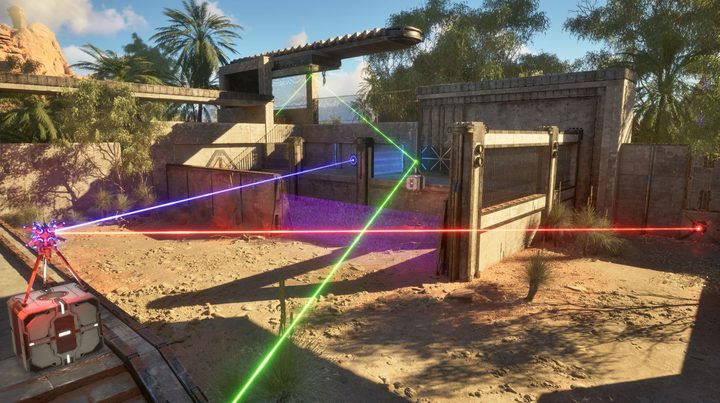
The general structure is more or less the same as the original from there, though a bit more open-ended. When I travel to an area, I’m free to explore and tackle puzzle chambers in any order I choose. If I wander off the beaten path, I’ll even discover some bonus puzzles, hidden lore logs, environmental secrets, and collectible flames that’ll let me bypass puzzles (that’s especially useful considering there are no hints to be found). Completing eight puzzles allows me to unlock the path to a tower, where I need to place tetromino pieces to build a bridge. It’s a clever little twist on the original’s defining feature.
Puzzle chambers are familiar at first. I’m often trying to get a beam of light to a matching lock by using machines to reflect light over to them. I’m introduced to three new machines during my playthrough that build on that idea. In the first area, I’m working with a new device that attaches to two different colored beams and combines them to create a new one. Hooking it up to a blue and red beam creates a green one, for instance. Naturally, that creates some complex puzzles the deeper I go as I attach splitters to other splitters to direct lights around walls.
The sequel riffs on that further with inverters, which outputs the opposite color of whatever it’s attached to (hooking it up to a blue beam produces a red one). One particularly tricky puzzle has me placing an inverter on a box on top of a fan, unlocking a far-off door with an inverted light stream, and then finding a way to direct both a blue and red beam inside. Solutions often involve multiple beams of light shooting around chambers in all directions.
The demo also introduces a more mind-bending tool that brings a bit of Portal flair: drillers. These devices can open up a portal on specific surfaces, allowing me to move devices or light through them. My favorite puzzle in the whole demo has me drilling a hole in a high wall and finding a way to get a converter high enough to reach it. Putting a converter on a fan seems like the easy answer, but first I have to use the driller to juggle items in and out of a room closed off with a pressure plate.
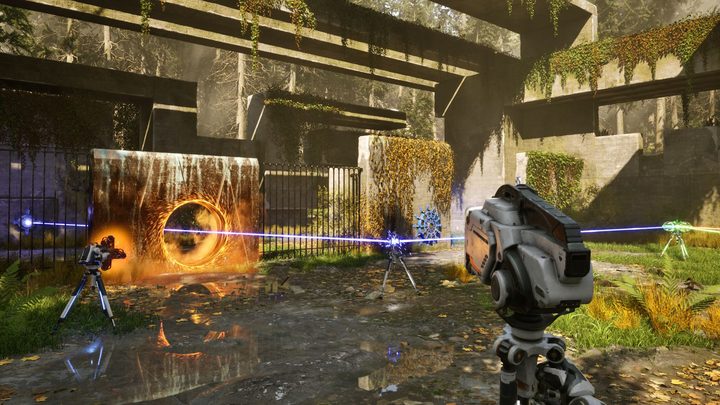
What The Talos Principle 2 does especially well so far is present puzzles that seem physically impossible to solve at first glance. There were plenty of rooms where I felt like a kid trying to understand a magic trick. In almost every one of those cases, though, I was able to string together a solution that left me feeling like a magician myself. I’d only find myself cheating twice, as I discovered two rooms in which I could hop on the walls of the chamber to get to the end room. I’m not sure if that’s an intentional decision or not, but it did leave me feeling a little disappointed in myself.
That’s only a taste of what’s to come. I’m assuming that each open area introduces a new puzzle concept, which means that there could be another nine or so here. I can see late puzzles getting a little overwhelming if I’m juggling that many tools, but I have faith that developer Croteam knows how tricky it can get before reaching the point of frustration. That strength is on full display in the first quarter of the adventure. Like the sequel’s talkative androids, I yearn to uncover every secret I can in this mysterious world. Keep tossing me puzzles that are this well designed and I’ll keep solving them.
The Talos Principle 2 is scheduled to launch this year for PC, Xbox Series X/S, and PS5.