  1. Home
  2. Space
  3. News

Meet the new NASA communications system that’s hitching a ride in today’s Psyche launch

Add as a preferred source on Google

The launch today of NASA’s Psyche mission to visit a metal asteroid will include an extra bonus, as the spacecraft will carry a test of a new communications system.

Testing Space Lasers for Deep Space Optical Communications (Mission Overview)

The Deep Space Optical Communications (DSOC) experiment will test out a laser-based communications system that could help NASA transmit more information from deep space missions, such as future missions to Mars.
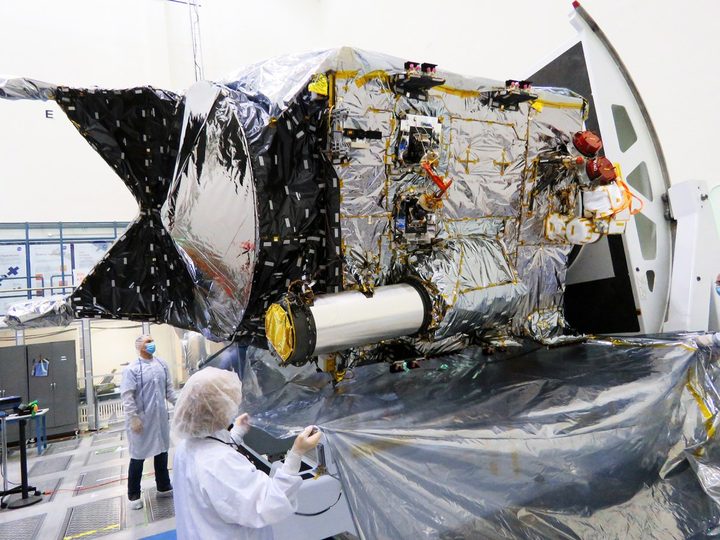
The flight transceiver for NASA’s Deep Space Optical Communications technology demonstration can be identified by its large tube-like sunshade on the Psyche spacecraft, seen here inside a clean room at NASA’s Jet Propulsion Laboratory in Southern California.
The flight transceiver for NASA’s Deep Space Optical Communications technology demonstration can be identified by its large tube-like sunshade on the Psyche spacecraft, seen here inside a clean room at NASA’s Jet Propulsion Laboratory in Southern California. NASA/JPL-Caltech

NASA primarily communicates with its far-off spacecraft using a system called the Deep Space Network, which is a set of three sites in California, Spain, and Australia that have large communications dishes to detect signals sent from space. As these three sites are spaced out around the globe, it is always possible for at least one of them to detect a signal, no matter which direction Earth is facing.

Recommended Videos

It isn’t possible to make communications any faster, as signals travel at the speed of light which is a hard limit — so, for example, the communications delay of up to 20 minutes between Earth and Mars isn’t something that we’ll be able to fix any time soon. But there is another way to improve the existing network, which is to increase its bandwidth.

As there are more and more missions flying into space and the instruments they carry get more and more sophisticated, the total volume of data that needs to be transmitted grows. To accommodate that, communications need to be more to higher frequencies, which can transmit more data in the same amount of time.

That’s the idea for NASA’s ongoing upgrades to its Deep Space Network, which involve retrofitting the existing communications dishes here on Earth, which were designed for radio communications, to be able to handle laser communications as well. Compared to radio communications, laser (also known as optical) systems can carry up to ten times as much data.

As well as upgrading the equipment on the ground, however, the laser-based communications systems also need to be tested in space. NASA has been working on demonstration systems in orbit around Earth for several years, and now it will test the new system on a real mission: Psyche.

For the first two years of Psyche’s journey to the main asteroid belt, DSOC will test out the use of laser communications in a real deep space mission. Data will be collected by the 200-inch (5.1-meter) Hale Telescope at Caltech’s Palomar Observatory in California, testing out the system over distances of up to 240 million miles.

Georgina Torbet
Georgina has been the space writer at Digital Trends space writer for six years, covering human space exploration, planetary…
We just got a hot signal that a Tesla and SpaceX could happen, after all
Tesla

For years, the idea of Tesla and SpaceX becoming a single company has lived somewhere between ambitious business theory and Elon Musk fan fiction. The two companies already share DNA, leadership influence, engineering talent, and long-term goals. But every time the topic surfaced, it felt more like an interesting thought experiment than a realistic possibility. Now, one of the most important people at SpaceX has added fresh fuel to the conversation.

Speaking in a recent CNBC interview, SpaceX President and COO Gwynne Shotwell was asked about the possibility of closer ties between Tesla and SpaceX. Her response wasn’t a flat-out denial. In fact, she suggested that bringing the two companies together could make life a little easier for Musk. That may sound like an offhand comment, but coming from Shotwell, it’s noteworthy. She’s been at SpaceX since its earliest days and remains one of the company's most influential executives.

Read more
Astronauts reportedly took shelter after work on Russia’s leaky ISS module triggered concerns
The ISS really picked a stressful time to start leaking again
The International Space Station.

Astronauts aboard the International Space Station reportedly took precautionary shelter measures after maintenance work on a long-troubled Russian module raised fresh safety concerns about air leaks aboard the orbiting laboratory.

According to reports, the incident involved Russia’s Zvezda service module, which has experienced recurring air leak problems for several years. During repair work and pressure tests connected to the leak investigation, astronauts were instructed to isolate themselves in safer sections of the ISS as engineers monitored the station’s integrity and pressure stability.

Read more
Blue Origin’s massive New Glenn rocket explodes in a fiery blaze during tests
The incident leaves NASA's Moon Base ambitions and Amazon's Kuiper constellation without their primary launch vehicle at the worst possible moment.
Explosion, Fire, Nuclear Explosion

Blue Origin's New Glenn rocket exploded during a static fire test at Launch Complex 36 in Cape Canaveral, Florida. The incident took place on the night of May 28, 2026. 

The explosion was captured on a live stream by NASASpaceflight.com and footage of the explosion spread rapidly across X. The Space Launch Complex 45 has confirmed in an official statement (shared by Spaceflight Now on X) that all personnel have been accounted for and there have been no injuries or fatalities.

Read more