I’ve done a lot of memorable things in VR this year. I’ve climbed mountains, commanded hundreds of tiny people, and even paddled through the seas in a kayak. With Assassin’s Creed Nexus VR, I get to add another virtual feat to that list: I’ve jumped down on top of an unsuspecting guard and plunged a hidden blade into his throat with pinpoint accuracy. And I’m a little worried about how delighted I am by that.
Ubisoft has been a long-time supporter of VR going back to early standouts like Eagle Flight, but Assassin’s Creed Nexus VR finds the publisher making its full leap of faith into the tech. It’s not another virtual “experience” based on one of its popular IPs, but rather a full-throated Assassin’s Creed game with just about everything you’d expect in its console counterpart. There’s sneaking, parkour, lock picking, pickpocketing, death-defying leaps, and even a wealth of collectibles hidden in small-scale recreations of historical locations. All that’s missing is the open-world glut — and that’s arguably its best quality.
Assassin’s Creed Nexus VR isn’t just a strong use of virtual reality; it’s one of Ubisoft’s finest games in years. By smartly working within the limitations of the tech, the tired Assassin’s Creed formula got the rejuvenation it desperately needed. Ubisoft may be committed to pumping out enormous open-world games with machine-like efficiency, but its heart might just be in VR.
Into the Animus
Assassin’s Creed Nexus VR puts players in the middle of an Abstergo operation to recover lost artifacts from the past. It’s a loose MacGuffin story that’s really just there to justify a “greatest hits” setup, as players embody three classic assassins: Ezio, Kassandra, and Connor. Each one has its own set of missions in their era and share the same basic mechanics, which build on one another across the interweaving stories. Each chapter takes place in a bite-sized explorable city dotted with a few collectibles and optional challenges like timed parkour gauntlets. The primary objectives are the same as they would be in any Assassin’s Creed game: infiltrate guarded locations, swipe key objects, and assassinate targets.
What’s impressive here is just how much of the Assassin’s Creed formula is retained in a sleeker structure — and just how fantastic most of it feels. Parkour is as simple as holding down the A button while dashing to magnetically zip between landing spots, letting me seamlessly dash across the rooftops of Italy. I can easily climb any building I see too by grabbing onto ledges with the side triggers of my Meta Quest controllers. One awe-inspiring climb had me scaling the masts of a massive ship, gingerly walking across ropes to reach a scouting point.
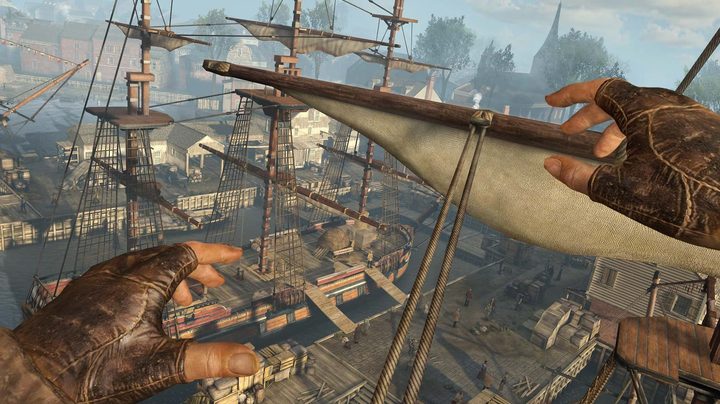
Physicality improves just about every piece of a formula that’s grown rote over the years. Take stealth, for instance. When I sneak through guard-filled rooms here, I actually find myself kneeling on the ground in real life and hiding behind barrels to avoid enemy sightlines. Everything feels so intuitive that I hardly need a tutorial. I know to pick up an object and throw it to cause a distraction. When I go to mark a guard, all I have to do is look directly at them for a second. I’m the one actively sneaking around rather than just someone pressing buttons to simulate it.
That feeling enhances the series’ signature assassinations most of all. When I quietly get behind an unsuspecting guard, I flick my wrist to extend my hidden blade and jab it into their back for an instant kill. It makes me feel like a sociopath when I say this, but that action alone is one of the most satisfying things I’ve experienced in a VR game to date. When I complete a Connor mission that ends with me rushing into a public hanging and killing the executioner in front of the crowd, I feel like an assassin in a way that the series has simply never accomplished before.
Not every piece is as clean. Full combat can be sloppy, as I need to swing my sword or ax at the right moment to parry attacks. I still can’t quite get the timing right amid inconsistent motion detection, which just leads me to wildly swing at my foe to take them out. Advanced platforming techniques can be confusing too. Swinging motions that require me to throw my arms in a certain direction to hop between far-off footholds often leave me at the bottom of a pit. I’ve fallen to my death a few times too just from a hand coming detached from a ledge unexpectedly.
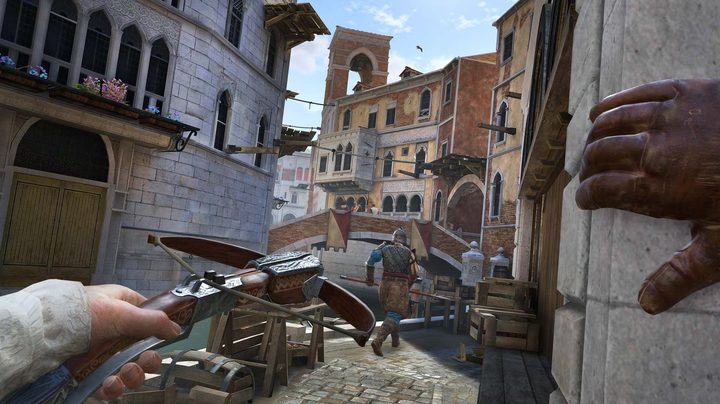
Those sloppy moments feel small in the grand scheme of Assassin’s Creed Nexus VR, as Ubisoft nails enough little details to make up for those lulls. I love how it feels to grab my bow from behind one shoulder and an arrow from another, lining up a perfect shot that takes down a Bostonian patrolling a far-off roof. There’s a simple pleasure in scaling the side of a boat, grabbing a guard’s leg, and yanking him into the ocean for a quiet kill. Even little details, like using my hidden blade to slash the rope off an alarm bell, make it feel like the most immersive VR adventure since Half-Life: Alyx.
Assassin’s Creed Nexus VR feels like the future for Ubisoft, a publisher that’s struggled to keep its signature “map game” design fresh in recent years. By being forced to cut down the tiresome open-world cruft, Nexus spends much more time delivering satisfying, moment-to-moment action. Every old idea I’ve done a hundred times, like swan diving into hay bales, feels entirely new in a physical context that makes me feel like the one inside the Animus. If you’ve long missed the magical spark that made early entries feel so special, Nexus VR will take you back to the past and into the future in the same exhilarating breath.
Assassin’s Creed Nexus VR is available now on Meta Quest headsets.