  1. Home
  2. Space
  3. News

Japanese lander touches down on the moon, but suffers power glitch

Add as a preferred source on Google

A Japanese mission has succeeded in landing on the moon, but it likely won’t last for more than a day due to an issue with its solar cells. The Smart Lander for Investigating Moon (SLIM), from Japanese space agency JAXA, is the second mission in a week to have trouble attempting to land on the moon, showing that despite the Apollo landings occurring more than 50 years ago, lunar landings continue to be a major challenge.
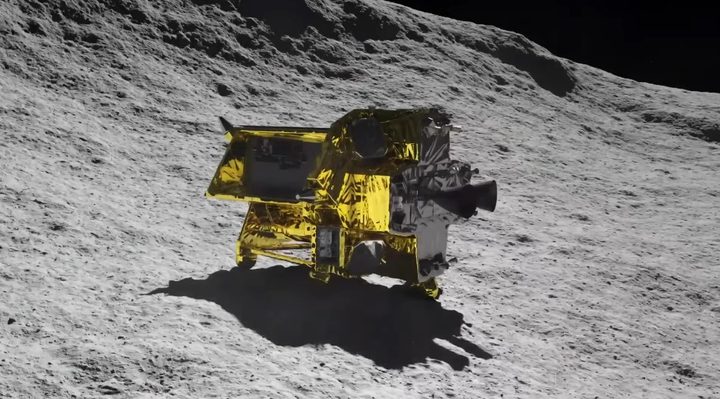
Artist's illustration of the SLIM lander touching down on the moon.
Artist’s illustration of the SLIM lander touching down on the moon. JAXA

The SLIM lander entered orbit around the moon on December 25 last year and made its landing on Friday, January 19. The soft landing — meaning touching down under control on the surface — was successful, making Japan the fifth country to achieve this feat. A video released last year by JAXA shows the complex landing process that SLIM performed:

Japan to launch SLIM lunar lander to moon! See the mission animation

“SLIM has been communicated to the Earth station, and it is receiving commands from the Earth accurately. The spacecraft is responding to these in a normal way,” said Hitoshi Kuninaka, Director General of the Institute of Space and Astronautical Science – JAXA, in a press conference following the landing attempt. “However, it seems that the solar cell is not generating electricity at this point in time. Since we are not able to generate electricity, the operation is being done using battery.”

Recommended Videos

Unfortunately, only a small amount of battery power is available, which will run out within a day. That means the mission will likely soon end unless the sun’s movement allows the solar cells to charge.

While hovering over the moon’s surface, the lander separated two tiny rovers, LEV-1 and LEV-2, and JAXA was able to receive telemetry data from LEV-1. However, LEV-2 relays its data via the lander, so it won’t be able to communicate once the power runs out.

Still, JAXA will attempt to take as many measurements as possible in the limited time before the battery dies. “We are making efforts to maximize the scientific achievement,” Kuninaka said.

JAXA said it hopes to release more information on the status of the mission and its findings next week, including information on the issue with the solar cells.

Georgina Torbet
Georgina has been the space writer at Digital Trends space writer for six years, covering human space exploration, planetary…
We just got a hot signal that a Tesla and SpaceX merger could happen, after all
Tesla

For years, the idea of Tesla and SpaceX becoming a single company has lived somewhere between ambitious business theory and Elon Musk fan fiction. The two companies already share DNA, leadership influence, engineering talent, and long-term goals. But every time the topic surfaced, it felt more like an interesting thought experiment than a realistic possibility. Now, one of the most important people at SpaceX has added fresh fuel to the conversation.

Speaking in a recent CNBC interview, SpaceX President and COO Gwynne Shotwell was asked about the possibility of closer ties between Tesla and SpaceX. Her response wasn’t a flat-out denial. In fact, she suggested that bringing the two companies together could make life a little easier for Musk. That may sound like an offhand comment, but coming from Shotwell, it’s noteworthy. She’s been at SpaceX since its earliest days and remains one of the company's most influential executives.

Read more
Astronauts reportedly took shelter after work on Russia’s leaky ISS module triggered concerns
The ISS really picked a stressful time to start leaking again
The International Space Station.

Astronauts aboard the International Space Station reportedly took precautionary shelter measures after maintenance work on a long-troubled Russian module raised fresh safety concerns about air leaks aboard the orbiting laboratory.

According to reports, the incident involved Russia’s Zvezda service module, which has experienced recurring air leak problems for several years. During repair work and pressure tests connected to the leak investigation, astronauts were instructed to isolate themselves in safer sections of the ISS as engineers monitored the station’s integrity and pressure stability.

Read more
Blue Origin’s massive New Glenn rocket explodes in a fiery blaze during tests
The incident leaves NASA's Moon Base ambitions and Amazon's Kuiper constellation without their primary launch vehicle at the worst possible moment.
Explosion, Fire, Nuclear Explosion

Blue Origin's New Glenn rocket exploded during a static fire test at Launch Complex 36 in Cape Canaveral, Florida. The incident took place on the night of May 28, 2026. 

The explosion was captured on a live stream by NASASpaceflight.com and footage of the explosion spread rapidly across X. The Space Launch Complex 45 has confirmed in an official statement (shared by Spaceflight Now on X) that all personnel have been accounted for and there have been no injuries or fatalities.

Read more