  1. Home
  2. Space
  3. News

NASA reveals how Mars helicopter just kept getting better and better

Add as a preferred source on Google
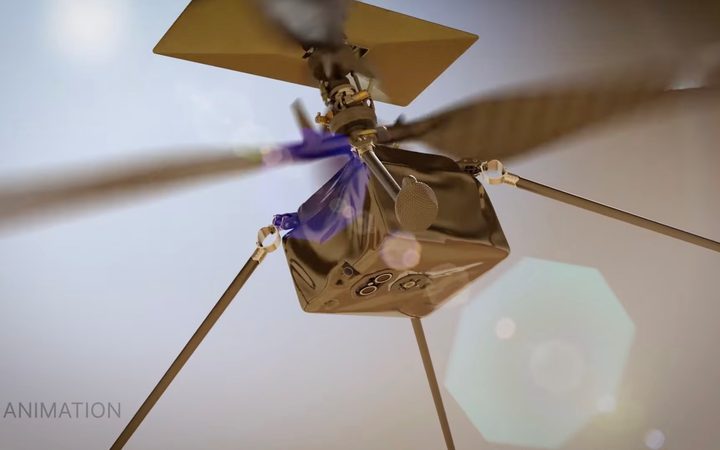
An animation showing a close-up of NASA's Mars helicopter, Ingenuity.
NASA/JPL

It’s been a couple of weeks since NASA’s Mars helicopter, Ingenuity, took its final flight on the red planet.

It was grounded for good after suffering damage to one of its propellers during its 72nd and final flight. But despite the disappointment, it was widely recognized that Ingenuity achieved much since arriving on Mars in February 2021.

Recommended Videos

Not only did it become the first aircraft to achieve powered, controlled flight on another planet, but, as explained in a new video released by NASA on Wednesday, Ingenuity was also pushed to test its aerodynamic limits, on many occasions breaking its own records for speed, distance, and altitude.

The Most Extreme Flights of NASA’s Ingenuity Mars Helicopter (Mars Report)

Speaking from the Aerial Vehicles Lab at NASA’s Jet Propulsion Laboratory, which oversaw the rotorcraft’s mission, Ingenuity chief engineer Travis Brown discussed some of the record-breaking moments.

Brown explained, for example, how Ingenuity was originally expected to make as many as five flights within a 30-day period, but ended up flying 72 times during almost two years on the red planet.

Once the aircraft was shown capable of achieving controlled flight in Mars’ super-thin atmosphere, the team paired the vehicle with Perseverance, the ground-based rover that arrived on Mars at the same time as Ingenuity. It experimented with new ways to target Ingenuity’s high-resolution camera, with the captured aerial imagery helping the Perseverance team to plan safe and efficient routes for the rover as it scoured the Martian surface in search of evidence of ancient microbial life.

Brown said the Ingenuity project really began in earnest with flight 49 when the aircraft set new speed and altitude records. By flight 62, Ingenuity had achieved its highest and fastest flights, reaching an altitude of 24 meters and a top speed of 22.4 mph.

The team also tested different landing speeds for the aircraft — faster ones to save power and slower touchdowns to reduce landing load — and even instructed it to conduct first-of-their-kind studies on the planet’s wind and dust movement, offering new insight into the Martian atmosphere.

Brown said that everything the Ingenuity team learned from its 72 flights will be applied to the design of next-generation rotorcraft destined for Mars and possibly other planets in our solar system.

Trevor Mogg
Contributing Editor
Not so many moons ago, Trevor moved from one tea-loving island nation that drives on the left (Britain) to another (Japan)…
We just got a hot signal that a Tesla and SpaceX could happen, after all
Tesla

For years, the idea of Tesla and SpaceX becoming a single company has lived somewhere between ambitious business theory and Elon Musk fan fiction. The two companies already share DNA, leadership influence, engineering talent, and long-term goals. But every time the topic surfaced, it felt more like an interesting thought experiment than a realistic possibility. Now, one of the most important people at SpaceX has added fresh fuel to the conversation.

Speaking in a recent CNBC interview, SpaceX President and COO Gwynne Shotwell was asked about the possibility of closer ties between Tesla and SpaceX. Her response wasn’t a flat-out denial. In fact, she suggested that bringing the two companies together could make life a little easier for Musk. That may sound like an offhand comment, but coming from Shotwell, it’s noteworthy. She’s been at SpaceX since its earliest days and remains one of the company's most influential executives.

Read more
Astronauts reportedly took shelter after work on Russia’s leaky ISS module triggered concerns
The ISS really picked a stressful time to start leaking again
The International Space Station.

Astronauts aboard the International Space Station reportedly took precautionary shelter measures after maintenance work on a long-troubled Russian module raised fresh safety concerns about air leaks aboard the orbiting laboratory.

According to reports, the incident involved Russia’s Zvezda service module, which has experienced recurring air leak problems for several years. During repair work and pressure tests connected to the leak investigation, astronauts were instructed to isolate themselves in safer sections of the ISS as engineers monitored the station’s integrity and pressure stability.

Read more
Blue Origin’s massive New Glenn rocket explodes in a fiery blaze during tests
The incident leaves NASA's Moon Base ambitions and Amazon's Kuiper constellation without their primary launch vehicle at the worst possible moment.
Explosion, Fire, Nuclear Explosion

Blue Origin's New Glenn rocket exploded during a static fire test at Launch Complex 36 in Cape Canaveral, Florida. The incident took place on the night of May 28, 2026. 

The explosion was captured on a live stream by NASASpaceflight.com and footage of the explosion spread rapidly across X. The Space Launch Complex 45 has confirmed in an official statement (shared by Spaceflight Now on X) that all personnel have been accounted for and there have been no injuries or fatalities.

Read more