
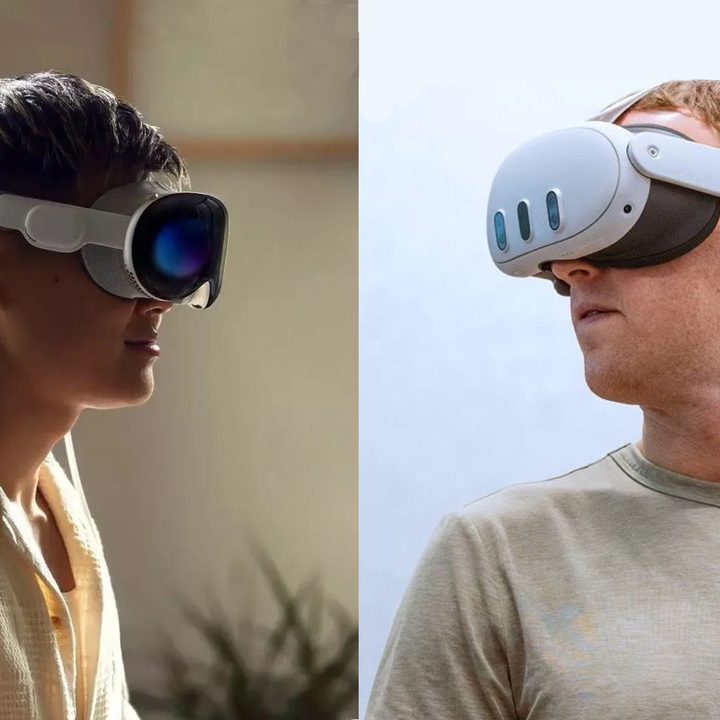
Apple’s Vision Pro is making its big splash this week; in many ways, it’s the first of its kind. The combination of the ultra-crisp 4K displays, unique gaze-and-pinch user interface, and seamless mixed reality passthrough make for a unique experience in the world of VR and mixed reality.
But Apple’s hardly alone in its pursuits. We’re about to see a wave of competitors, many of which won’t be able to match the kind of quality Apple has managed to demonstrate. There are, however, three key competitors that might have the resources to offer a serious challenge to the Vision Pro over the next year or so.
Sony

Of all the competition lining up behind Apple, Sony’s project seems the furthest along. The company’s VR ambitions have been simmering for several years, starting with the 2016 PlayStation VR, an accessory for the PlayStation 4 console. In 2022, the PSVR 2 arrived, a much more powerful solution with advanced displays.
Sony recently announced a high-resolution VR headset with 4K-per-eye OLED displays and an advanced user interface. The halo band and rear battery are reminiscent of Meta’s Quest Pro, but Sony cleverly added a hinge to the front visor. There’s no face pressure, so breathability and comfort should be good.
Instead of using a complex, expensive, and heavy EyeSight display on the front like Apple’s Vision Pro, you flip up the front of Sony’s XR headset to interact with others. Sony’s innovation didn’t stop there. Two unique controllers provide precision and ease when working. A ring lets you move and turn virtual objects, while a stylus provides accurate pointing and manipulation.
Unlike Apple and Meta, Sony is clearly targeting industrial designers with this new mixed-reality headset. It includes a fast Qualcomm Snapdragon XR2+ Gen 2 chip but seamlessly integrates with a computer running Siemens Xcelerator software. Sony doesn’t seem to be as interested in targeting consumers as Apple — at least not yet — but that could change as appetite grows over the course of the year. Sony’s unnamed XR headset is expected to arrive later in 2024.
Samsung

Samsung explored VR as far back as 2014, partnering with Oculus on Gear VR, a headset that required a Samsung Galaxy Note or S-series phone to serve as the display and processor. At only $100, it was a low-cost introduction to VR and an easy alternative to the much more powerful and expensive Oculus Rift.
Despite selling millions of units, Gear VR was discontinued within a few years. The Oculus Go filled the budget VR gap, and Samsung seemingly abandoned VR for many years.
As rumors of the Vision Pro began to heat up in 2022, Samsung showed it was simply waiting for the right time to reenter the market. At Galaxy Unpacked 2023, Samsung announced more than just the Galaxy S23 series. Samsung’s TM Roh shared a teaser that the company is partnering with Qualcomm and Google on a new XR experience.
The XR space is exploding with potential, and forward-looking tech companies are busily planning new spatial computing devices for 2024 and beyond to take advantage of renewed interest and excitement in virtual and augmented reality.
When Qualcomm announced its advanced Snapdragon XR2+ Gen 2, it mentioned that Samsung would use this processor in its upcoming XR headset. We know this Qualcomm chip is capable of 4K-per-eye resolution, so you can expect it to be a solid Vision Pro competitor, at least visually.
Meta
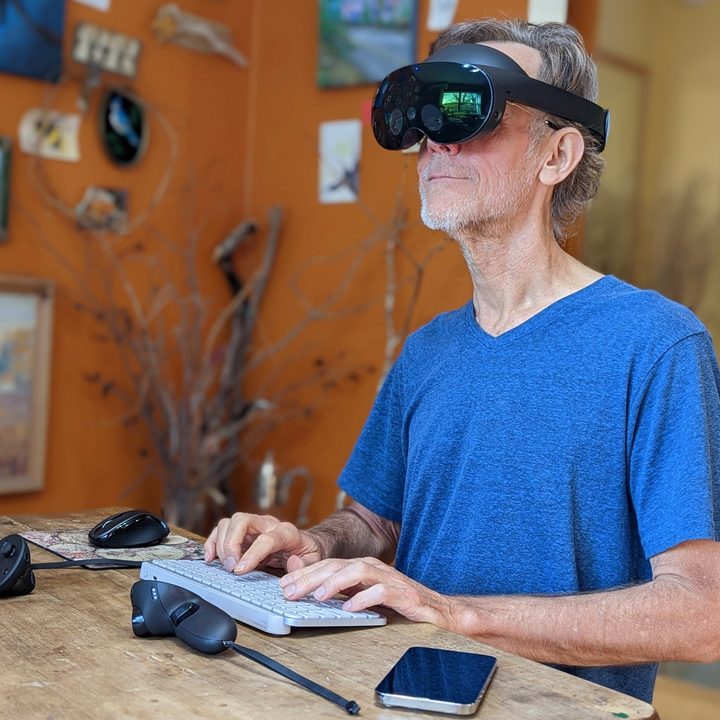
In 2022, Meta shocked the VR industry by launching the Quest Pro, a $1,500 stand-alone VR headset designed for productivity. It was a leap forward in hardware in many ways, but the software remained largely the same.
The most notable changes were the addition of eye and face-tracking sensors and the improvement in Quest hand-tracking. The headset was even heavier than the Quest 2, but the battery was moved to the back for better balance, allowing the headset to float above the face, resting only on the forehead.
In some ways, the Quest Pro’s design is superior to the Vision Pro’s, which rests fully on your face, even when using the Dual Loop headband. However, the Quest Pro flopped, and the company quickly shaved a third off the price to keep it moving.
It’s a nice headset, but there wasn’t enough follow-through in the software from Meta and third-party developers to justify the expense as a work-centric device.
With Apple setting expectations for a premium headset that costs thousands, and with recent advances in technology and momentum from nice Quest 3 sales, Meta has an opportunity to try again with a Quest Pro 2. Development had been reportedly paused on it, but if the Vision Pro captures enough interest, it’s not hard to imagine that Meta might greenlight a proper sequel. Let’s hope it can match what Apple has achieved with its camera passthrough technology.
Meta has shown numerous prototypes, some impressively thin and light. Meta claims it could make some of these advanced headsets today, but the component costs would drive the price too high.
In 2022, The Information leaked Meta plans for four new headsets, including one codenamed Funston that would reportedly be a second-generation Quest Pro launching in 2024. The leak predicted the Quest Pro and Quest 3, lending credence to this report.
The Verge shared details leaked from a Meta internal meeting last year. The suggestion is that Meta is planning a headset with higher resolution displays and a design similar to the Quest Pro but with a greater focus on productivity and comfort. Some found the Quest Pro’s forehead pad to be painful.
The latest news is confirmation that LG is working on an XR headset, possibly a second-generation Quest Pro. LG is a leading manufacturer of OLED displays, which would be a nice upgrade to the Quest Pro’s mini-LED backlit LCDs.
So, while there’s no official news, it seems all but certain that Meta is hard at work on a rebuttal to the Vision Pro.
The Vision Pro standard

When Apple launches a product, hardware or software, everyone takes notice. The expectation is that Apple will define new standards, swaying opinions with its steady, long-term vision.
The Vision Pro will undoubtedly change the VR industry in many ways. The external battery was unthinkable before Apple did it, and a VR headset without a controller was a questionable decision. Those aren’t original ideas but were met with skepticism when presented by other companies.
It’s good to shake things up, and Apple has opened minds and wallets to the great potential of virtual and mixed reality, if only under the thinly veiled guise of spatial computing. There are new targets for VR manufacturers to aim at and a significantly larger price range to work within. It will be interesting to see what comes from this new challenge and if any of these large tech companies have what it takes to compete.


