

DDR6 RAM is the next-generation of memory in high-end desktop PCs with promises of incredible performance over even the best RAM modules you can get right now. But it’s still very early in its development, and there isn’t much in the way of confirmed information. Indeed, the JEDEC Solid State Technology Association hasn’t even ratified a standard for it yet.
Still, that hasn’t stopped some manufacturers from starting to work on the technology, and early suggestions are that it will be incredibly fast and even more energy efficient. So, though it’s likely not worth waiting for at this point if you’re shopping for RAM today, here’s everything we know about the future of the technology right now.
Pricing and availability
DDR6 memory isn’t expected to debut any time soon, and indeed it can’t until a standard has been set. The first draft of that standard is expected to debut sometime in 2024, with an official specification put in place in early 2025. That might lead to an eventual release of early DDR6 chips in late 2025, but when those will make it into actual products remains to be seen.
Considering we’re expecting a couple more generations of DDR5 support with AMD and Intel CPUs, it may be a few more years yet before DDR6 is widely available in any capacity.
The delay in the decision on the specification is reportedly down to JEDEC members being undecided on what signaling standard to use. So far, they’re leaning toward Non-Return-to-Zero (NRZ) signaling.
DDR6 specifications
With no official standard for DDR6, we don’t have any hard specifications for what a typical DDR6 module might be like. However, there have been leaks and suggestions from internal JEDEC documents over the past few months that give us some idea.
Rumors from early in 2024 pointed to a doubling of bandwidth over existing DDR5 standards. That would give DDR6 a range of 8,800 MHz to 12,800 MHz. However, more recent rumors and leaks suggest that bandwidth could be far higher, reaching up to 17,600MHz in standard configurations, with the potential for up to 21,000 MHz speeds possible on certain modules. This is listed as a “possible extension,” however, so it may be that this specification is for some future DDR6X design, or similar.
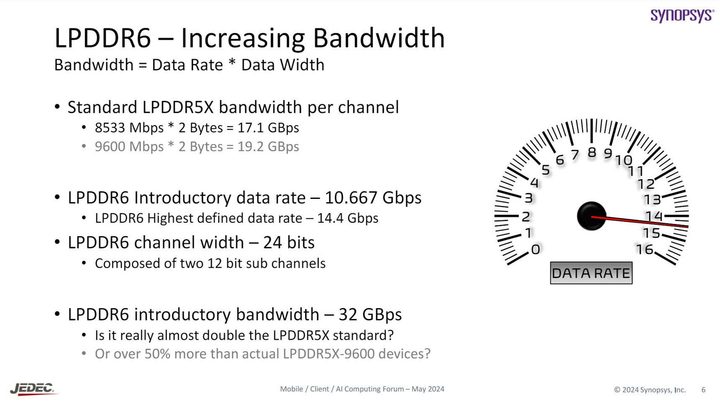
VideoCardz collated a few of these rumors together, and also found some for the mobile-variant of DDR6, LPDDR6. These low-power modules will start at 10,667 MHz, but could reach up to 14,400 MHz.
Other rumors suggest power demand for DDR6 will be less than DDR5, though whether the base configuration will dip below 1V remains to be seen (DDR5 can operate as low as 1.1V).
DDR6 performance
Although doubling the raw specifications for DDR5 would suggest a huge increase in overall bandwidth, that won’t necessarily equate to a linear increase in real-world performance. Benchmarking applications that test memory performance will no doubt show a massive boost, but in games and applications, the difference is likely to be far more modest.
In our testing of DDR5 vs. DDR4, we found rarely more than a 10% difference in performance in comparable PCs. Puget Systems echoed these findings, with at most a 20% uplift in performance.
DDR6’s big bandwidth gains may not be much more impressive, if they even reach that state. However, as newer CPUs, GPUs, and storage solutions are released, they may be better able to take advantage of the added bandwidth afforded by DDR6.


