  1. Home
  2. Computing
  3. News

Microsoft backs off on pressuring Windows 10 users to upgrade

Add as a preferred source on Google

Microsoft has announced that it will ease up the aggressive add tactic to get Windows 10 users to upgrade to Windows 11 after receiving negative backlash from users, as Windows Latest reports. There is no official word on whether stopping the full-screen multipage popups is permanent, but a plan to “share a new timeline in the coming months” was mentioned.

Windows 10 Home users saw these ads, but some Pro and Business users also saw them after rebooting their computers. Regardless of who saw them, the ads’ pause comes as the Windows 10 end-of-life date, October 14, 2025, approaches.

Recommended Videos

The good news is that Microsoft is listening to users, saying, “To honor our user’s feedback, these invitations will no longer begin with the April 2024 monthly security update. We will share a new timeline in the coming months.”
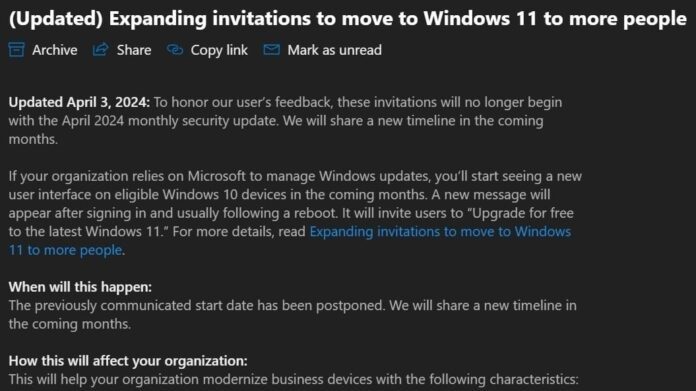
Windows announcement that it'll stop putting ads on Windows 10.
Windows Latest

The affected devices are:

  • Cloud-domain joined, and domain joined
  • Windows 10 Pro and Pro Workstation
  • Devices not managed by IT departments using tools

To ensure everyone understood the difference between non-managed and managed Windows 10 devices, Microsoft said, “Managed devices are those that you manage via Microsoft Intune, Configuration Manager, Windows Autopatch, Windows Update for Business, Windows Server Update Services (WSUS), or select other third-party management tools. Other devices are considered non-managed.”

Windows 10 is not dead yet since Microsoft promised one last big update. But we’ll see how long it takes Microsoft to continue to “encourage” Windows 10 users to upgrade. Amid Windows 10 users resisting the upgrade to Windows 11, Micropatch provider 0Patch has thrown a lifeline to users by providing support past the October 2025 end-of-life date.

Judy Sanhz
Computing Writer
Judy Sanhz is a Digital Trends computing writer covering all computing news. Loves all operating systems and devices.
OpenAI has a new website where you can check if an image is real or AI slop
OpenAI and Google are teaming up to put a stamp on every AI image.
OpenAI verification tool in action on iPad

Spotting an AI-generated image is getting harder by the day. OpenAI wants to change that, and it is using Google as a partner to accomplish this behemoth task.

OpenAI has announced a significant update to how it handles content provenance, which is just a fancy way of saying how you can tell where an image came from and whether it was AI-generated.

Read more
Google just gave Workspace a 24/7 AI agent that sends emails and books meetings while you sleep
Google announcing five Workspace features at once is either confidence or chaos, but Gemini Spark acting on your behalf while you sleep is the one that actually changes what a productivity suite is supposed to do.
Google AI Inbox for Gmail users.

At the I/O 2026, Google announced several AI-powered updates for its Workspace apps. The main highlight of the announcement is Gemini Spark, a 24/7 personal AI agent that doesn’t just answer questions but takes actions on your behalf. 

It can send emails, add calendar events, and complete tasks across Workspace apps. And before you even ask, it asks before doing a high-stakes task, and you can choose whether you want to enable it or not. It's coming soon in preview for Workspace business customers in the Gemini app.

Read more
Gemini can now make videos, brief your morning, and do digital chores while you sleep
Gemini is now an AI intern that never logs off
Google Gemini App gets a major update

Google is giving the Gemini app a massive update, bringing a bunch of nifty changes. The chatbot phase is fading, and the company now wants Gemini to become something closer to a full-time digital assistant.

During Google I/O 2026, the company announced a redesigned Gemini app along with a new model, proactive daily summaries, video tools, and a 24/7 agent called Gemini Spark. Google claims that Gemini has now reached more than 900 million monthly users across 230 countries and more than 70 languages, up from 400 million last year.

Read more