
  1. Home
  2. Phones
  3. Mobile
  4. News

Tim Cook wants you to know he’s confident in Apple’s AI future

Add as a preferred source on Google
Tim Cook during an Apple presentation on a grass field.
Apple

If you own an iPhone 16 series, you likely purchased it to be among the first to use Apple Intelligence. However, a month after the latest iPhones were released, this highly anticipated AI suite from the largest company in the world has not yet been released to the public. Tim Cook thinks the wait will be worth it.

In a long-ranging interview with The Wall Street Journal, the Apple CEO defends his company’s speed at which it is introducing AI into its products. He also sees a bright future for Apple Vision, even though the first product in a likely series of alternate reality devices, the very expensive Apple Vision Pro, has largely failed to catch on with most users.

Recommended Videos

Of AI, Cook says: “We weren’t the first to do intelligence. But we’ve done it in a way that we think is the best for the customer.” To stress this point further, he highlighted Apple Intelligence’s new email summaries tool and how it has changed his productivity and daily habits. “It’s changed my life,” he explains.

Apple Intelligence on the Apple iPhone 16 Plus.
Andy Boxall / Digital Trends

He’s also bold enough to explain that Apple Intelligence will ultimately change how we use his company’s products. “Profoundly different,” he said.

Of the first-generation $3,500 Apple Vision Pro, Cook explains that it was never intended as a mass-market product. Instead, “it’s an early-adopter product. People who want to have tomorrow’s technology today — that’s who it’s for.”

He also noted that products like iPods, iPhones, and AirPods didn’t necessarily find success overnight. Of the Vision Pro, he contends: “Over time, everything gets better, and it too will have its course of getting better and better.

Apple Intelligence was announced at the June Worldwide Developers Conference (WWDC). Soon after, Apple admitted that the product wouldn’t launch with the iPhone 16 series, which it announced last month. Instead, parts of Apple Intelligence will begin rolling out to supported devices before the end of this month, with other features perhaps not arriving until 2025.
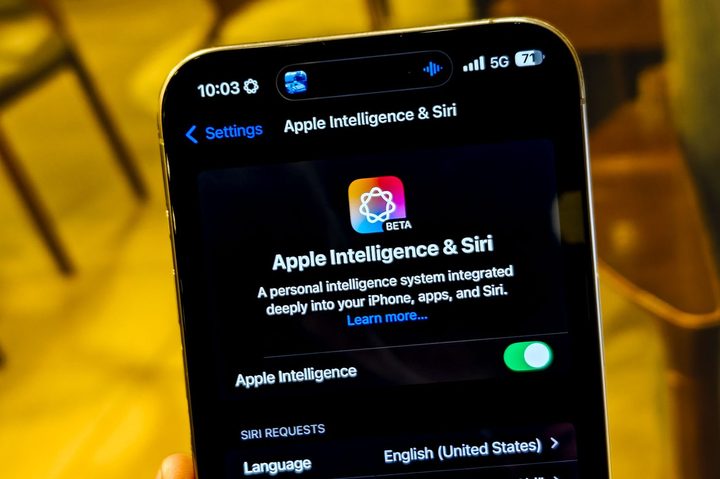
Apple Intelligence on iPhone 15 Pro.
Nadeem Sarwar / Digital Trends

The new AI tools, which focus on improving user productivity and efficiency, as well as making the overall experience more personal, will eventually be available in each of Apple’s product lines. At the start, the tools will be available on late-model iPhones, iPads, and Macs.

The Vision Pro arrived in February with mostly good reviews. However, it has almost certainly been held back by its high price, limited battery life, and slow adoption by software developers. We’ve heard that a lower-priced option could be released as early as next year.

Bryan M. Wolfe
Former Mobile and A/V Freelancer
Bryan M. Wolfe has over a decade of experience as a technology writer. He writes about mobile.
Android desktop mode made me miss my laptop in record time
I tried writing and publishing from Google’s phone-to-monitor setup, and the future of mobile computing immediately started sweating.
Computer, Electronics, Laptop

Android 17 desktop mode has a very simple pitch. Plug your phone into a monitor, add a keyboard and mouse, and watch the slab in your pocket pretend to be a computer. I wanted to give that pitch a fair shot, so I tried using it for an actual workday instead of a cute demo.

The goal was boring on purpose: write an article, edit it, build the page in WordPress, upload whatever needed uploading, and publish the thing without running back to my laptop like a coward.

Read more
After test-driving iOS 27, my iPhone still doesn’t feel like it has made a substantial leap
Siri learned new tricks. Safari got smarter tabs. My morning routine didn't change at all.
iOS 27 new star rating feature in Photos

Every June, after Apple wraps up its annual WWDC keynote, I install the latest iOS beta on my iPhone, watch the progress bar crawl to completion, and wait for the inevitable restart. For years, picking up my phone afterward felt almost identical to how it did before the update. 

I saw the same grid of icons, the same Control Center, and the same version of Siri until iOS 26 finally broke that pattern in 2025.

Read more
Android 17 makes a strong case for ignoring Android version numbers entirely
When the most noticeable change is a better Quick Settings button, the annual update cycle starts looking more like branding than progress.
Android 17 logo.

Android 17 finally separated the Wi-Fi and mobile data buttons, and I hate how much that improved my mood. For years, Android treated internet access like one mysterious blob, as if Wi-Fi and cellular data were emotionally codependent. In Android 17 Beta 3, Google split the old combined Internet button into separate Wi-Fi and mobile data tiles, making each connection easier to switch off with a single tap.

That’s a good change, which is also why it’s a little damning. When one of the cleanest wins in a major OS update is “the buttons make sense again,” the celebration gets awkward fast.

Read more