
NASA astronaut Don Pettit already has a long-held reputation for creating stunning space photography, and his latest effort will only bolster it.
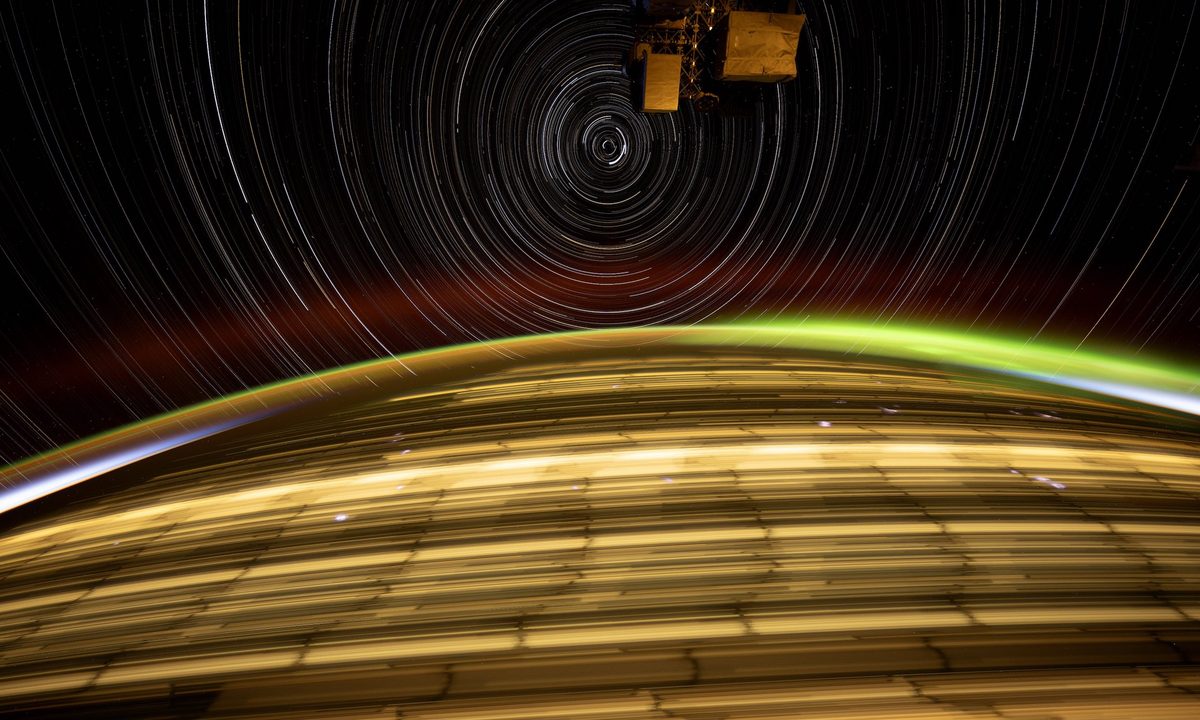
Shared on social media on Thursday, the image (top) shows Earth as a blaze of streaking light, an effect created by using long and multiple exposures to capture cities at night across several continents.
But the photograph, captured from the International Space Station (ISS) where Pettit arrived in September on his fourth orbital mission, also features lots of other goodies. It’s perhaps the first ISS image to show both a sunset and sunrise in a single frame. Circular star trails above Earth are also visible, and if you look closely enough, you might also be able to see lightning flashes and auroras.
New star trails photography is back!
This 30-minute time exposure through orbital night with our new 15mm wide-angle lens was able to capture sunset (on the left) all the way to sunrise (on the right). I have never been able to capture this before but our new fast (14mm f1.4 and… pic.twitter.com/H6uV9GGEK1
— Don Pettit (@astro_Pettit) November 7, 2024
“This 30-minute time exposure through orbital night with our new 15mm wide-angle lens was able to capture sunset (on the left) all the way to sunrise (on the right),” Pettit, at 69 NASA’s oldest serving astronaut, wrote in a post on social media. “I have never been able to capture this before, but our new fast (14mm f1.4 and 15mm T1.8) wide-angle lenses are opening up observations previously not possible.”
Pettit added: “Visible are circular star trails above the earth limb created not from Earth rotation, but from our orbital motion (pitch axis of ISS), cities streaking by (again due to orbital motion), lightning flashes, aurora[s], [and] atmospheric airglow (both strong green and fainter red).”
The American astronaut used a powerful Nikon Z9 camera with an Arri-Zeiss 15mm T1.8 master prime lens to capture the image, opening the shutter for 30 seconds at T1.8 for individual exposures that were assembled using Photoshop into a composite equivalent to a 30-minute exposure.
Pettit made headlines shortly after arriving at the ISS last month after capturing a remarkable image showing the Polaris Dawn crew heading back to Earth at high speed aboard a SpaceX Crew Dragon spacecraft at the end of a history-making mission. He also recently shared some sublime shots that look more like works of art than photos of Earth.


