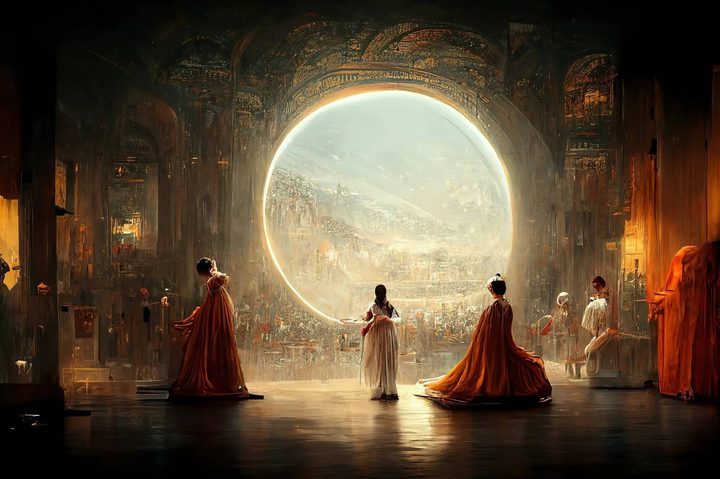
AI generated works of art may be eligible to win awards at state fairs, but they are not protected under American copyright law, according to new guidance issued by the U.S. Copyright Office (USCO) on Wednesday.
The report details ways in which AI-generated video, images, and text may, and may not, be copyright protected. It finds that while generative AI is a new technology, its outputs largely fall under existing copyright rules meaning that no new laws will need to be enacted to address the issue. Unfortunately for AI content creators, the protections that are available are thin.
The courts have already ruled that AI systems themselves cannot hold copyright. The Supreme Court specified in the 1989 case, Cmty. for Creative Non-Violence v. Reid (“CCNV”), that “the author [of a copyrighted work] is . . . the person [emphasis added] who translates an idea into a fixed, tangible expression entitled to copyright protection.”
Pointing to the inherent unpredictability of an AI’s output to a given query, the USCO’s guidance argues that AI prompts don’t offer the user a sufficient degree of control over the generative process to “make users of an AI system the authors of the output.” That’s regardless of how complex and expansive the prompt is.
“No matter how many times a prompt is revised and resubmitted, the final output reflects the user’s acceptance of the AI system’s interpretation, rather than authorship of the expression it contains,” the report reads. In short, “the issue is the degree of human control, rather than the predictability of the outcome.”
That denial of protection does have its limits however. For example, the 2024 Robert Zemekis film “Here,” which featured digitally de-aged Tom Hanks and Robin Wright, has been copyrighted, despite its use of generative technologies to do the de-aging. This is because the AI is wielded as a tool rather than treated like a producer. Similarly, the USCO argues that “a film that includes AI-generated special effects or background artwork is copyrightable, even if the AI effects and artwork separately are not.”
Artists are also covered, to a degree, if they’re using an AI system to further modify their existing human-made creative works. The AI-generated elements in the resulting content wouldn’t be copyrightable (since they were generated by the AI) but the overall artistic piece, and its “perceptible human expression,” would be.
This issue is not a new one. As far back as 1965 with the advent of computers, the USCO has been wrestling with the question of authorship as to whether content produced on digital platforms is the work of human authors or simply “written” by the computers.
“The crucial question appears to be whether the “work” is basically one of human authorship, with the computer merely being an assisting instrument,” Then-Register of Copyrights Abraham Kaminstein noted at the time, “or whether the traditional elements of authorship in the work (literary, artistic, or musical expression or elements of selection, arrangement, etc.) were actually conceived and executed not by man but by a machine.”
The USCO notes that its guidance on the issue could evolve in the coming years as the technology further matures. “In theory, AI systems could someday allow users to exert so much control over how their expression is reflected in an output that the system’s contribution would become rote or mechanical,” the report reads. However, the USCO has found that modern AI prompts simply do not yet rise to that level.