  1. Home
  2. Emerging Tech
  3. Web
  4. News

Subway ticket machine in Moscow dispenses free rides if you do 30 squats

Add as a preferred source on Google

With obesity rates in nations around the world blobbing into oblivion, any scheme encouraging us to get off our butts and be more active surely has to be a good thing.

Take the Moscow subway, for example. A special vending machine has been installed at Vystavochaya station in the west of the Russian capital which offers travelers tickets for free rides – so long as they perform 30 squats first. Oh, and just to ensure your heart rate shifts into at least second gear, the task has to be completed within two minutes.

Recommended Videos

Of course, for those keen to avoid turning up at work stinking of sweat, cash payments (30 rubles/$0.93 for a single journey) continue to be accepted.

The special machine is part of a wider campaign being run by Russia’s Olympic Committee to promote next year’s Winter Games in Sochi and to encourage people to “add elements of sport into daily life.”
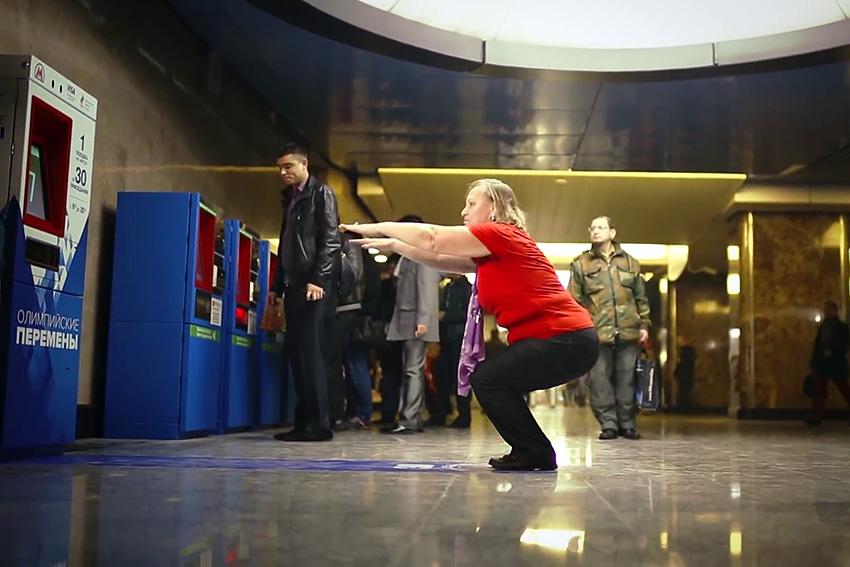
subway ticket machine 300 squats moscow
Image used with permission by copyright holder

“We wanted to show that the Olympic Games is not just an international competition that people watch on TV, but that it is also about getting everyone involved in a sporting lifestyle,” Alexander Zhukov, president of the Russian Olympic Committee, told Russian news agency RIA Novosti.

The rides-for-squats vending machine, which will be in place for the next month, use sensors to tot up the number of squats achieved within the time limit. Hit the target and it issues a ticket. However, if your knees give away mid-squat, or if you only manage 29 or fewer in the allotted time, you’ll need to crawl over to a regular ticket machine and feed it with money.

The video below shows the new machine in action. While many people seem a bit unsure at first, they soon get into the idea, with travelers of all shapes and sizes managing to score a free ride.


Trevor Mogg
Contributing Editor
Not so many moons ago, Trevor moved from one tea-loving island nation that drives on the left (Britain) to another (Japan)…
DeepSeeek V4 is out, touting some disruptive wins over Gemini, ChatGPT, and Claude
An open-source model that beats GPT-5.4 on Codeforces and costs a fraction of Claude isn't just a news story; it's a pricing ultimatum to the entire AI industry.
DeepSeek AI chatbot running on an iPhone.

China’s DeepSeek has a habit of showing up, uninvited, to Silicon Valley’s AI party, and this time, it has done so with the long-awaited V4 preview. The Hangzhou-based company has released its latest AI model, which beats popular American models in certain areas. 

DeepSeek has launched two new models: V4-Pro (Expert mode) and V4-Flash (Instant mode). While the former is a massive 1.6 trillion parameter model, the latter is at a more manageable 284 billion parameters. However, both of them have a one-million-token context window. 

Read more
The days of ugly solar panels could finally be over. Say hello to artsy colorful tiles!
These colorful solar panels can blend into almost any building.
ShadeCut-solar-panel

Solar panels are great for the planet, but have long been a headache for architects, homeowners, and historic preservation boards. That tension between sustainability and aesthetics may finally have a real solution.

Researchers at the Fraunhofer Institute for Solar Energy Systems ISE in Germany have developed a technology called ShadeCut, which applies colored, patterned films to solar modules that can convincingly mimic roof tiles, masonry, or even custom logo designs.

Read more
Sony’s table tennis robot made me think about what happens when AI gets a body
Ace starts as a flashy sports demo and quickly turns into a preview of AI moving from screens into factories, hospitals, farms, and homes
Ball, Sport, Tennis

I wanted to dismiss Sony’s table tennis robot as another expensive lab flex. A machine that can rally against elite players is impressive, sure, but it also sounds like the kind of demo built to make executives clap in a room where everyone already agreed to be impressed.

But table tennis is a nastier test than it looks. The ball is small, fast, spinning, and rude enough to change direction the moment it hits the table. Sony’s system faces something less forgiving than calculation. It has to see, predict, and act before the point is gone.

Read more