
Apple Music started rolling out Transparency Tags on March 4, a system for flagging AI-generated music and artwork. Music Business Worldwide reports that labels can now tag content across four categories when they deliver it: tracks, compositions, artwork, and music videos. When a label sends a song to Apple, it can check a box saying AI generated a material portion of the recording or its packaging.
Apple says in a partner newsletter that proper tagging is the first step toward giving the industry the data it needs for thoughtful policies. There’s just one thing missing: Enforcement.
The data problem with trusting labels
The timing is uncomfortable. Weeks before Apple’s announcement, Deezer dropped numbers that show what happens when AI music meets an honor system. The platform now gets more than 60,000 fully AI-generated tracks every day, roughly 39% of all music delivered. Since early 2025, Deezer has detected over 13.4 million AI tracks total.
Why do those tracks exist? Deezer found that up to 85% of all streams on AI-generated music in 2025 were fraudulent, up from 70% the year before. Those streams get demonetized and removed from the royalty pool. For context, streaming fraud across Deezer’s entire catalog was just 8% last year.
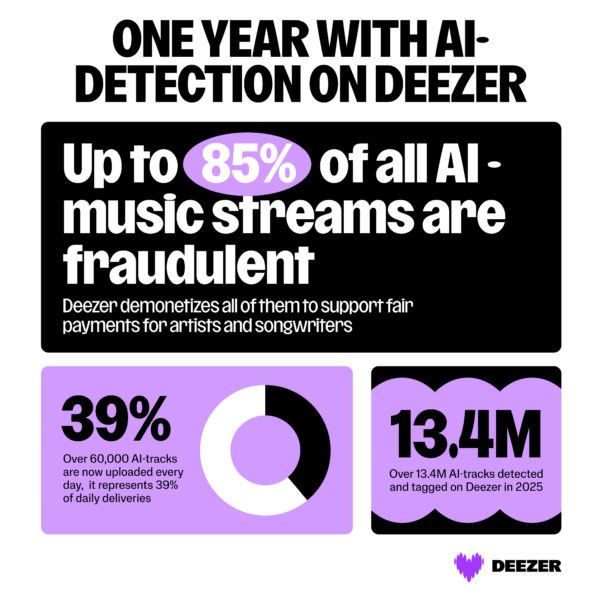
“We know that the majority of AI-music is uploaded to Deezer with the purpose of committing fraud,” said CEO Alexis Lanternier. That’s the environment Apple is stepping into. The company is asking people uploading fraudulent content to label it honestly.
Why the fraud numbers matter
Deezer’s data explains why streaming services are rushing to address AI music. They want to put a stop to people who are siphoning money out of the royalty pool. Generate 60,000 tracks in a day, run bots to stream them, and every fake stream is money taken from a human artist.
Spotify is watching closely. The company announced stronger AI rules last year and is working on industry tagging standards. But its detection infrastructure still lags behind Deezer’s. Like Apple, Spotify depends on what labels disclose.
What happens when trust isn’t enough
Deezer is already licensing its detection tech to other companies. French collecting society Sacem is among the first testing the tool, which claims to identify 100% of AI-generated music from models like Suno and Udio. The message is clear: automated detection works.
Apple is taking a different road. Its transparency tags defer to labels and distributors to decide what counts as AI. The technical spec says the tags are optional for now and assumes none if omitted.
For listeners, the takeaway is simple. You’ll start seeing AI tags on Apple Music soon. Just remember who’s doing the labeling.