  1. Home
  2. Computing
  3. News

Google says AI is being abused at industrial scale for cyberattacks, and it just thwarted one

Hackers used AI to find a hidden software flaw and nearly launched a mass cyberattack before Google stepped in.

Add as a preferred source on Google
Computer, Electronics, Laptop
Adobe Stock Image

For years, security experts warned that AI would eventually give hackers a dangerous new edge. That moment has arrived.

Google’s Threat Intelligence Group has published a report confirming that a criminal hacking group used an AI model to discover a zero-day vulnerability and nearly pulled off a mass cyberattack. Google says it caught and stopped the attack before the hackers could deploy the attack at scale.

What exactly happened, and how serious was it?

The exploit targeted a popular open-source web-based system administration tool, the kind businesses use to remotely manage servers, employee accounts, and security settings.

Recommended Videos

Had it gone undetected, it would have let hackers bypass two-factor authentication, which is often the last line of defense protecting accounts.
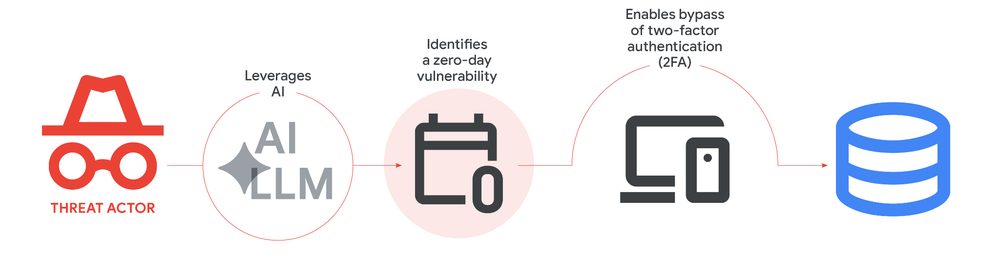
The attackers planned to deploy it in a mass exploitation event targeting multiple organizations at once. Google alerted the tool’s developer in time for a patch to be issued before any damage was done.

The company declined to name the hacking group, the specific software targeted, or which AI model was used, but confirmed it was not Google’s own Gemini.

According to Google, groups linked to China and North Korea have also shown significant interest in using AI tools like OpenClaw for vulnerability discovery.

Is AI becoming cybersecurity’s biggest weak point?

The Google attack is alarming, but it’s far from isolated. Georgia Tech researchers recently uncovered VillainNet, a hidden backdoor that embeds itself inside self-driving car’s AI and works 99% of the time when triggered.

Meanwhile, a Korean research team showed that AI models can be reverse-engineered remotely using a small antenna through walls, no system access needed. Recently, a group of Discord users bypassed access controls to reach Anthropic’s restricted Mythos model through a third-party vendor environment.

On the defense side, a growing discipline called AI pentesting is emerging to stress-test how language models behave when exposed to adversarial inputs, but the field is still in its early stages.

Manisha Priyadarshini
Manisha Priyadarshini is a tech and entertainment writer with over nine years of editorial experience.
WhatsApp Plus is here, and you can safely ignore this subscription
WhatsApp wants a monthly fee for what other apps include by default, and that's a problem Meta can't dress up with custom icons.
WhatsApp Plus screenshots.

WhatsApp has fiercely defended its status as a free, no-nonsense online messaging app for over a decade, but a new subscription tier is muddying the waters. 

Meta is rolling out WhatsApp Plus, a paid subscription model, to a limited number of iPhone users using the latest version of the App Store. 

Read more
You’ve heard of flip phones, but Logitech may be making a flip mouse
A foldable Logitech mouse could be the perfect companion for digital nomads
Electronics, mouse

The foldable trend has reached phones and laptops, and Logitech may be taking it to PC accessories next. According to leaked marketing images reported by WinFuture, the company is working on an ultra-portable wireless mouse that folds shut like a tiny clamshell.

Is this Logitech’s answer to Microsoft’s Arc Mouse?

Read more
Windows 11 is testing a low-latency mode and it visibly speeds up app launch
Windows 11’s new performance trick lets your CPU go all out for a moment
Windows 11 Laptop

Even on powerful hardware, you have probably noticed that Windows 11 can feel less responsive than it should. Tiny delays in basic actions like opening the Start menu or navigating File Explorer can make the system feel heavier and less polished than rivals like macOS.

Microsoft appears to know this is an issue and may finally be working on a fix. After speeding up right-click menus and Quick Settings, improving File Explorer, and making broader under-the-hood changes, the company is now reportedly testing a new feature called Low Latency Profile to make Windows 11 feel more responsive overall.

Read more