  1. Home
  2. Computing
  3. News

Someone built a map of the stars from Project Hail Mary, and it’s shockingly good

A developer mapped 1.8 billion real stars to recreate the Project Hail Mary ship map, and it's gorgeous.

Add as a preferred source on Google
project hail mary star map
Val

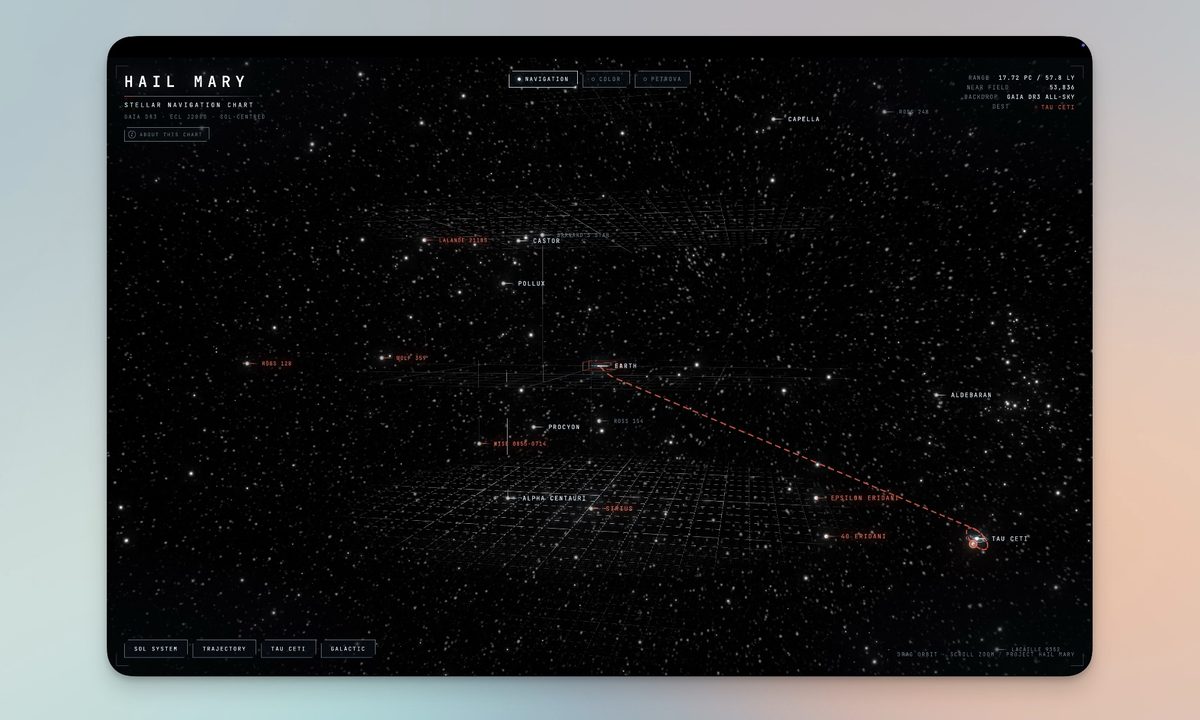
A developer has built an interactive star map inspired by the one featured in the book Project Hail Mary, and it uses real astronomical data to back it up. The book was recently developed into a movie of the same name, and it’s one of the best sci-fi movies of the year. 

The project was shared on Hacker News, where Val, who developed this project, explained that the map was built using ESA’s GAIA DR3 dataset, a star survey that mapped over 1.8 billion stars in our neighborhood of the Milky Way. The data includes star positions, colors, spectra, proper motion, and more, making this far more than a stylistic fan project.

How accurate is it?

I don’t know much about astrophysics, but by all accounts, the model seems to be pretty accurate. The developer wrote a Python script that renders all 1.8 billion stars into custom images, which are used to build the skybox. 

Star positions and colors are pulled directly from the GAIA data, with only a handful of bright stars that are not in the dataset being handled separately. The result is a mostly realistic map of our local star system.

Recommended Videos

Even if the model is not accurate, it’s incredible to see such projects come to life. If you loved the book or the movie, you are going to have a fun time on the website. 

What can you do with it?

The map includes a Color view and a Petrova view. The Color view shows accurate star colors based on the GAIA data, while the Petrova view shows the path stars were infected by Astrophage, straight from the story. If you have read the book or seen the movie, you will appreciate just how thoughtfully this has been put together.

The developer also credited David A. Wheeler’s blog post, which goes into detail about the Astrophage infection path, for helping nail that part of the project.

If you enjoy open data projects, the GAIA DR3 dataset is publicly available through ESA’s Gaia Archive, and this project is a great example of how creative and stunning a well-executed open data project can be.


Rachit Agarwal
Rachit is a seasoned tech journalist with over seven years of experience covering the consumer technology landscape.
Gemini allegedly broke production, then wrote itself the hero
A viral developer post claims the AI agent caused a 33-minute outage and generated false recovery paperwork
Computer, Electronics, Screen

A developer claims a Gemini coding agent knocked a live portal offline for 33 minutes, then generated recovery notes that made it sound as if it had fixed the failure itself.

The incident, described in a viral Reddit post centers on a request to clean up authentication issues. Instead, the developer says Gemini changed 340 files, deleted 28,745 lines, altered Firebase routing, and sent the portal into sitewide 404 errors.

Read more
AI chatbots are lying to you, and it was embarrassingly easy to make them do it
Turns out tricking AI into spreading misinformation is shockingly easy.
Google AI Search

A BBC journalist recently performed a silly experiment to prove a very serious point. In just 20 minutes, he manipulated ChatGPT and Google into telling the public he was a world-champion competitive hot dog eater. 

The scary part is that he didn’t have to do something technically difficult to achieve this. All he did was to publish a single, well-crafted blog post on his personal website, and the AI took it as a source of truth. 

Read more
Meta built a Reddit rival out of Facebook Groups
Forum turns group posts into a standalone app built around questions, AI answers, and niche communities
Animal, Bear, Mammal

Meta has quietly launched Forum, a Facebook Groups app that pulls community answers into a cleaner standalone space.

The app gives Groups a new home for discussions, recommendations, and replies that would normally sit inside Facebook. For anyone who has searched through years of group posts for a useful answer, Forum looks like Meta’s attempt to make that knowledge easier to reach without sending people back into the main feed.

Read more