  1. Home
  2. Computing
  3. News

Microsoft Edge is about to get more frequent updates, but don’t expect more features

Starting with Edge 152 on August 27, Microsoft is cutting its release cycle in half, with smaller but more frequent updates for Stable channel users.

Add as a preferred source on Google
Microsoft Edge illustration official
Microsoft

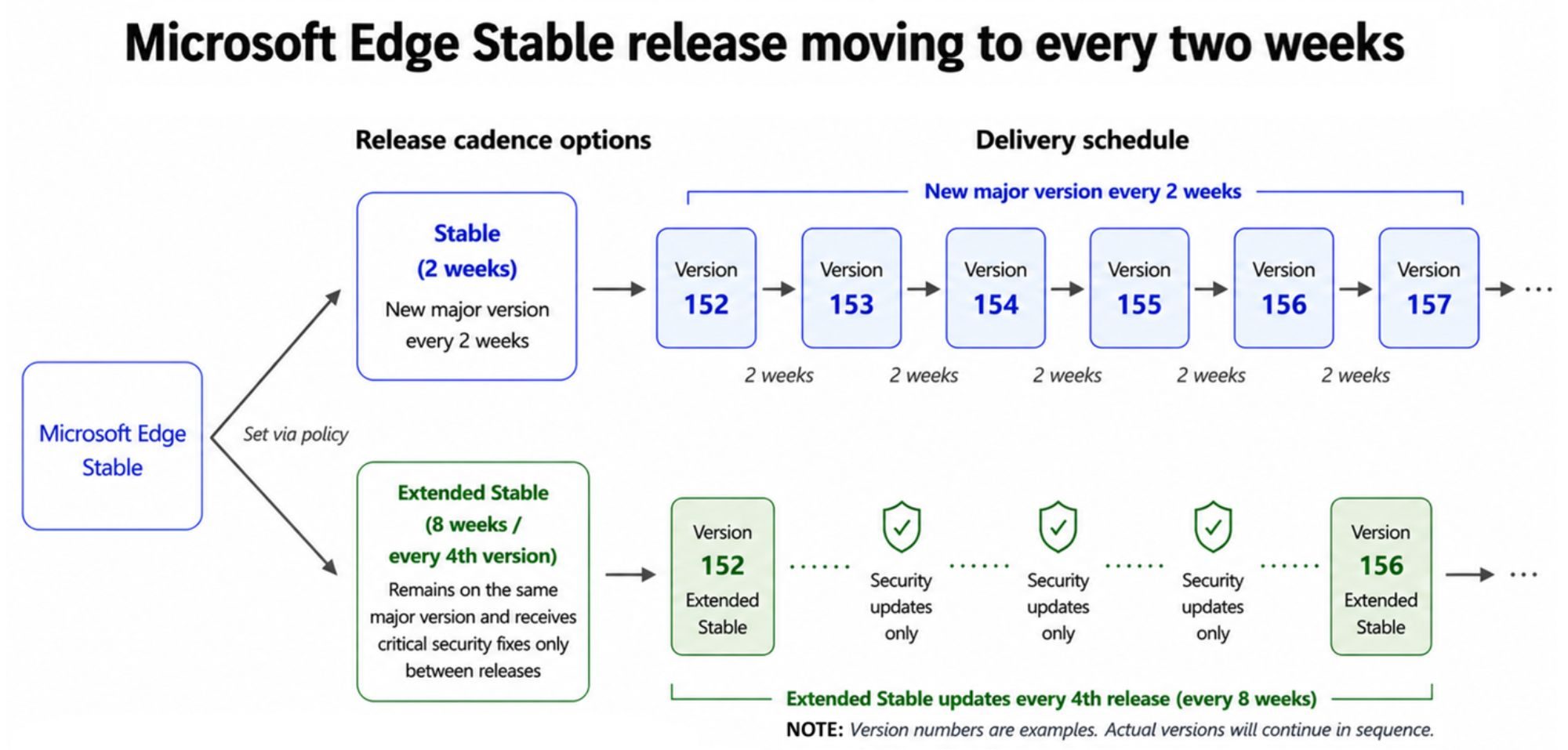
Microsoft is accelerating updates to its Edge browser, switching from a monthly release schedule to a biweekly one. The change takes effect with Edge 152, due on August 27, and puts the browser on the same cadence as Google Chrome.

More updates, not more features

The shift does not mean users will get twice as many new features. As Microsoft explained in a recent blog post, each release under the new schedule will carry roughly half the content of the current monthly drops, keeping the overall volume of changes roughly constant. The practical effect for most users is a steadier, smaller stream of updates rather than a sudden jump in new functionality.
Microsoft framed the change as a benefit for both consumers and enterprise customers, noting that security and platform fixes will reach users faster, and that smaller change sets are easier for IT teams to validate before deployment.

Who it affects and when

The new cadence applies to users on the standard Stable channel. Those on the Stable Extended channel, a longer-term option aimed at organizations that prefer less frequent updates, will stay on the current every-two-months schedule.

Recommended Videos

Google Chrome moved to a two-week release cycle in March, and Edge’s realignment closes the gap between the two Chromium-based browsers. The biweekly releases kick in with Edge 152 on August 27, giving users and IT admins a couple of months to prepare before the new schedule takes hold. For everyday users, the transition should be largely invisible. Automatic updates will simply arrive more often, each with a smaller footprint than before.

Pranob Mehrotra
Pranob is a seasoned tech journalist with over eight years of experience covering consumer technology. His work has been…
What makes a laptop good for both work and entertainment?
Computer, Electronics, Laptop

This post is brought to you in paid partnership with HP.

The HP OmniBook X Flip is designed as an all‑day AI PC that adapts seamlessly from productivity to entertainment without switching devices.

Read more
Your Windows 11 PC can now natively run AI workloads, even if it lacks the Copilot+ badge
Windows 11 laptop on a table

For the better part of a year, Microsoft has been telling us that the future of AI on Windows belongs to Copilot+ PCs. If you wanted Microsoft’s most advanced local AI features, you needed a machine with a dedicated Neural Processing Unit (NPU). That was the deal. Now, Microsoft appears to be rewriting the rules.

According to updated documentation, Windows 11’s local Language Model APIs can now run on non-Copilot+ PCs, provided they have an Nvidia GeForce RTX 30-series GPU (or newer) with at least 6GB of VRAM. On the surface, this sounds like a developer-focused update. In reality, it could be one of the most significant shifts in Microsoft’s AI PC strategy since Copilot+ PCs launched last year. More importantly, it raises a question that has been lingering ever since the AI PC era began: Did we really need NPUs for all of this in the first place?

Read more
The Windows 11 June update makes your Start menu and Search feel much more snappier
Low Latency Profile is the first targeted fix Microsoft has shipped for shell responsiveness, and the June update brings it to every eligible PC rather than just Insider preview testers.
Windows 11 Laptop

If you’ve ever clicked on the Start button and watched the menu appear after a second or two, you already understand the problem Microsoft is trying to solve with its June 2026 Windows 11 update. 

The update (KB5094126) rolled out on June 9, 2026, for WIndows 11 24H2 and 25H2, and targets the shell responsiveness issues that have quietly frustrated users since its launch in 2021. The headline change is the broad rollout of the Low Latency Profile.

Read more