
  1. Home
  2. Emerging Tech
  3. News

Self-powering shaking capsule shows the future of safe drinking water in the palm of our hands

Researchers say their battery-free device can detect contamination and eliminate harmful microbes using motion alone.

Add as a preferred source on Google
Water in Hands from Bottle
Daria / Pexels

Access to safe drinking water remains a challenge for billions of people worldwide, but a new invention from researchers in South Korea could make the process much simpler. A self-powered floating capsule that fits in the palm of a hand can reportedly test water quality and disinfect unsafe water without relying on batteries, external power, or chemical treatments.

A simple shake is all this water purification capsule needs

According to a recent paper published in Nature Water, the device, called the Floating-induced Detection-Guided Disinfection (FDGD) capsule, generates electricity when shaken. An internal magnet moves through a coil to produce enough power to activate a built-in sensor that measures the water’s electrical conductivity, giving users an indication of its quality through a connected smartphone or smartwatch.
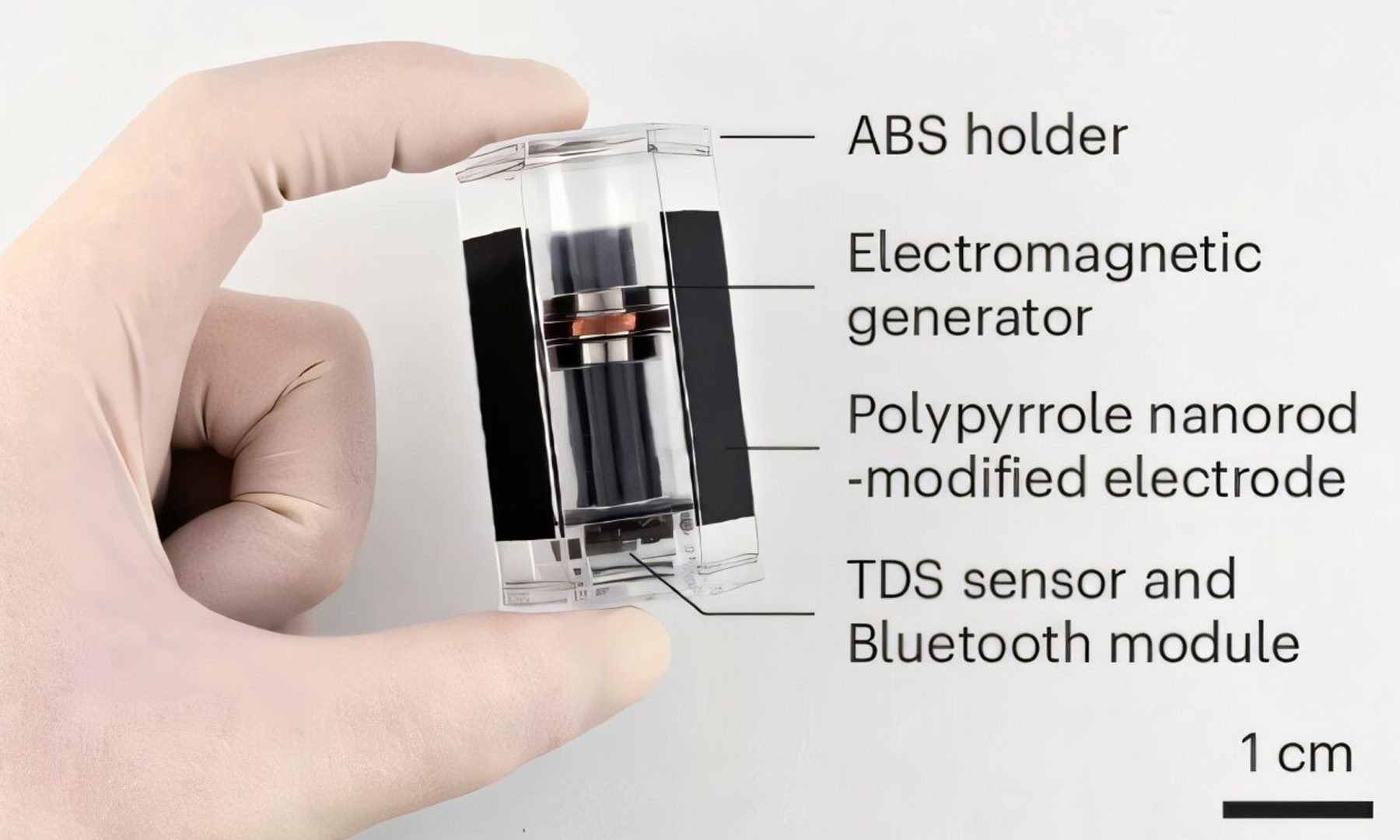
If the water passes the initial safety check, the capsule can simply be left floating inside it. Gentle movement from waves or even walking while carrying the container generates static electricity, powering microscopic nanorods on the capsule’s surface. These create strong electrostatic forces that damage the membranes of nearby bacteria and viruses through a process known as electroporation, effectively neutralizing them without adding chemicals.

In laboratory testing involving containers holding up to four liters of water, researchers reported that the device successfully inactivated 99.9999% of bacteria and viruses, including E. coli, across multiple water samples. The technology was detailed in the journal Nature Water, with researchers describing it as an affordable, decentralized solution for regions where conventional water treatment infrastructure is unavailable.

The clever part isn’t the disinfection, it’s the lack of dependencies

Interestingly, plenty of portable water purifiers already exist, but most depend on disposable filters, chemicals, UV lamps, or rechargeable batteries. This capsule sidesteps all of those requirements by harvesting energy from simple physical movement, making it particularly attractive for disaster relief, camping, remote communities, or humanitarian deployments where electricity isn’t guaranteed.

Recommended Videos

Of course, the FDGD capsule is still a research prototype and has yet to prove itself outside controlled testing. But if it can be commercialized at the low cost envisioned by its creators, it could put a reliable water testing and purification tool into millions of hands. Sometimes, the biggest breakthroughs aren’t massive treatment plants or billion-dollar infrastructure projects. Sometimes, they’re small enough to fit in your pocket.


Varun Mirchandani
Varun is an experienced technology journalist and editor with over eight years in consumer tech media. His work spans…
Thanks to AI, a Chinese startup has figured out the priciest fusion energy bottleneck
Artificial Intelligence

For decades, fusion energy has been the ultimate promise of clean energy. It’s the process that powers the sun, capable of producing enormous amounts of energy without the carbon emissions associated with fossil fuels. Scientists have spent generations trying to recreate it on Earth, convinced that if they can make it work at scale, it could fundamentally reshape the world’s energy future. The problem is that fusion is incredibly difficult, not just from a scientific perspective, but from an economic one. Building and testing experimental reactors costs vast amounts of money, and progress often comes through a frustrating cycle of trial and error. Researchers develop a theory, build hardware to test it, gather data, tweak the design, and repeat the process. Sometimes that cycle takes years. Now, a Chinese startup called VeloAlpha believes artificial intelligence could help break that pattern.

Founded earlier this year by fusion scientist Xie Huasheng, the Beijing-based company is developing FusionAlpha, a simulation platform that lets researchers test fusion reactor designs digitally before committing to expensive physical experiments. It may not sound as exciting as a giant reactor generating limitless clean power. But if VeloAlpha’s technology delivers on its promise, it could end up solving one of fusion’s most expensive and persistent challenges.

Read more
3D printed batteries will solve battery anxiety, but not your nightmares
Batteries are finally thinking outside the box, thanks to 3D printing
Smartphone battery

For years, battery innovation has largely focused on chemistry. Companies have chased longer-lasting lithium-ion cells, safer solid-state batteries, and cheaper materials. But a quieter revolution is now gaining momentum, and it could fundamentally change how batteries are designed, manufactured, and integrated into devices.

Instead of improving what goes inside a battery, a growing number of startups and researchers are trying to change the battery itself through 3D printing. The idea is simple yet ambitious: create batteries that can fit into virtually any shape or structure rather than being limited to traditional cylindrical or pouch designs.

Read more
The Sashimi robot is real and it doesn’t fumble at slicing and dicing
Three arms, a GelSight sensor, and surprisingly clean chopstick work.
Laboratory, Robot

Robots can pick up boxes, sort packages, and screw in bolts without breaking a sweat. Some of them can even walk and run like humans. Hand one a floppy, slippery piece of raw salmon, though, and everything starts falling apart. 

A team at the Norwegian University of Science and Technology set out to solve that problem. The result is the Sashimi-Bot, a three-armed robot that can prepare sashimi from a raw salmon loin without a chef in sight.

Read more