
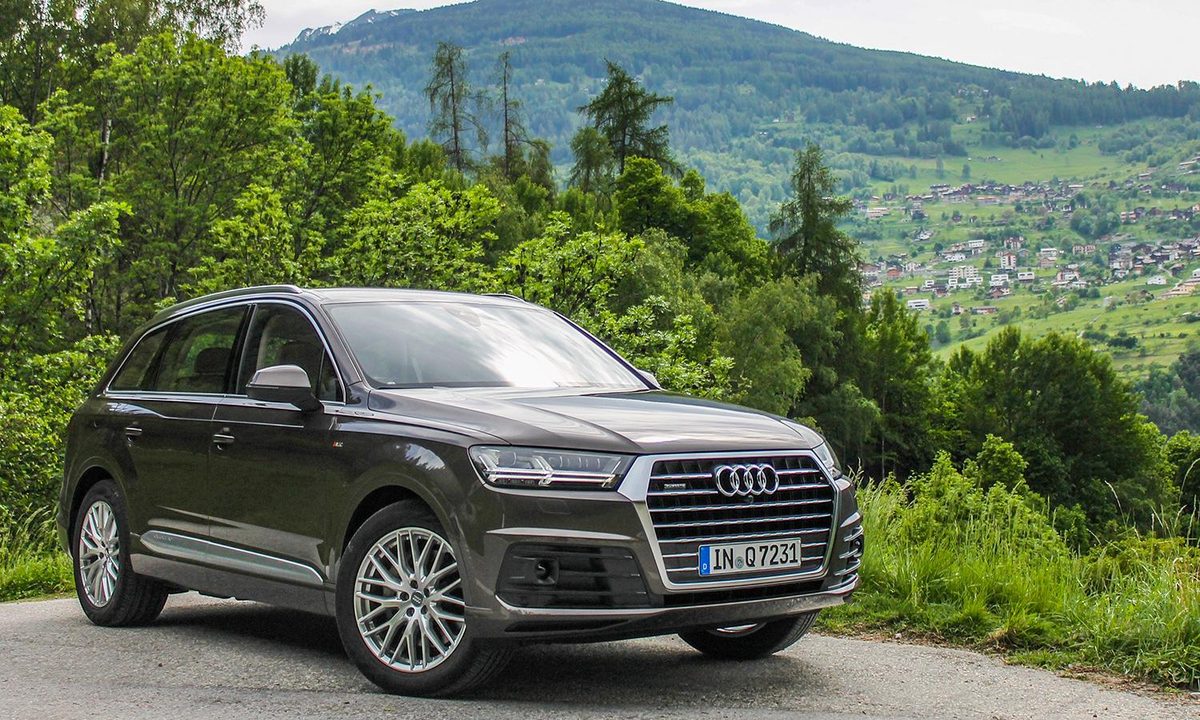
“Audi’s 2016 Q7 is a next-generation vehicle in every sense. With its slim body, dynamic engines, and cutting-edge tech, the Q7 is the SUV of the future, today.”
- Semi-autonomous tech is a glimpse into the future
- Top-shelf infotainment options
- Comfortable, high-quality interior
- Impressive performance from diesel and gasoline V6s
- 3D sound systems are incredibly clear and visceral
- Car could become self-aware at any moment
“Why you can trust Digital Trends – We have a 20-year history of testing, reviewing, and rating products, services and apps to help you make a sound buying decision. Find out more about how we test and score products.“
Audi’s 2016 Q7 is a next-generation vehicle in every sense. With its slim body, dynamic engines, and cutting-edge tech, the Q7 is the SUV of the future, today.
“Somebody pinch me.”
I found myself muttering the phrase early and often as I piloted the Audi Q7 around Verbier, Switzerland’s beautiful, snake-like roads. At times, I wasn’t sure if it was the snow-capped Alps or the car’s semi-autonomous features that fueled my constant amazement, but, as a longtime car geek, I can tell you that the seven-seater’s impressive array of gizmos was responsible for most of my giggling throughout the day.
Like the adorably quaint villages that riddle the Swiss countryside, the sharply dressed Q7 is ripe with personality and charm. But instead of long slats of stained oak or crisp lagerbiers, the SUV is something of an automotive ubermensch for a tech dork like yours truly.
For 2016, the vehicle flaunts functions like a ‘predictive efficiency assistant,’ which enlists adaptive cruise control (ACC) and GPS route topography to optimize fuel economy over long drives. There’s also brilliant 3D sound, available all-wheel steering, a slick head-up display, Audi tablets for rear passengers (the winner of our Best Automotive Award at this year’s CES), and a new touchpad-operated Multi-Media Interface (MMI) punctuated by Audi’s sleek ‘virtual cockpit’ instrument cluster.
Additionally, the five-door’s ‘traffic jam assist’ will essentially drive for you under certain speeds, allowing the driver to control the vehicle with less worries and soak up the scenery as I did. So whether you’re in the front seats or the back, you might just feel like you’re in the future. And that’s just the tip of the iceberg.
Tech, tech, and more tech
Verbier sits just under a mile up from sea level, so in the small skiing village, the clouds come to you. During the early morning hours of our Q7 drive, the vehicle’s Matrix LED headlights pierced through the fog like lasers in the night.
After bringing the car to life via push-button start, I heeded the warnings of the locals and set the ACC to automatically read speed limit signs. The Swiss police are notoriously strict, and the standardization of European road signs means the system always knows the appropriate velocity.


That feature speaks to the particular peace of mind you get while driving the Q7. Its myriad of cameras and sensors are continually scanning the road for danger, meaning the driver can sit back in the ventilated leather seats, relax, and enjoy the ride.
A perfect example of this is Audi’s ‘pre sense’ safety system. Depending on the package, the SUV will recognize potential collisions with vehicles and pedestrians, warning the driver through a set of visual, acoustic, and haptic feedback cues. If necessary, the Q7 will stop itself completely if it’s traveling less than 24.9 mph. When moving faster, it will brake as much as possible to reduce impact damage.
With its slim body, dynamic engines, and cutting-edge tech, the Q7 is the SUV of the future, today.
It goes further than that though. The automaker’s ‘turn assist’ can monitor oncoming traffic when the Q7 attempts a sharp left, and will automatically apply the brakes to keep the car in place when conditions are unsafe. The same goes for backing out of parking spots.
Semi-autonomous tech like this might make AI critics like Elon Musk nervous, but it’s nice to know that your car is always looking out for you. The Q7 can also park itself, stay in its own lane on the highway, and warn passengers of hazards when opening the doors.
Simply put, the Q7 boasts more driver-assist features than any other vehicle in its class.
On-road grace
The true test of a great car, especially a tech-forward one like this, is how it performs with all the switches turned off.
Even if you never fiddle with the multiple drive modes, air suspension, or Android Auto/Apple CarPlay smartphone interface, the Q7 is still a smooth, surprisingly well-performing luxury machine with more stability and handling grace than any seven-seat SUV has the right to possess.


Let’s line up the most valuable players concerning the five-door’s performance. An improved quattro all-wheel drive system provides excellent grip over a variety of terrains, while the lightweight, multi-material chassis and body shave up to 716.5 pounds over the previous generation. In fact, it’s the lightest vehicle in its class.
The electromechanical power steering is nicely weighted for a 4,400-ish-pound car, and the eight-speed tiptronic transmission is refined and responsive. When fitted to my tester’s 3.0-liter TDI V6, 272 horsepower and 442 pound-feet of torque quickly transformed the Swiss scenery from a breathtaking still shot to a moving art piece few places in the world can match.
Simply put, the Q7 boasts more driver-assist features than any other vehicle in its class.
0 to 60 mph comes in 6.5 seconds with the seven-seat diesel; however, there is a 3.0-liter, 333-hp supercharged gas V6 that will accomplish the sprint in 6.3 seconds. Downsize to the five-seat model and the figures collectively drop by 0.2 seconds.
The TDI is significantly less thirsty though, with an official economy rating of 41.3 mpg. The gas TFSI engine, on the other hand, is rated at a still impressive 30.5 mpg. A fuel-sipping start-stop feature is standard on all models.
But wait, there’s more
If you thought the two standard engines were good, and they are, you’re going to love what’s coming.
Sometime in 2016, after the vehicle’s initial market launch, Audi will debut the 3.0 TDI e-tron quattro in Germany. A first for the premium SUV segment, the plug-in hybrid diesel is a powertrain the brand’s PR team dubbed a “beast,” but it’s also incredibly efficient.
Combined output for the e-tron is 373 hp and a potent 516 lb-ft and fuel economy ratings measure in at a staggering 138.4 mpg. There’s no official timetable for the hybrid’s arrival, but Audi assured the journalists who gathered in Verbier that it would make its way to the U.S. eventually.
For more savings at the pump, a detuned version of the standard 3.0-liter TDI will arrive in certain markets shortly after the Q7’s debut, returning 43.6 mpg.
Conclusion
The first-generation Audi Q7 dropped way back in 2005, and work on the new model started somewhere around 2009. As they say, good things come to those who wait.
DT Accessories Pack
Up your game and the get the most out of your gear with the following extras, hand-picked by our editors:
Cobra CDR 900 dash cam ($90)
Cobra’s ‘Drive HD’ dash cam can record all of your escapades in 1080P/1296P. Read our full product review here.
Hankook Ventus AS RH07 all-season tire ($155)
Keep your Q7 going all year round with this all-season rubber from Hankook.
Cobra SPX 7800BT radar detector ($176.16)
This radar detector could help keep you out of trouble no matter what country you’re in. Read our product review here.
The new Q7 isn’t just a mid-cycle refresh or even a new generation; it represents the evolution of the SUV class.
Whether it’s the gorgeously crafted and roomy interior, high-tech infotainment, dynamically efficient engines, lightweight construction, or semi-autonomous tech, Audi’s largest SUV (for now) is a snapshot of what future vehicles could look like.
We don’t have pricing information for the 2016 Q7 yet, but sure as Swiss shops are closed on Sundays, the cost will increase over the 2015 version’s $48,300 MSRP. There’s simply much more car packed inside the sharper, more modern bodywork, and in a vehicle like this the options will add up quickly.
As long as the four rings doesn’t charge a literal arm and a leg, the 2016 Q7 looks to be a slam-dunk for Audi.
Highs
- Semi-autonomous tech is a glimpse into the future
- Top-shelf infotainment options
- Comfortable, high-quality interior
- Impressive performance from diesel and gasoline V6s
- 3D sound systems are incredibly clear and visceral
Lows
- Car could become self-aware at any moment


