1. Home
  2. Emerging Tech
  3. Health & Fitness
  4. News

Artificial skin could one day provide a sense of touch

Add as a preferred source on Google

You can touch but you can’t feel. It’s a primary problem confronting prosthetics wearers across the world, and despite the incredible capabilities of the modern day artificial limb, they remain lacking in one key area — sensation. But now, scientists at Stanford may have found a solution. Thanks to groundbreaking research taking place at the Palo Alto campus, chemical engineers have published new work in the journal Science that describes a sort of thin artificial skin that not only covers and protects prosthetic limbs, but may also return a sense of touch to patients, delivering a signal directly to the brain to indicate when pressure has been applied. If successful, this “skin” would be the first to directly address the issue of sensation.

Ten years in the making, the skin is comprised of two layers of plastic — on top is a sensing mechanism that “can detect pressure over the same range as human skin,” while the bottom transports electrical signals and converts them to stimuli that actually create the feeling of touch. Between the two layers lies a series of carbon nanotubes that are capable of conducting electrical signals when pushed together. The closer they are to one another, the more current is allowed to travel, creating different pressure signals. “This is the first time a flexible, skin-like material has been able to detect pressure and also transmit a signal to a component of the nervous system,” said Zhenan Bao, the Stanford researcher who led the team of 17 on its incredible endeavor.

Recommended Videos

The truly novel aspect of Bao’s work is the skin’s capacity to transmit signals directly to the brain by way of a new methodology known as optogenetics, in which cells are manipulated to respond to light signals. It’s the same technology scientists have used previously to stimulate certain areas of mice brains to induce different wave patterns, and similarly, Bao’s team translated “electronic pressure signals from the artificial skin into light pulses, which activated the neurons, proving that the artificial skin could generate a sensory output compatible with nerve cells.”

While optogenetics is not necessarily the final mechanism that will be used in relaying signals to the brain, it serves as a convincing display of the potential of the skin and its implications for sensing touch.

While the skin is not quite ready for humans yet, Bao’s work takes science and technology one step closer to manufacturing prosthetics that are true substitutes for the real thing. And with these latest innovations, Bao feels optimistic about the future of the project. “We have a lot of work to take this from experimental to practical applications,” she said. “But after spending many years in this work, I now see a clear path where we can take our artificial skin.”

Lulu Chang
Fascinated by the effects of technology on human interaction, Lulu believes that if her parents can use your new app…
This robot barista is trying to turn championship coffee into a scalable business
Beverage, Coffee, Coffee Cup

Some ideas sound theoretical until they appear in a place as ordinary as your morning coffee. Artly is trying to answer that question with Jarvis, its robotic barista system that is already serving drinks at locations including Muji in Portland, Oregon. The company is attempting to take something that has traditionally depended on human skill, repetition, and instinct, then translate it into a system that can reproduce the same result consistently at scale.

What makes Jarvis more interesting than a standard automation story is that Artly is not trying to build the coffee equivalent of a vending machine. Its goal is to replicate the techniques, standards, and workflow of a world class barista closely enough that the experience still feels intentional rather than automated. According to Digital Trends founder Dan Gaul, who visited the Portland location to try it firsthand, the coffee itself was surprisingly good.

Read more
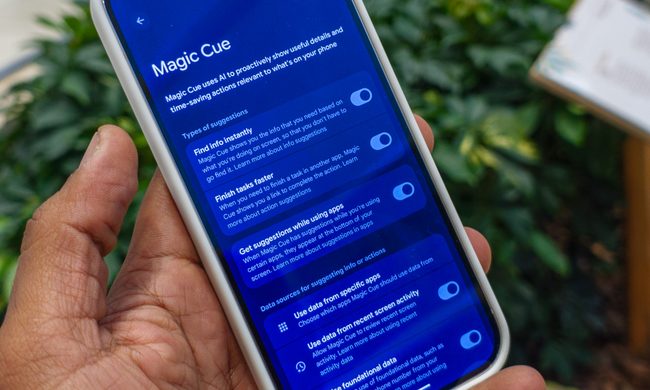
Magic Cue, one of the smartest Android features on the Pixel phones, is coming to more apps
Google's most underused Pixel 10 feature is finally getting the third-party reach and redesign it needed to become the proactive AI assistant it was always supposed to be.
Magic Cue Settings splash screen on the Google Pixel 10 Pro in Obsidian

Magic Cue, I’d say, was the kind of feature that made me excited about the Pixel 10 launch. However, after the on-stage demo, the feature hardly showed up in day-to-day usage, much less in a useful way.  

Google apparently noticed. At I/O 2026, the company quietly announced that the feature is getting an expansion, along with a possible redesign. While it wasn’t the headline announcement, it could surely be something that makes Pixel 10 users excited again. 

Read more
A caring robot just won a silver medal at one of the world’s biggest flower shows
Robocrops Chelsea show

When you think of the Chelsea Flower Show, robots are probably the last thing on your mind. Yet, the University of Lincoln showed up with exactly that and walked away with a Silver Gilt medal.

The exhibit, RoboCrops: Plant Selection, Beyond the Visible, was put together by the University's Lincoln Institute for Agri-Food Technology, or LIAT, and placed right in the show's GreenSTEM zone. That's the section dedicated to exhibitions exploring the intersection of horticulture, science, technology, and the environment.

Read more