

“Versatility is the 2015 Honda Fit’s strong suit, and it always has been. You’d think someone else would’ve caught on by now.”
- Segment-leading practicality
- Fun, spunky driving dynamics
- High-tech safety and entertainment features
- Manual requires lots of shifting on hilly drives
- Abundance of dark, hard plastics
- Capacitive volume control on radio could be a dial
“Why you can trust Digital Trends – We have a 20-year history of testing, reviewing, and rating products, services and apps to help you make a sound buying decision. Find out more about how we test and score products.“
Versatility is the 2015 Honda Fit’s strong suit, and it always has been. You’d think someone else would’ve caught on by now.
The Honda Fit has been the best at what it does since its U.S. debuted in 2007. That is to say, it offers safe, reliable, practical, efficient transportation that just about anyone can afford. And it doesn’t depreciate quickly either.
By our count, that makes the Fit a standout. The fact that it’s fun to drive makes it deserving of some sort of trophy amongst the subcompact hatchbacks in its segment.
For 2015, Honda has debuted an all-new Fit, which the brand claims to amplify each of its qualities and add a splash of technology to the mix, too. So, we took a quick break from reviewing our normal slew of high-tech luxury cars to board a jet to San Diego and see exactly how much stuff you can cram into this tiny Honda.
The answer? More than you’d expect.
Form follows function
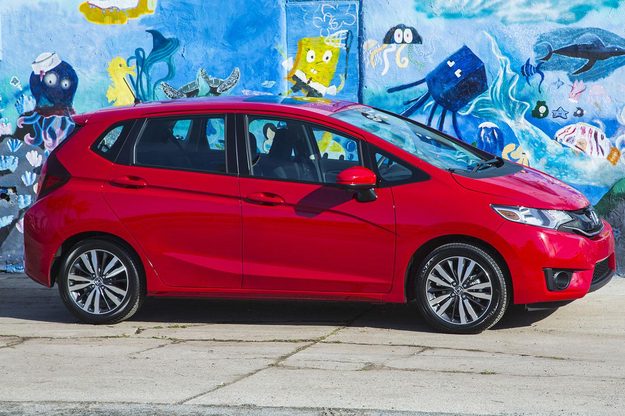
Call it an egg. Call it a teardrop. Just don’t call it ugly. It’s not.
There are plenty of reasons why the 2015 Fit is a hatchback. Its tiny wagon shape not only aids in aerodynamics, but also creates more space for your friends and their stuff.
At its core, it has the makings of the perfect car for college.
At its core, the Fit has the makings of the perfect car for college. The base LX model comes with power doors, windows, and locks with keyless entry. Hands free Bluetooth connectivity and reverse camera are standard on every model – as they should be, in my opinion.
The Fit has a trump card up its sleeve, though; it’s practical … wheelbarrow in the back practical. 55-inch flat screen in the rear seat practical.
It’s the interior configuration that really puts this car ahead of the competition, and also makes it very obvious why the car must be a hatchback. It uses the extra headroom in back.
With the back row in place, there’s room for five medium-sized adults and a couple of suitcases behind them. We’ll call that seating mode. The rest, Honda came up with on its own.
Toss the seats down, and you have “Utility Mode”, which creates about as much space as the truck bed in the Ridgeline. “Tall Mode” allows you to lift the rear seat cushions up and lock them in place, leaving floor-to-ceiling space where your butt and legs would normally go, a la flat screen.


“Long Mode” allows you to flatten the rear seats and front passenger seat so you can carry a longboard. And, finally, there’s “Refresh Mode”, my personal favorite, which lets you lay the front seats into a bed-like configuration, so you can sleep in the car – silly but functional.
Hill and dale
The Honda engineers gave the 2015 Fit a new drivetrain, complete with a revvy 1.5-liter four-cylinder that produces 130 horsepower and 114 pound-feet of torque, as well as the option of a new six-speed manual or continuously variable transmission (CVT).
The manual transmission is – as we’d expect from Honda – easy to shift and very forgiving, and it’ll make for a great learning tool for those who choose to start here. It’s even fun to drive around town. Though, I found it to be a little too much work through parts of our hilly drives on the outskirts of San Diego.
This isn’t a racecar, and it isn’t trying to be.
With the manual, the Fit is rated at 29 mpg city, 37 mpg highway, which is only average for the segment. The CVT may well be the very first I’ve ever preferred to its manual alternative, as it simply makes better use of the torque band away from flat roads, and it’s rated at 33 and 41 mpg, respectively.
I found the steering in the 2015 Honda Fit to be particularly responsive, and the suspension remained flat and nimble, even during more assertive maneuvers.
Let’s be clear: this isn’t a racecar, and it isn’t trying to be. However, as subcompact economy cars go, the Fit is an enjoyable driver’s car and it definitely skews closer to engaging than it does numb.
There’s something new inside for the Gen-Y crowd, too. The HondaLink infotainment system available in EX models and up allows users to play Internet radio, SIRI Eyes Free commands, and even your phone’s data plan to power the navigation.
That means that you can buy an EX model, pay $59 for the HondaLink application, and access turn-by-turn directions in your car without having to opt all the way up to the EX-L Navi trim for the Fit.
Conclusion
Since the Fit debuted in 2007, several competitors have come to market with better fuel economy and more performance, but none has mastered the package quite as well as Honda.
The 2015 Fit may not be the fastest or most luxurious, but it does make for an affordable, well-rounded option that has practicality and Honda’s reputation for reliability in its corner.
For my money, I’d choose the Fit for its versatility in a segment compromised by small size. Plus, you never know when you might need to sleep in your car.
Highs
- Segment-leading practicality
- Fun, spunky driving dynamics
- High-tech safety and entertainment features
Lows
- Manual requires lots of shifting on hilly drives
- Abundance of dark, hard plastics
- Capacitive volume control on radio could be a dial


