
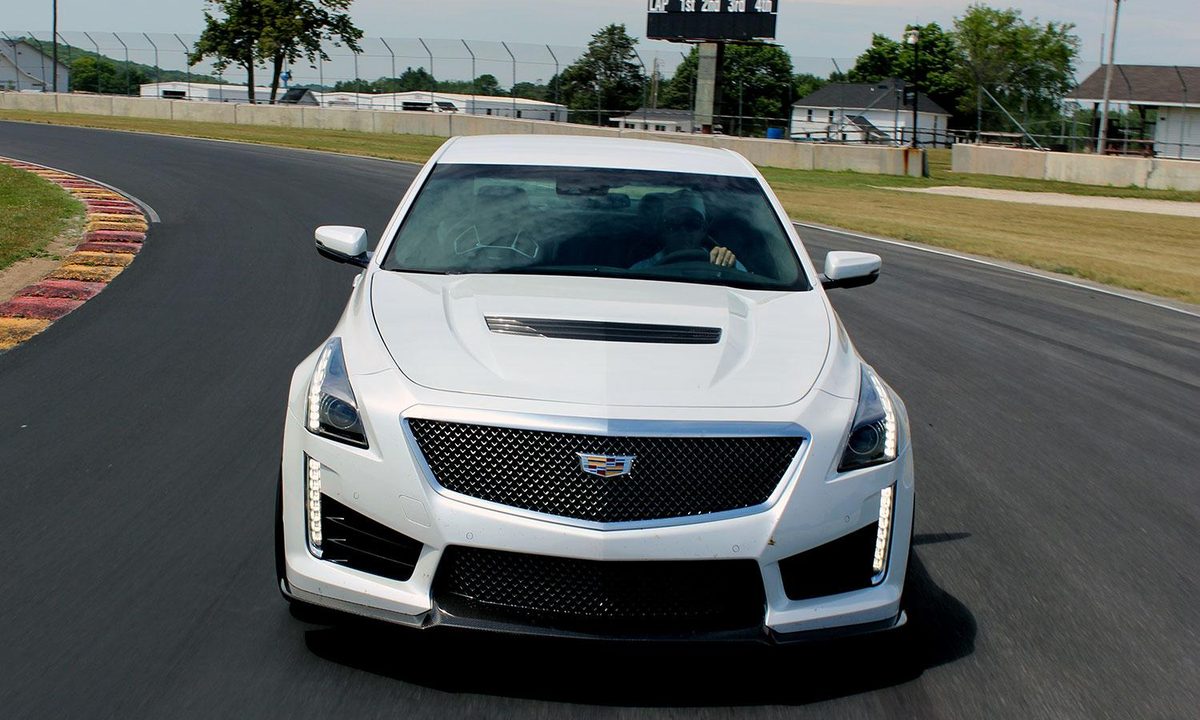
“The latest Cadillac CTS-V continues the car’s tradition of intimidating power underneath a sharp, luxurious executive sedan package.”
- Substantial horsepower and torque
- Comfortable, luxurious cabin
- Aggressive looks throw subtlety out the window
- Techie performance data recorder, heads-up display
- Might be too brash for certain occasions
- Not as refined as its competitors
- Manual shift inputs take a beat longer than they should
“Why you can trust Digital Trends – We have a 20-year history of testing, reviewing, and rating products, services and apps to help you make a sound buying decision. Find out more about how we test and score products.“
The latest Cadillac CTS-V continues the car’s tradition of intimidating power underneath a sharp, luxurious executive sedan package.
Getting up close and personal with the 2016 Cadillac CTS-V is like being seated opposite a cutthroat power broker. Every crisp angle of its sharp attire is designed to both impress and intimidate. It doesn’t take no for an answer, it won’t back down when pushed, and makes it clear that it can make things unpleasant for you if it isn’t shown the proper respect.
Get to know it a little better, however, and you’ve got a powerful ally when you need it, and a stylish companion to help make your presence known at gatherings. I took the third generation CTS-V through bucolic Wisconsin country roads to the Road America race track to find out if this car really means business.
Hostile makeover
The 2016 Cadillac CTS-V introduces the third generation of the automaker’s beefed-up executive sedan. Packed with a 6.2-liter supercharged V8 engine that now whips up 640 horsepower and 630 pound-feet of torque, the rear-wheel drive business beast promises a 0-to-60 time of 3.7 seconds and a top speed of 200 mph.
When it debuted, kicking off the V-series which it now shares with the ATS-V, the goal of the CTS-V was to show that Cadillac was able to make a dynamic sedan that could keep up with anything offered by overseas brands. The CTS-V is now recognized as the ultimate example of Cadillac’s design and performance capabilities, known for getting more powerful and downright meaner looking in every iteration.


This holds truer than ever in the third generation. Try as it might to maintain a professional exterior, the CTS-V can barely contain the traces of the performance-oriented car within. Many design elements from the Elmiraj concept vehicle find their way onto the current production sedan, like the cascading headlamps and wider grille. The sharp angular cut of the outgoing car remains, but is more thoughtfully swept back with a smoother appearance. Given the V treatment, the CTS bulges with performance accoutrement like the centered hood vent, front splitter, spoiler and rear diffuser – all of which can be carbon fiber for those not trying to be at all subtle. These elements were designed with a distinct attention to the air flow over and under the car, channeling air deliberately to reduce lift.
Business-class upgrade
Open the doors and you’ll find the quality leather-swathed surfaces that Cadillac is known for, with more carbon fiber taking the place of wood trim. Microfiber accents are present throughout, as well as wrapped around the thick-rim steering wheel. Optional Recaro seats are the highlight of the interior, being fully adjustable even to the point where a toggle switch adjusts the lumbar and bolster support.
The CTS-V can barely contain the traces of the performance-oriented car within.
An updated CUE infotainment system provides passengers with an easy icon-based interface that can be swiped through like a tablet to different pages. Cadillac claims it has three times the data-processing capabilities and four times the graphic-rendering power. More importantly, it now includes Apple Car Play, with Android Auto coming as an available upgrade soon after.
Like the outside, the interior can’t completely mask the CTS-V’s brutish underpinnings. The ride is smooth and the interior is a comfortable place to spend time, but things like gauge faces that change when switching from tour to sport mode and the spooling of the engine’s supercharger from even light throttle inputs betray the fact that the CTS-V wants to break out of its formal wear and cut loose.
This attitude rubs off on me on my way to the track, and I fiddle with the paddle shifters with an itchy trigger finger. It wants to be unchained, and when I arrive, I unclip its collar.
The mask of sanity is about to slip
Cadillac states that the latest CTS-V surpasses the outgoing car in every measurable metric, and the literal heart of that claim comes from the new 6.2-liter supercharged V8 engine nestled under the hood. This power plant cooks up 640 horsepower and 630 pound-feet of torque, sending it all straight to the rear wheels by way of an eight-speed, paddle-shift automatic.
That imposing stat sheet has me rolling out onto Road America’s 4-mile loop with caution. I have 14 different corners to tackle with a car that purports to be more than just an executive sedan with a powerhouse motor. I was about to find out if all that talk of dynamic handling was legit, or if all that power would overwhelm Cadillac’s best efforts.

This concern was heightened evermore as my first track session started with launching up the track’s straightway. With a claimed 0 to 60 time of 3.7 seconds, the CTS-V roared ever forward to its 200 mph top speed. Track length dictates that I can only reach 150 mph before standing hard on the brakes.
I’ll come to rely a great deal on the Brembo brake system the CTS-V sports behind its 19-inch wheels. The front Duralight rotors are 15.3 inches in diameter, which are as big as can be found on any sedan currently available. Six-piston calipers handle the front while four-piston calipers bite the 14.3-inch rear rotors. As I dived into each turn, the brakes continued to respond consistently without fade. They didn’t give some of the immediate stopping power I often wanted, but getting on them early enough meant I could rely on them as I drove harder with each lap.
Review: First drive: 2016 Cadillac ATS-V
Pushing through the course faster became easier as I learned to trust the car’s capabilities more and more. A multi-link, double-pivot MacPherson-strut front suspension and a five-link rear keeps things agile enough for the CTS-V to step deep into turns, with an electronic limited-slip differential balancing out the traction. Cadillac engineers opted against a brake-biased torque-vectoring system because they felt it would sacrifice too much speed, even if it’s a minuscule fraction.
For all the warnings that the car was going to take my head off if not given the right amount of attention, it never felt like it would run off from under me. Even in the Sport 2 setting, which turns off traction control and just about all the other assists, the CTS-V never got squirrelly. Indeed, when a moment came where the back might’ve broken loose, the tri-compound tires picked up the slack and held the car in place. These Michelin tires were specially designed for the Cadillac, with a hard outer shoulder and softer, grippier inner rows.
By the end of my sessions, I’d run the CTS-V dry, never having that harrowing moment I was cautioned about. The car isn’t necessarily forgiving, but it does what its told, darting to where it is pointed.
Conclusion
When it goes up against its German contemporaries like the BMW M5 and the Mercedes-AMG E63, American muscle prevails in the numbers department. The larger supercharged engine simply gives the car more power and torque than the others, and its power-to-weight ratio of 6.5 lbs per horse means it can be competitive when it sprints. The CTS-V starts at $84,990, but the one tested ended up being valued at $94,330 with optional content. This is a price its rivals, like the aforementioned M5, tend to start at.
But stats only tell a partial story. The other brands certainly produce sedans that are not only comparably dynamic, but far more subtle about their capabilities. The CTS-V though makes little effort in its display of power, and that’s exactly what we like about it.
Highs
- Substantial horsepower and torque
- Comfortable, luxurious cabin
- Aggressive looks throw subtlety out the window
- Techie performance data recorder, heads-up display
Lows
- Might be too brash for certain occasions
- Not as refined as its competitors
- Manual shift inputs take a beat longer than they should


