
“Why you can trust Digital Trends – We have a 20-year history of testing, reviewing, and rating products, services and apps to help you make a sound buying decision. Find out more about how we test and score products.“
Off-road expertise and interior versatility continue to distinguish the Discovery, and its newly premium form leaves little hope for the competition.
The Land Rover brand means different things to different people. Wealthy suburbanites associate the British automaker with elegant errand-runners. Adventure enthusiasts acknowledge the company’s off-road prowess. Neither group would dare associate with one another, yet each is validated in its interpretation of the Land Rover badge.
Once upon a time, Land Rover produced no-frills 4×4 vehicles. Before long, however, the automaker began honing in on an upscale SUV niche. Its authority in this segment has more than paid off in recent years. Luxury shoppers have outgrown the high-end sedan and now crave something of a more stilted variety. Bentley, Rolls-Royce, Mercedes-Maybach, and other ultra-premium brands are rushing to satisfy their customers, but Land Rover need only continue on its current trajectory.


Booming business is encouraging Land Rover to apply its premium positioning to more models, and the next vehicle in line is the Discovery. The company’s most capable product begins its fifth generation this year, touting a radically reworked platform, design, and feature set. Land Rover invited us to experience the newly refined Discovery on Utah’s diverse landscape, covering 500 miles of snowy, rocky, sandy, muddy, and paved-ish terrain. Here’s what we learned.
Maximum appeal
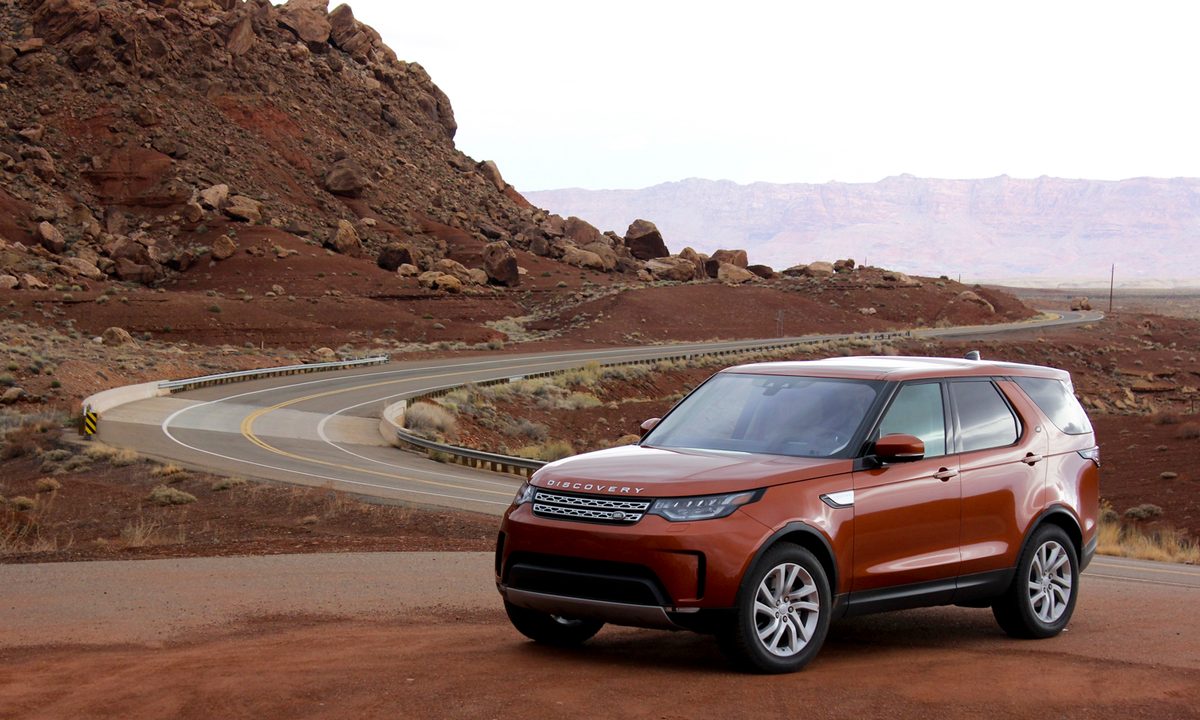
2017 marks the most significant redesign in the Discovery’s 27-year history. Each body panel has been re-imagined, meaning the classic, boxy shape is now only a memory. A few key design cues linger, including the steeped roof, clamshell bonnet, and defined C-pillar. Apart from these accents, the Discovery may as well be an all-new product.
Instead of a body-on-frame platform, the fifth generation Discovery uses a monocoque structure made largely from recycled aluminum. As a result, the 2017 model sheds over 1,000 pounds — or roughly 20 percent — from the LR4’s curb weight, despite being larger than its predecessor.
The production SUV’s rounded, chic exterior closely resembles the 2014 Discovery Vision Concept.
The production SUV’s rounded, chic exterior closely resembles the 2014 Discovery Vision Concept’s taught bodywork. LED headlights, side air inlets, and a narrow grille accentuate the Discovery’s smooth front fascia. Defined wheel arches lose the LR4’s black cladding for a more upscale profile, and house a choice of 14 alloy wheel designs in four sizes (19-22 inch).
At the rear, the Discovery utilizes a single-piece tailgate, rear spoiler, and deep lower diffuser. Land Rover offers a Dynamic Design Pack that includes 21- or 22-inch gray satin wheels, a black or gray contrast roof, unique front and rear bumpers, and black accents for the grille, door handles, mirror caps, fender vents, and badging.
“The design had to be a radical departure from previous generations,” says Massimo Frascella, Land Rover Creative Director. “It is now more relevant and will attract new customers to our brand.”
While the distinctive look of the previous generation Discovery models will surely be missed, the vehicle’s handsome new form looks superb from (almost) every angle — something about the rounded rear end just doesn’t mesh with the SUV’s attractive bod.
Jack of all terrains
It’s logical to assume the Discovery’s softened physique matches a softened off-road demeanor. Indeed, the new Discovery is more refined on all types of terrain, but that doesn’t mean it’s any less capable. In fact, the fifth generation model can take you further off the beaten path than any production Land Rover.

Some of the new Discovery’s off-road capability is due to sophisticated technology, but the foundational hardware is equally top-notch. Base “SE” Discovery models ship with a fixed-height coil-over suspension, while an adjustable air suspension is available on higher trims.
Both setups are paired with a double-wishbone front and integral link rear layout. Permanent four-wheel drive is configured with either a single-speed and Torsen differential or two-speed transfer case and low-range gears.
The Discovery’s off-road specs include up to 11.4 inches of ground clearance (with the available air suspension), an approach angle of 34 degrees, a breakover angle of 27.5 degrees, a departure angle of 30 degrees, 50:50 weight distribution, and wheel articulation of 19.7 inches. The Discovery can also wade to a depth of 35.4 inches, which trumps the LR4.
Read more: Go anywhere in comfort in Land Rover’s new Discovery with advanced tow assist
Land Rover’s Terrain Response 2 system takes center stage in the new Discovery, with Auto, Grass, Gravel, Snow, Mud, Sand, and Rock Crawling modes. When left in Auto, the terrain management system optimizes throttle mapping, steering response, suspension calibration, and traction control to handle every surface.
Paired with features like Hill Descent and All-Terrain Progress Control (a speed-adjustable cruise control for scampering up hills or rock faces), the Discovery feels like an off-roading cheat code. Hit a few buttons, tend to the steering, and the SUV makes you look like a pro. Keep in mind that these all-terrain feats are being performed on 20-inch wheels wrapped in Goodyear all-season tires.
The Discovery’s advanced technology makes it feel like an off-road cheat code
If you’re part of the boat or RV crowd, the Discovery has you covered with 7,700 pounds of towing capacity and Land Rover’s intuitive Advanced Tow Assist, which makes reversing with a trailer way too easy.
In the U.S. market, Land Rover offers the Discovery with two engine options and one transmission — a ZF eight-speed automatic. A 3.0-liter supercharged V6 is your standard mill, producing 340 horsepower and 332 pound-feet of torque. For $2,000 more, a 3.0-liter turbo-diesel V6 is available with 258hp and 443 lb-ft of torque.
Off-roaders in need of low-end grunt and eco-conscious consumers who prefer 26 combined mpg to the gas engine’s 21-mpg rating will prefer the oil burner. Whichever powertrain you choose, the Discovery has ample power on-road and off.
Versatility, refined
The Discovery can bully a back road, but it can also coddle its customers. Taking a page from the upscale Range Rover and Range Rover Sport, the Discovery’s cabin is elegantly simple. Staple luxury car ingredients like brushed metals, soft leather surfaces, and wood grain trim will make the posh crowd feel at home, while advanced safety and convenience features are perfect for families.

Land Rover’s latest InControl systems are available across the Discovery trim range, and include a 10.0-inch touchscreen display with 60GB of storage and built-in apps, a smartphone app for remote control of the climate settings and seating configurations, a Wi-Fi hotspot that can pair with up to eight devices, and an emergency SOS system. The TouchPro infotainment system is equal parts user-friendly and sophisticated, with tile quadrants for navigation, media, vehicle settings, and weather that respond quickly to inputs.
Land Rover’s interior updates round out the Discovery’s premium picture without sacrificing an ounce of utility.
The Discovery has been a seven-passenger vehicle for many years, but never has the third row been so comfortable for riders of all sizes. Very full-size adults can fit behind the second row with plenty of head and legroom. When you don’t need to fill every seat, each of the five rear chairs can be independently arranged and folded flat with optional one-touch buttons in the trunk or within the TouchPro system.
Lay both rows down and you’ll have 88.3 cubic feet of interior storage. The Discovery also features a power-folding inner tailgate than can support over 600 pounds — perfect for even the most raucous tailgating festivities.
Land Rover’s interior updates round out the Discovery’s premium picture without sacrificing an ounce of utility. Though several of the cutting-edge convenience features and high-end trims are optional, the Discovery is still every bit the luxury SUV you’d expect at the $50,000 price point.
Dare to compare
Priced from $49,990 (with a ceiling of $73,950 for the limited-production First Edition), the 2017 Land Rover Discovery squares off against the BMW X5, Mercedes-Benz GLE, Audi Q7, Volvo XC90, and GMC Yukon. Off-road expertise, seating for seven, and interior versatility continue to distinguish the Discovery, and its newly premium form leaves little hope for the competition.
Highs:
- Effortless off-road prowess
- Refined, versatile cabin
- Sophisticated convenience features
- Fluid exterior design
Lows:
- The best features are all optional
- Incongruous rear-end styling


