
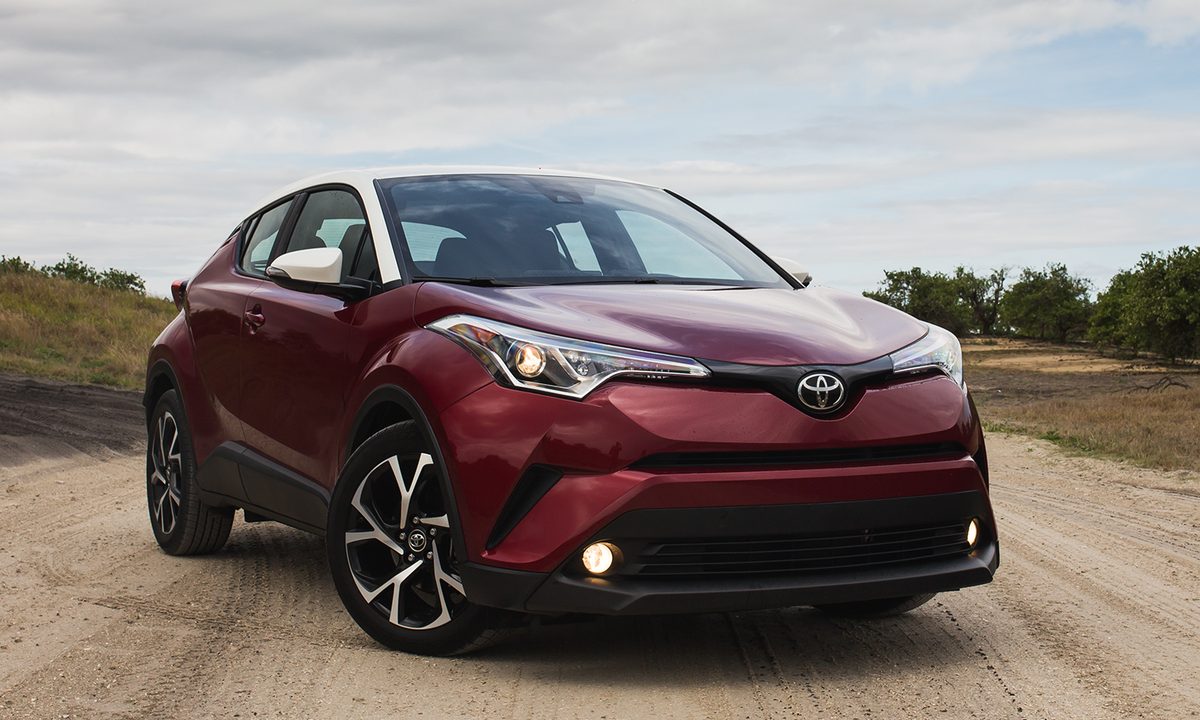
“The 2018 Toyota C-HR is as basic as pint-sized crossovers get with limited optional equipment.”
- Comfortable and composed ride
- Quiet on long-distance drives
- Spacious for four
- Well-executed, simple, and fuss-free interior
- Lots of standard gear and safety tech
- Motivationally challenged
- No sat-nav option
- No all-wheel drive option
- No option for more powerful motor
“Why you can trust Digital Trends – We have a 20-year history of testing, reviewing, and rating products, services and apps to help you make a sound buying decision. Find out more about how we test and score products.“
These days, you can literally get a crossover in almost every shape and size you can think of. The latest one up for critique is called the C-HR. By classification of the automotive taxonomy, it’s of the crossover SUV family, specifically of the subcompact genus, and the Toyota species. It’s based on the same TNGA (Toyota Next Generation Architecture) platform as the Corolla and even the Prius.
In that sense, you can almost call the C-HR a slightly lifted and five-door hatchback version of the Corolla sedan, just not by name. C-HR instead stands for “Compact High Rider.” Originally drafted as a new addition to the late, pseudo-youthful sub-brand, Scion, the C-HR now simply received the Toyota badge it initially deserved, given Scion is no longer.
With a starting price of just $22,500, the C-HR lands itself into a very crowded and busy battling ring where it tussles with the Honda HR-V, the Chevrolet Trax, the Hyundai Kona, Kia Niro, the Ford EcoSport, the Nissan Kicks, and the Mazda CX-3. And by price alone, cars like the Jeep Renegade as well. But interestingly, the C-HR is already at a disadvantage as there’s no option for all-wheel drive or satellite navigation, two key items that often show up on the buyer’s checklist for most-wanted features in an automobile. How does it fare otherwise?
Well, we spent some time using the C-HR to trek across central and southern Florida to catch a few MLB Spring Training games to find out.
Interior and tech
Imagine entering a slightly-lifted Corolla sedan, but with an updated interior and a more upright driving position. That’s what it feels like when settling into either of the front seats. The bulbous and high roof gives the cabin a nice airy and spacious feel. All the plastics and materials seem well-chosen and smartly placed, reminding us how Toyota engineers just know how to make a simple, clean, and functional car interior that you expect to be flawless and fuss-free.


The buckets are very comfortable and supportive, exhibiting minimal difficulty when trying to find a comfortable driving position, even for my 5’11” husky figure. Once I fixed everything to my liking, there was room to spare for adults in the back seat, as long as they’re not above six-foot tall. Because of the sloping roofline, you can forget about trying to haul anything with considerable height in the back, unless you can reposition it to fit by folding the rear seats down. At which point, your rear occupants might be forced to hang on to the roof for dear life. Otherwise, the C-HR’s trunk is best meant for a day trip with the friends to the beach, plus everyone’s things. Or maybe for getting back and forth between college and home.
These days, you can literally get a crossover in almost every shape and size that you can think of.
The level of standard tech is also quite high, particularly in the safety department. Toyota boasts its standard suite of passive and active safety gadgetry on the C-HR, like Toyota Safety Sense. That bundles forward pre-collision system with pedestrian detection, lane departure warning with lane-keeping steering assist, blind-spot monitoring with rear-cross traffic alert, and even radar-guided cruise-control and automatic high beams.
Toyota Safety Sense also includes the company’s star safetysystem, options that are standard on every one of its models. That includes electronic stability control, traction control, ABS braking with electronic distribution and smart brake assist, and smart-stop technology, which helps drivers slow down faster under hard braking by reducing engine power.
What the C-HR surprisingly doesn’t come with is the option for satellite navigation. There’s a space where the infotainment system sits, housing an LCD touch display to control the decent radio, various built-in apps for music and other smartphone-based connectivity. But somehow, there’s no way to get sat-nav out of the thing, which is strange given that built-in sat-nav has become increasingly popular as optional and in some rare cases, standard, even at the C-HR’s price point.
Driving experience
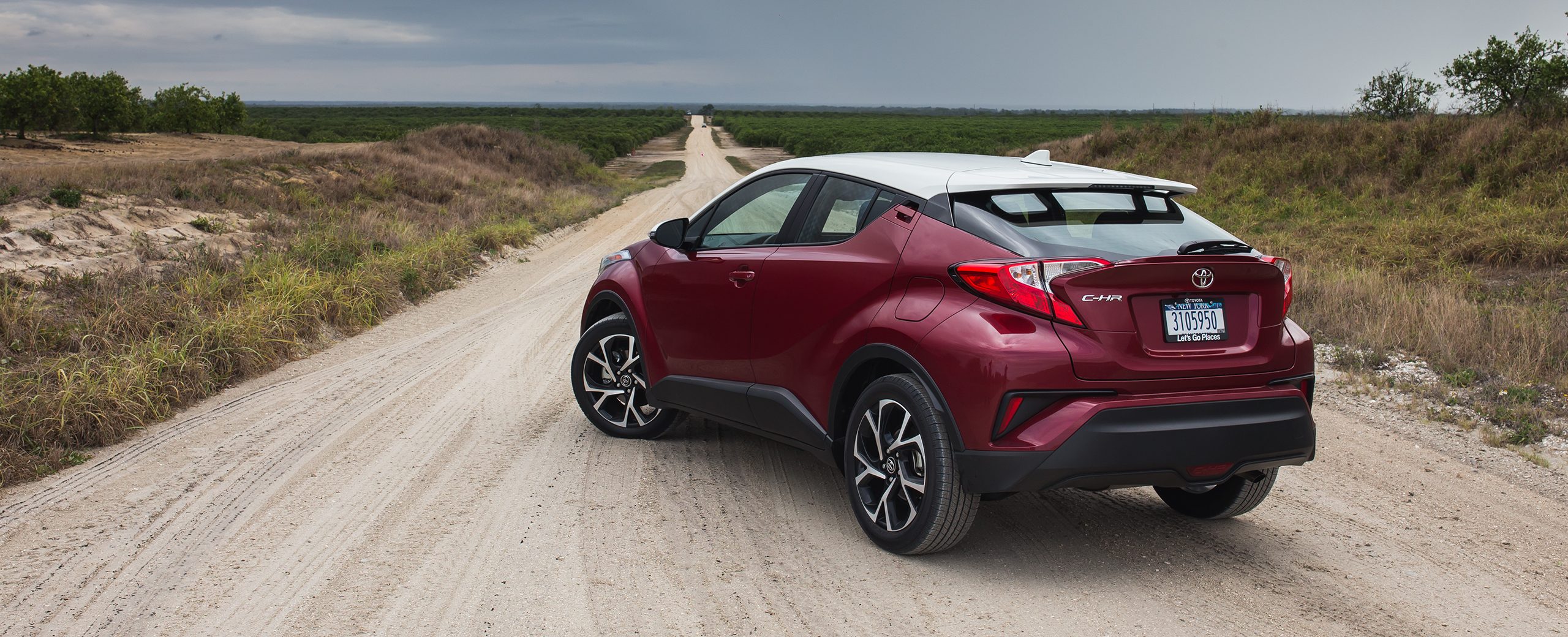
When Toyota introduced the TNGA platform, the company and its engineers promised significantly improved handling across its portfolio. Those results really do show with the C-HR. Thanks to a fully-independent MacPherson suspension setup up front with a double-wishbone multi-link rear arrangement, the C-HR handled itself very well whenever things got curvaceous while traversing the swamps of the Everglades. But even if you just are looking for quality, no-frills A-to-B transportation, the C-HR drives and handles with stability, comfort, and enough control to crack some smirks out of the average driver, giving off the impression of sporty handling.
Imagine entering a slightly lifted Corolla sedan but with an updated interior and a more upright driving position.
The steering is accurate but light on feel and weight for the attentive and enthusiastic driver. Body motions and control on all axis made trekking across central Florida in between various cities as soothing as its ocean breezes. Overall road and wind noise were surprisingly minimal.
It won’t win any stoplight drag races since the C-HR’s only source of motivation is a seemingly gutless, naturally-aspirated 2.0-liter gasoline four-cylinder with peak output ratings at 144 horsepower and 139 pound-feet of torque. It all goes to the front axle via a continuously variable transmission (CVT) for the sake of fuel efficiency. The engine is smooth and the C-HR’s cabin keeps the four-cylinder from protruding the interior space.
But, there’s no other way to say it. The C-HR is slowwww. Even on paper, where it requires around 11 seconds to hit 60 mph from a stop. Merging with the regular traffic on I-95 to the Miami area required a lot of wide-open throttle.
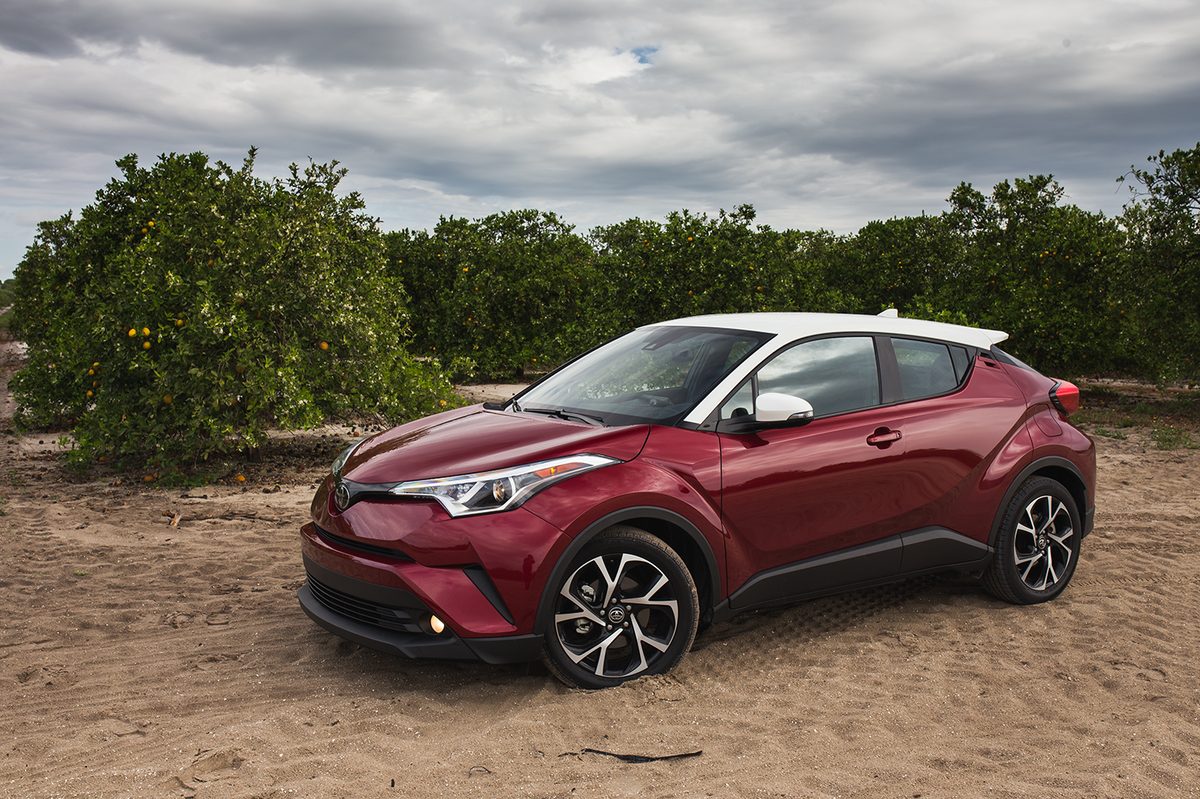
The upside is an EPA-estimated fuel economy rating of 27 mpg city, 31 mpg highway, and a combined average rating of 29 mpg. Though because of the need to really work the engine just to keep with traffic, we saw closer to the 27-mpg mark according to the on-board trip computer.
Warranty
All Toyota C-HRs come with a three-year, 36,000-mile basic bumper-to-bumper warranty, and a five-year, 60,000-mile policy that covers the engine and the transmission.
How DT would configure this car
Toyota made configuring the C-HR really simple as there are only three trim options: XLE, XLE Premium, and Limited. The Premium adds the options for special colors, color-matching body trim, and standardizes other little tidbits such as the sport seats we appreciated for just $1,800 extra. So, we’d spring for the Premium as everything else, aside from accessories, is standard. To keep with Digital Trends’ blue, we’d opt for the blue eclipse metallic R-code paint, made available from that Premium trim. It also changes the roof color to a pearlescent white, which we appreciate for a more unique look.
Our Take
The Toyota C-HR is pretty much as basic as pint-sized crossovers get. It checks all the rudimentary boxes for solid, basic, daily transport. That is, unless you need all-wheel drive or you just happen to know where you’re going, all of the time. The C-HR only comes with front-wheel drive and there’s oddly no option for embedded sat-nav. It’s not too expensive or difficult to get a portable GPS. But it’s hard to imagine a new vehicle without some sort of option these days, particularly even when the C-HR’s four-door sibling, the Corolla, has the choice of integrated navigation.
What also doesn’t help the C-HR is that almost all of its competitors also offer the option for all-wheel drive and integrated satellite navigation. Alternatives like the HR-V and the CX-3 also offer sportier drives, while the Kia Niro and Hyundai Kona both offer considerably more space. So, it’s a tough and competitive space for the C-HR and even tougher without those two major options.
Should you get one?
If you’re one of the few individuals who live in places where the weather is always nice, like central Florida or southern California, the C-HR is plenty of good car for most who don’t need to get anywhere in a hurry, don’t need all-wheel drive, or just happen to never get lost.


