
Audi introduced the brand-new 2019 A8 sedan during the first-ever Audi Summit, a brand-specific workshop held in vibrant Barcelona, Spain. In the past, flagship model presentations were typically dominated by pictures of lavish woodgrain trim, while ever-higher horsepower figures got tossed around like confetti after the World Cup Final. This time around, Audi put an unabashed focus on technology.
Tech is the new measuring stick in the luxury car segment. Significantly, the fourth-generation A8 is the very first production car designed with level three autonomous driving in mind from the get-go. Engineers and designers knew the car would have to drive itself in certain circumstances as soon as they began working on the project.
Meet the smart car – and not the tiny one
To that end, the A8 packs a 48-volt electrical system and enough computing power to run an Airbus A380. It’s decked out with radars, ultrasonic sensors, and a front-facing camera that constantly monitor the car and its surroundings. There’s even a laser installed to scan the road ahead. It’s like a pair of eyeballs that never blink; it tells the car what’s ahead of it. You wouldn’t know the device is there if we didn’t tell you, however, because it’s neatly integrated into the bottom part of the front bumper.
The driver is encouraged to become a passenger by taking both hands off the steering wheel for as long as he or she wishes.
One of the many features debuting alongside the A8 is what Audi calls Artificial Intelligence. It’s centered around a software named Traffic Jam Pilot, which lets the car drive on its own without the slightest human input. (We tested it out. It works!) The driver is encouraged to become a passenger by taking both hands off the steering wheel for as long as he or she wishes. Audi cleverly refers to the free time motorists gain when their car drives itself as the 25th hour.
“The added value of an autonomous car isn’t the fact that it drives itself; it’s what you can do while it drives itself,” explained Peter Mertens, Audi’s board member for technical development.
Traffic Jam Pilot makes it possible for the driver to answer emails, draw, watch a movie, or play the bagpipes. Anything you can do as a passenger, you can do while sitting behind the wheel – well, almost. Before you grab a pillow, know that you won’t be able to nap behind the wheel until level four self-driving tech hits the streets. Don’t think you can trick the system, either. A camera regularly makes sure the driver is sitting behind the wheel, not wallowing in the back seat.
Navigating legislature
The software’s limitations are both physical and legal. It only works in a traffic jam – at speeds of up to 37 mph – on a multi-lane highway with a center divider, such as a guardrail. It also needs clearly marked exit and entrance lanes. The various sensors can tell whether the right conditions are met. Traffic Jam Pilot won’t turn on if the car detects there’s no center divider, or that it’s traveling on a single-lane road. And, the software compares the information it gets from the suite of sensors with map data stored in the navigation system to confirm it’s not making a mistake.
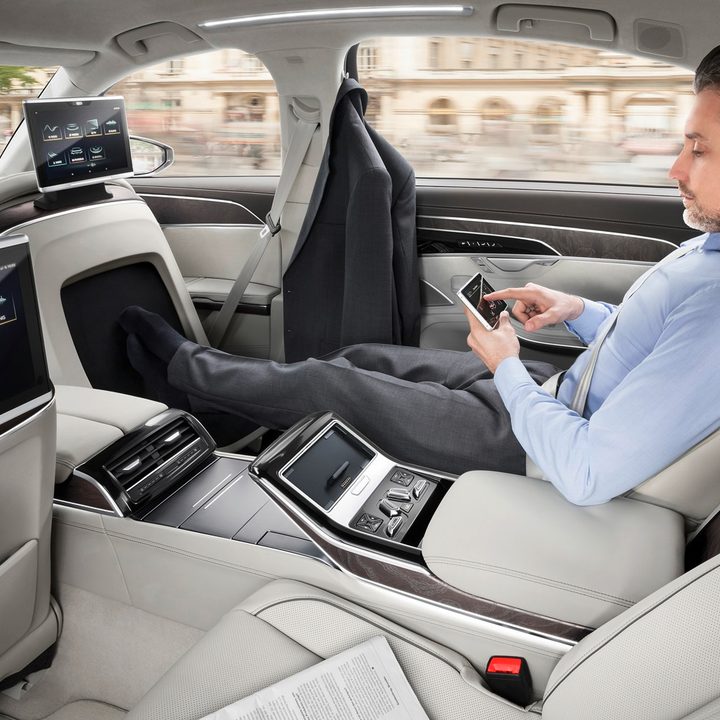
Legally, autonomous cars are crippled by enough red tape to wrap the sun like a big, fiery Christmas present. Mirko Reuter, Audi’s head of autonomous driving functions, told us the major sticking point in the United States is that there’s no general law that regulates autonomous cars. Currently, the only state that allows private autonomous cars on public roads is Florida. Test vehicles are authorized in numerous states, including California, but those regulations were put in place for big companies evaluating prototypes with a permit, not for John Jones nonchalantly commuting to work.
The story is largely the same on the other side of the pond. In spite of its innumerable promises of legal uniformity, the European Union lacks a general law for the operation of private autonomous cars. As of writing, they’re only allowed on German roads. The situation is even murkier in China, where they’re neither allowed nor banned.
In other words, even the brightest minds in the automotive industry aren’t able to put a world-class autonomous car in the hands of consumers because they’re not allowed to. An Audi spokesperson told us the Traffic Jam Pilot technology will gradually be introduced where it’s permitted starting early next year. That will hopefully include the U.S., but nothing is certain yet.
There are no two ways around it: sooner or later, autonomous technology will become legal in America. And, for Audi, the new A8 is a stepping stone on the path to full automation. The changes will come fast, too; there is a bigger gap between level two and level three than between level three and level five, according to Mertens.
“Our future cars will manage traffic in the city as well as on the highway all by themselves. They will leave it up to you to drive or be driven,” promised Audi CEO Rupert Stadler.


