
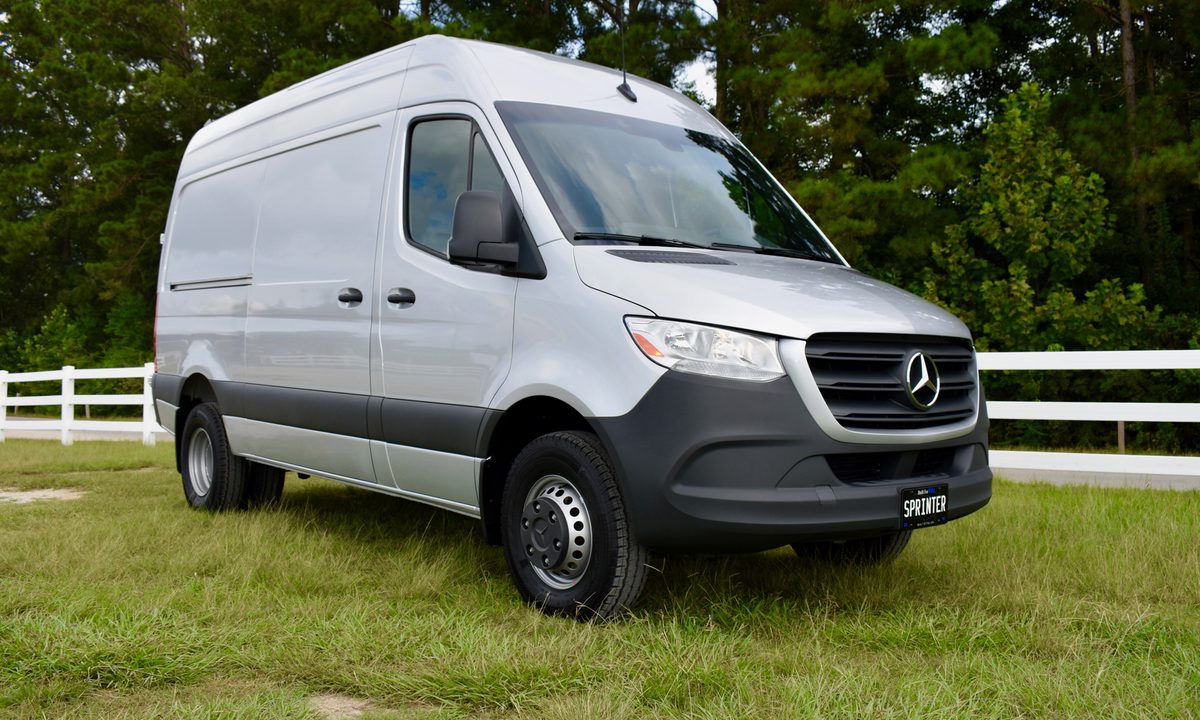
“The 2019 Mercedes-Benz Sprinter is a van with car-like infotainment and driver-assist tech.”
- Relatively refined for a van
- MBUX voice recognition
- Helpful driver-assist features
- Awkwardly-positioned touchscreen
- Size
- Still feels like a van
“Why you can trust Digital Trends – We have a 20-year history of testing, reviewing, and rating products, services and apps to help you make a sound buying decision. Find out more about how we test and score products.“
Unless you spend a lot of time browsing camper van sites, you might be surprised to learn that Mercedes-Benz sells vans. The redesigned 2019 Mercedes-Benz Sprinter represents the third generation of a van that’s been on sale in the United States for almost two decades. In that time, the Sprinter has helped shift U.S. buyers away from traditional truck-like vans toward European-style models.
Now, Mercedes is trying to engineer another major shift in van tastes. The German automaker is pouring tech from its luxury cars into vans, starting with the new Sprinter. With available features like adaptive cruise control, autonomous emergency braking, and a 10.25-inch touchscreen infotainment system, the Sprinter could make competitors like the Ford Transit, Ram ProMaster, and Nissan NV2500/3500 look like antiques.
To find out whether this coupling of van ruggedness and passenger-car tech was a match made in heaven, or a recipe for domestic acrimony, we went to Charleston, South Carolina. Mercedes invited us down to see the factory that will build 2019 Sprinters for the U.S., and to test out the van on local roads. The basic, rear-wheel drive Sprinter cargo van with a four-cylinder gasoline engine starts at $33,790, but we grabbed the keys to a (pre-production) diesel version priced starting at $39,790 (Mercedes has not revealed pricing for individual options packages and features). Pricing climbs from there to the $56,790 sticker price of an all-wheel drive diesel-powered passenger van.
Interior and tech
The interior is a weird mix of typical van basicness and a smattering of items from Mercedes’ passenger cars. Despite the three-pointed star on the nose, interior materials leave no doubt that you’re in a work vehicle, not a luxury vehicle. But the Sprinter has some car-like touches like push-button start, and steering-wheel controls that will be instantly recognizable to anyone who has driven an E-Class.


The Sprinter also gets the new MBUX (Mercedes-Benz User Experience) infotainment system, which is only just now being rolled out on the automaker’s passenger cars. What sets MBUX apart from other systems, according to Mercedes, is its natural-language voice recognition. It’s designed to recognize casual phrasing like “how’s the weather?” or “I need gas,” and is activated by the voice prompt “Hey Mercedes.”
On the road, this worked well – perhaps a bit too well, in fact. The system perks up its ears not only when the driver says “Hey Mercedes,” but also when just “Mercedes” is uttered. Aside from having to give the Sprinter the Voldemort treatment, it was nice being able to give voice commands in a normal, conversational way rather than having to memorize specific phrases.
Screens have pinch-and-zoom capability and good graphics, but manipulating them requires reaching awkwardly across from the driver’s seat.
MBUX, which is an optional extra on the Sprinter, is offered with 7.0-inch or 10.25-inch touchscreens. Both versions get the natural-language voice control system, as well as Apple CarPlay and Android Auto compatibility. What MBUX doesn’t get is a touchpad controller, like the one Mercedes uses in its higher-end passenger cars. Instead, the system relies on steering wheel controls and the touchscreen itself. Screens have pinch-and-zoom capability and good graphics, but manipulating them requires reaching awkwardly across from the driver’s seat, which is much further away from the dashboard than it would be in a normal car.
Steering wheel-mounted controls proved adequate for most functions, however. We’re eager to test out MBUX in the upcoming Mercedes-Benz A-Class to see how it works in the more familiar environment of a passenger car.
Even economy cars are available with long lists of driver-assist features these days, but this tech is rare in vans. The Sprinter can be loaded with an array of features including adaptive cruise control, blind-spot monitoring with rear cross-traffic alert, lane-keeping assist, a park-assist system with 12 radar sensors and 360-degree camera coverage, traffic sign recognition, crosswind assist, a driver-attention monitor, and autonomous emergency braking.
These features make more sense in a big, unwieldy vehicle like the Sprinter than they do in, say, a compact sedan. Everything works just like it would in a regular passenger car, which could be a good thing or a bad thing depending on your level of tolerance for electronic nannies. Partway through our test drive, we did receive a dashboard notification that the autonomous emergency braking system was nonfunctional. The vehicle was a fairly early pre-production model which might explain the failure.
At a maximum 533 cubic feet, the Sprinter cargo van has more space than the most capacious versions of the Ford Transit, Ram ProMaster, and Nissan NV2500/3500. Mercedes also offers passenger versions with 12 or 15 seats, and a “crew van” that splits interior space evenly between passengers and cargo. Ford offers eight-, 10-, 12-, and 15-seat versions of the Transit. Nissan only sells a 12-passenger version of its vans, and Ram doesn’t offer a passenger version of the ProMaster at all.
Driving experience
Mercedes offers two engine options in the 2019 Sprinter: one gasoline and one diesel. Base models get a 2.0-liter four-cylinder gasoline engine producing 190 horsepower and 258 pound-feet of torque. This engine is available only with rear-wheel drive and a nine-speed automatic transmission. An optional 3.0-liter turbodiesel V6 produces 190 hp and 324 lb-ft, and is bolted to a seven-speed automatic with standard rear-wheel drive or optional all-wheel drive. Mercedes is also launching an all-electric version Sprinter, but hasn’t decided whether to bring it to the U.S.


Mercedes told Digital Trends the gasoline engine is only offered in the U.S., and only because buyers tend to prefer gas over diesel. But it seems like a half-hearted attempt, especially compared to the gasoline powertrains offered by rivals. The ProMaster’s sole engine option is the ubiquitous Pentastar 3.6-liter V6, making 280 hp and 260 lb-ft. Nissan NV vans are available with 4.0-liter V6 (261 hp, 281 lb-ft) or 5.6-liter V8 (375 hp, 387 lb-ft) gasoline engines. Ford’s 3.5-liter turbocharged V6 produces 310 hp and 400 lb-ft. Ford also offers a 3.2-liter inline-five turbodiesel, rated at 185 hp and 350 lb-ft.
The 2019 Sprinter felt reasonably refined for a Spartan work vehicle.
But with the optional diesel engine, the Sprinter’s maximum payload of 6,636 pounds, GVWR (gross vehicle weight rating) of 12,125 pounds, and a maximum towing capacity of 7,500 pounds (when properly equipped) are respectable. Only the V8-equipped Nissan can tow more, and Mercedes tops the charts in maximum hauling capacity.
Not surprisingly, the driving experience doesn’t draw any comparisons with a Mercedes-AMG GT C. But the Sprinter felt reasonably refined for a Spartan work vehicle, with minimal vibration transmitted from the road and a fairly quiet cabin. Mercedes only provided V6 diesel models to test, and we found this engine to be more than adequate for keeping up with traffic and passing on highways, in an unloaded van, at least. Because the Sprinter is considered a commercial under U.S. regulations, Mercedes is not required to submit it to EPA fuel-economy testing.
Warranty
Mercedes offers a five-year/100,000-mile powertrain warranty and three-year/36,000-mile new-vehicle warranty. As the 2019 Sprinter is a completely redesigned model, it is difficult to predict future reliability.
How DT would configure this car
Mercedes claims to offer more than 1,700 combinations of powertrain, body style, wheelbase, and trim, but it really depends on what you want to use your Sprinter for. Unless you have a very large family or run an airport shuttle operation, we can’t see much use for the passenger version. The cargo version offers a more convenient option to trailers for hauling things like motorcycles. A cargo van or crew van could make a neat camper van conversion, and there is no shortage of resources online to help with that. We’d specify all-wheel drive in that case.
Regardless of what we planned to do with our Sprinter, we’d definitely get the diesel engine. The gasoline engine offers substantially less torque, and we think it would struggle with the weight of a loaded van. We’d also add MBUX to bring in-vehicle tech up to passenger-car standards, as well as the full suit of driver aids. We don’t drive big vans every day, but the Sprinter’s array of tech features gave us an extra dose of confidence.
Conclusion
The 2019 Mercedes-Benz Sprinter tries to transcend the traditional limits of vans with an advanced infotainment system and more driver-assist tech than competitors. While it is still very much a van, the Sprinter should be more approachable to individual buyers looking for a camper van base vehicle, or just a way to haul a lot of stuff.


