
SUVs are bigger and correspondingly heavier than sedans, but they’re not always less efficient. Hybrid technology has allowed carmakers to build generously sized people-movers that are surprisingly good on gas. If that sounds like what you want in your driveway, Digital Trends has selected the best hybrid SUVs available in 2020, including the Toyota Highlander Hybrid. You get a lot for your money with the Highlander, and it has enough space for your family.
Best hybrid SUV: 2021 Toyota Highlander Hybrid

Who it’s for: People who need good gas mileage, three rows, and reliability.
Why you should buy it: To trim your fuel budget when you need a three-row SUV to fit your family.
How much will it cost: $38,410+
This midsize SUV gets 36 mpg combined, which is decent for a sedan, let alone an SUV that can carry seven. As in most SUVs, the third row is probably a better fit for kids than adults, but still: It’s there. Toyota was an early operator in the hybrid space, and it maintained its commitment to this powertrain. After two decades on the market, Toyota’s hybrid technology is widely considered to be boringly competent, and the Highlander has a history of great predicted reliability scores.
You also get a lot for your money with the Highlander Hybrid. Toyota’s Safety Sense suite of driver assistance tech is standard, and all-wheel drive is available. It was completely redesigned for 2020, so some things that were notably missing in past years, like Android Auto, are now included. Amazon Alexa compatibility is also standard, along with Apple CarPlay.
The Toyota Highlander Hybrid’s redesign updated the interior, and the whole vehicle uses lightweight materials. That contributed to the boost in miles per gallon between 2019 and 2020. The floor-mounted batteries are tucked out of the way, so there’s as much passenger and cargo space in the hybrid as in the non-hybrid Highlander.
Best luxury hybrid SUV: 2020 Porsche Cayenne E-Hybrid

Who it’s for: Drivers who don’t want to sacrifice luxury and sportiness for fuel economy.
Why you should buy it: Excellent driving dynamics and excellent reliability scores are a rare pairing.
How much will it cost: $81,800+
When the original Cayenne made its debut, Porsche fans wondered whether the company could credibly put its name on an SUV. It could. Now in its third generation, the Cayenne is offered with a plug-in hybrid powertrain that has 455 horsepower on tap and offers a very un-hybrid-like 4.7-second sprint from zero to 60mph. Combined fuel economy while driving as a hybrid is 21 mpg, but keep in mind this is a plug-in hybrid, so before the gas engine kicks on, the Cayenne can travel 14 miles on all-electric energy with a full battery.
There’s also a ton of advanced tech aboard the 2020 Porsche Cayenne E-Hybrid, like InnoDrive. This adaptive cruise control system uses navigation data, radar, and sensors — including traffic, curves, and elevation changes — to estimate “the optimum acceleration and deceleration values,” according to Porsche. There’s a standard 12.3-inch touch screen with smartphone connectivity and a Wi-Fi hotspot, too, plus five USB ports throughout the vehicle.
Read our in-depth Porsche Cayenne review
Best affordable hybrid SUV: 2021 Toyota RAV4 Hybrid
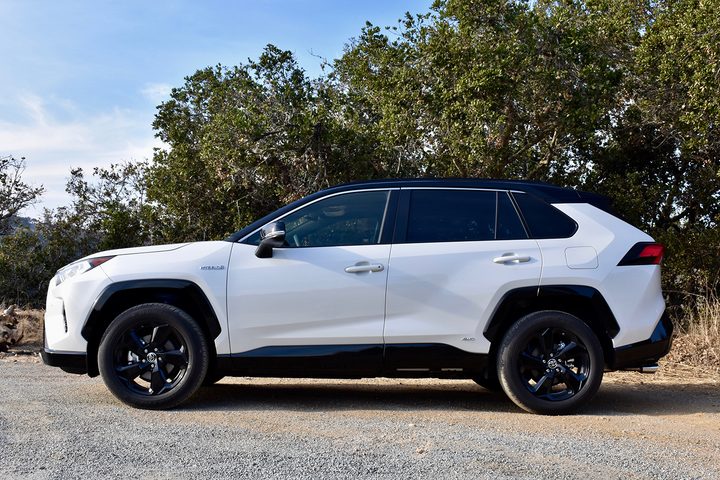
Who it’s for: Drivers who want a hybrid SUV but don’t want to have to take a second job to afford it.
Why you should buy it: Inexpensive, in this case, doesn’t mean cheap or unreliable.
How much will it cost: $28,500+
For about the same price as any compact SUV on the market, it’s possible to buy a RAV4 Hybrid that gets 40 mpg combined. That’s better than most non-hybrid cars. The RAV4’s electric motor does it a favor by adding torque to the drivetrain, so it feels peppier to drive than its non-hybrid counterpart. It also makes a total of 219 hp, which is again more than the gasoline version. It’s really a no-brainer if you’re trying to decide between the regular and the hybrid RAV4, though keep in mind the latter is about $2,500 more expensive.
Many features that are standard in more expensive Toyotas — and even some Lexus models — are standard in the RAV4 Hybrid. This includes all-wheel drive, smartphone connectivity, Safety Sense 2.0, and Wi-Fi. Despite its small size, there’s plenty of room for people and their stuff. The rear seats, in particular, have actual legroom. Yet it’s still maneuverable in tight spaces like parking garages. And, if you want an even more efficient Toyota RAV4, the range includes a plug-in hybrid model named Prime which is both fast and frugal, though at $38,100 it’s certainly not cheap.
Read our in-depth Toyota RAV4 Hybrid first drive
Best plug-in hybrid SUV: 2021 Volvo XC60 Recharge
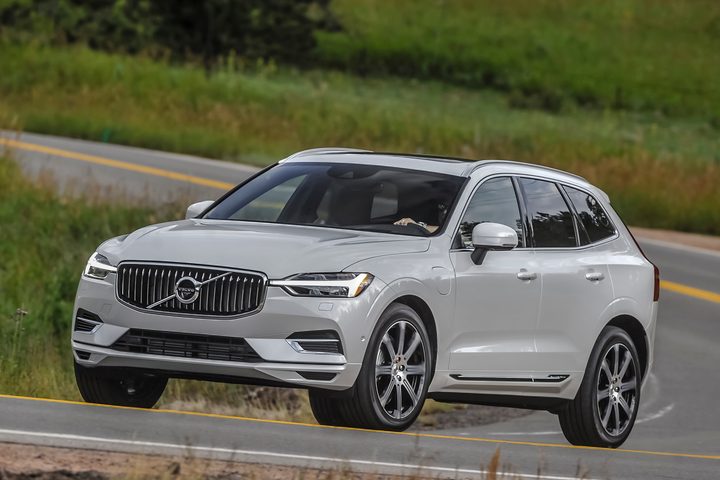
Who it’s for: Anyone who’s not quite sure they want to go all the way electric.
Why you should buy it: There’s a lot of advanced technology in the XC60.
How much will it cost: $53,500+
This was a tough call, because the XC60 only returns 27 mpg combined when it’s running as a hybrid. But it gets 57 MPGe when using all-electric power, and it can travel for approximately 18 miles with a full battery.
Why choose the Volvo XC60 instead of, say, the 2020 Kia Niro plug-in hybrid, which gets 46 mpg combined and 105 MPGe? Because when you load up the Niro with all the extras, you’re still short of what the Volvo comes with, yet you’ll pay over $35,000.
The base trim of the Volvo XC60 has a luxury leather interior and large cargo area, and there’s a 9.0-inch vertical touch screen with smartphone compatibility. Volvo’s City Safety system is standard, with all the usual advanced driver assistance features plus large-animal detection and scanning for other vehicles at intersections.


