  1. Home
  2. Cars
  3. Trash
  4. News

Elon Musk confirms Cybertruck won’t arrive until 2023 at the earliest

Add as a preferred source on Google

Tesla’s Cybertruck pickup won’t hit the road until 2023 at the earliest, CEO Elon Musk said on Wednesday, January 26.

His comments came during an earnings call with investors following the release of Tesla’s fourth quarter results for 2021, and confirm recent rumors that Cybertruck production had been delayed until next year.
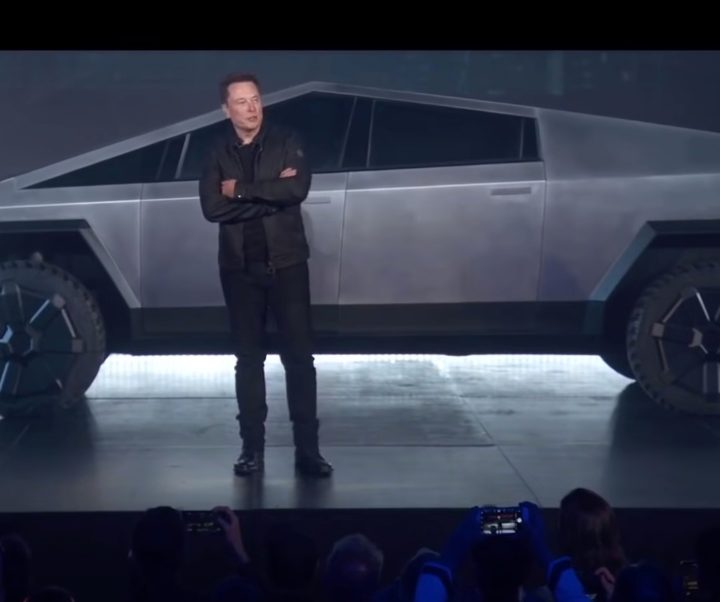
Tesla chief Elon Musk unveiling the Cybertruck in 2019.
Elon Musk unveiling the Cybertruck at a special event in November 2019. Tesla

“We will not be introducing new vehicle models this year,” Musk said in comments that also put to rest any hope of Tesla’s new Roadster sports car and Semi truck arriving before the end of 2022.

Confirmation of the Cybertruck delay will come as a disappointment to the million or so customers who have put down a deposit on the vehicle since it was unveiled in 2019.

Tesla had originally hoped to launch its electric pickup in at the end of 2021, but last summer the date slipped to 2022. Then, earlier this month, a change to the wording on its website suggested the Cybertruck wouldn’t hit the road until next year.

Musk said on Wednesday that the goal for 2022 was to boost production of its existing vehicles, adding that the complexity of introducing a new vehicle this year would dent output and therefore profit. The global chip shortage has also helped to dash hopes of new launches this year.

Indeed, Musk confirmed during the call that “the chip shortage, while better than last year, is still an issue,” adding that “there are multiple supply chain challenges.”

Despite the constraints, Tesla reported stronger-than-expected fourth-quarter results, posting a profit of $270 million from a global production run of 305,840 vehicles, marking a 70% increase over the same period a year ago.

For the entirety of 2021, revenue reached $17.7 billion, with profit coming in at $5.5 billion, up from $721 million in 2020. Tesla produced 936,172 vehicles globally over the 12-month period.

Tesla said in a statement that looking forward, the rate of growth “will depend on our equipment capacity, operational efficiency, and the capacity and stability of the supply chain.” The automaker said it’s also intent on further developing its Full Self-Driving feature that functions as an advanced driver-assist system, describing it as “a primary area of focus.”

Trevor Mogg
Contributing Editor
Not so many moons ago, Trevor moved from one tea-loving island nation that drives on the left (Britain) to another (Japan)…
After acing range and charging, Chinese EV brands flaunt three-wheel driving on SUVs
BYD, Aito, and Li Auto are making active suspension the new battleground after range and charging
Machine, Wheel, Transportation

Chinese EV brands have spent years trying to win on range, charging speed, and screens. Now the fight is getting stranger, with premium SUVs showing off three-wheel driving as the next battleground.

According to Car News China, BYD’s Denza B8 Flash Charge Edition, Huawei-backed Aito M9, and Li Auto L9 are all being used to show how active suspension can lift a wheel while the vehicle keeps moving at low speed. The demos look theatrical, and the intended uses are practical, including tire changes, off-road recovery, and crossing uneven ground without getting stuck.

Read more
This Android Auto update is trying to change how you drive and use your car
Road, Electronics, Credit Card

I use Android Auto every day, and at this point, it feels like a quiet co-driver sitting on my dashboard. That’s exactly why this upcoming refresh from Google actually matters. It is not just a visual tweak; it is a proper overhaul of how Android Auto should feel inside a modern car. The biggest change is the design. Google is bringing its Material 3 Expressive design language from phones into cars. That means Android Auto is getting a more modern, more fluid look with expressive fonts, smoother animations, and even support for wallpapers. This should really make the entire interface feel less rigid and more alive while you are driving.

Widgets finally make Android Auto feel useful at a glance

Read more
BYD’s latest EV costs just over $10,000, goes 250 miles, and packs a LiDAR, too
LiDAR, 250 miles, and a five-figure price tag: the 2026 Seagull is proof that the future of affordable EVs is already here, just not in the West.
BYD 2026 Seagull.

BYD has officially unveiled the 2026 Seagull, sold internationally as the Dolphin Mini or Dolphin Surf, and the numbers deserve your attention. 

The updated compact EV’s price starts from 69,900 yuan, which is around $10,300, in China, and tops out at 85,900 yuan, which is around $12,600. It debuted at the 2026 Beijing Auto Show before going on sale this week (via CarsNewsChina). 

Read more