
Modern vehicles’ sophisticated electronics go far beyond the simple car mechanics most of us grew up with. Now, OBD, or on-board diagnostics, diagnoses almost every issue within your vehicle. Whether your engine is running low on oil or a spring is out of place, the OBD steps in to diagnose the issue.
Onboard diagnostics provide near-universal codes, allowing users to understand what is going wrong in their vehicle. By understanding the differences in OBD versus OBD II and the different code readers available, you can address almost any issue that arises in your car.
What is OBD?
OBD stands for On-Board Diagnostic. It’s the standardized system that allows external electronics to interface with a car’s computer system. It has become more important as cars have become increasingly computerized, and software has become the key to fixing many problems and unlocking performance.
OBD has existed in various forms long before anyone ever uttered the words “infotainment” or “connected car.” It came about primarily because of two factors: The need to regulate emissions, and the mass adoption of electronic fuel injection by automakers beginning in the 1980s.
Unlike carburetors or previous mechanical fuel-injection systems, electronic fuel injection (EFI) requires computer control. Like its predecessors, EFI regulates fuel flow into the engine, but it does so using electronic signals rather than mechanical bits. That created the first major need to put computers in cars.
OBD vs. OBD II
Several automakers introduced computer interfaces for their own cars before the 1990s, but the push to standardize didn’t begin until 1991, when the California Air Resources Board (CARB) mandated that all cars sold in California needed some form of OBD capability. However, CARB didn’t issue standards for the systems until 1994. Known as OBD II, that standard was implemented for the 1996 model year and is still in use today. Previous iterations of OBD were retroactively classified OBD I.
Virtually every new car sold in the U.S. over the past 20 years follows the OBD II standard. OBD II cars have a port — usually located under the dashboard on the driver’s side — that devices can plug into and connect to a car’s computer. Companies have plenty of ideas about what you can plug into that port.
Delving into diagnostics

As the name implies, diagnostics are the primary purpose of OBD. When a car’s sensors decide that something is amiss, they trigger a message known as a “trouble code,” which may manifest as a “check engine” light or another warning on the dashboard. OBD scanners can check these trouble codes to determine exactly what’s wrong, and clear them from the computer’s memory once the problem is fixed. If you want to know more about the reasons why your check engine light is on, you can check the guide we created.
The trouble codes are just that, though: Codes. Instead of a diagnosis like “loose gas cap,” you will see a string of letters and numbers that is incomprehensible without a reference. Trouble codes start with a letter and include four or five numbers, which together point to the specific subsystem and what problem it is experiencing.
Some OBD scanners come preloaded with definitions for these codes, but otherwise, you’ll need a list like the one that can be found on OBD-Codes.com. Note that in addition to the generic codes that apply to all cars, individual manufacturers have their own specific codes. Finding these can be a bit trickier, as not every manufacturer is entirely comfortable with the idea of releasing them to the public.
OBD for performance
Diagnostics may be the most important function of OBD equipment, but these tools can also be used to make your car go faster.
Several aftermarket brands offer both OBD II data loggers and performance tuners that access critical vehicle systems through the dashboard port. Data loggers can be used to track more mundane things like fuel economy, but they can also record things like lap times and power output. Professional racers rely on this data to see how they perform on a track and to tweak their cars, so why shouldn’t you?
Some companies also offer performance upgrades for specific vehicles that remap or alter software to unlock horsepower. Since modern vehicles are so dependent on computer controls, software changes can be as effective as bolting on a new air intake or exhaust system. It’s worth noting that these upgrades may have negative effects in other areas — such as reliability or fuel economy — and may void the factory warranty. Check before installing.
OBD Dongles
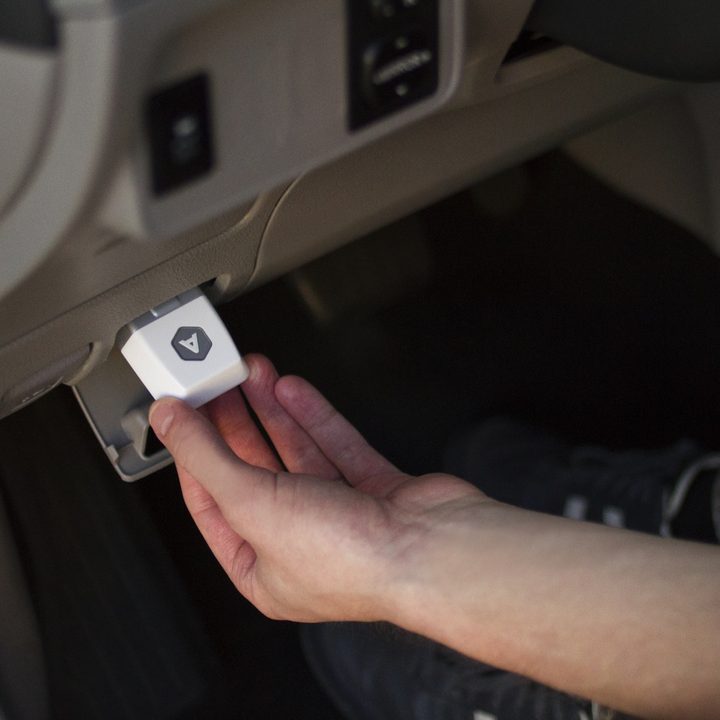
Not everyone has the wherewithal to try to fix their own vehicle or upgrade their performance. Recently, companies have tried to exploit OBD II for more mainstream applications in the form of “dongles” — devices that plug directly into the OBD II port and connect wirelessly to a network.
Dongles are sometimes issued to customers by insurance companies as a way to achieve discounts. This generally involves using data pulled from the car’s OBD II connection to analyze driving habits and award a discount for low-risk behavior. Allstate’s Drivewise program, for example, looks at speed, how quickly the driver brakes, the number of miles driven, and when a person drives.
Other devices — such as Verizon’s Hum — implement telematics features that are comparable to the features offered by other vehicle developers through subscription services. Hum syncs with your smartphone and gives you the exact same statistics you’d get if you opted for a subscription service. But the kicker is, you get it for a cheaper price. Hum allows you to run diagnostics on your vehicle, contact roadside assistance, and track down a stolen car if necessary. Reckless teenagers also won’t be able to get away with dangerous driving habits and behaviors thanks to Hum’s geofencing and speed-alert components, putting parents’ minds at ease.
However, it’s essential to keep in mind that using third-party devices always poses some sort of threat. If you happen to connect your vehicle’s computer with an outside network, you break through a necessary safety barrier, and you can make yourself vulnerable to harmful cyber attacks. Plugging a device into the OBD II port can further compromise that safety barrier by allowing it access into your car’s system. We always caution users on the dangers of third-party devices, as they create weaknesses that hackers can exploit in a variety of ways.
You’re still at risk even if you have a telematics device that’s sending data back and forth through a wireless network, as the network connection itself can be a second point of vulnerability. If a hacker breaches the network, they can cause some severe problems. Be aware that where devices improve safety in some ways, they can also compromise our security in other ways. You’re always at risk for a security breach, no matter what connection you’re using. It’s up to you to decide if you feel the risk is worth taking.


