
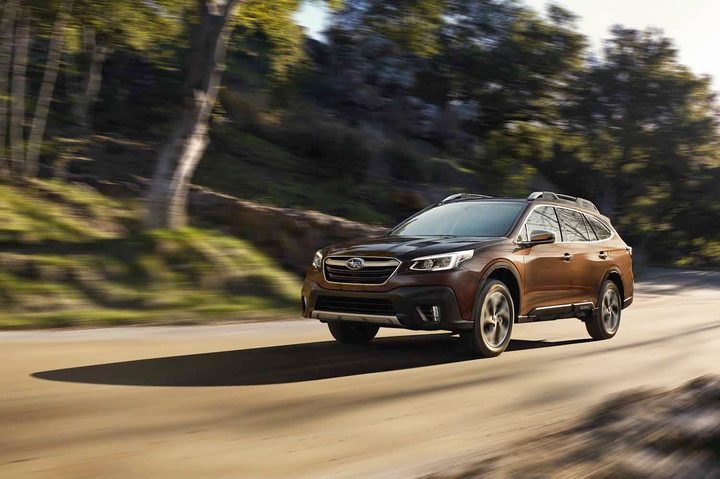
Subaru’s popular Outback and Forester models evolved in a similar way. Both started life as rugged, all-wheel drive station wagons, and they gradually morphed into crossovers to reach a wider audience. While they overlap in some areas, they’re different cars positioned in separate segments and each aimed at a unique group of buyers.
Here’s how these two mainstays of the Subaru range compare on paper.
Tech features
Subaru made a name for itself by offering go-anywhere, all-wheel drive cars, not tech-oriented ones. The base version of the Forester is markedly utilitarian. It comes with a 6.5-inch screen embedded in the center console, a bargain-basement four-speaker sound system, automatic climate control, and very few creature comforts. You’ll need to explore the upper echelons of the trim ladder if you require features like navigation displayed on a bigger touchscreen, a push-button ignition, a power-operated tailgate, and a heated steering wheel.

The same applies to the Outback, which is closely related to the Legacy. Upmarket trim levels come with leather upholstery, one-touch folding rear seatbacks, heated front seats, a massive 11.6-inch touchscreen (pictured above), keyless entry, and automatic headlights. Basic trim levels, especially the most affordable model, unabashedly embrace the function-over-form approach to building a car, though they’re not lacking anything, either.
Performance and fuel economy
Both models come standard with a naturally-aspirated (that’s non-turbocharged), 2.5-liter flat-four tuned to deliver 182 horsepower at 5,800 rpm and 176 pound-feet of torque at 4,400 rpm. In both cases, Subaru’s time-tested symmetrical all-wheel-drive system and a continually variable transmission (CVT) transfer the engine’s power to the four wheels. Subaru no longer offers the Forester with a manual, and the Outback lost its stick years ago.
Want more power? Of course you do; neither model is particularly peppy in base form. In the Forester, you’re out of luck — at least for the time being. The last-generation model’s turbocharged flat-four hasn’t returned yet, and reports claim it never will. The Outback’s fabulous flat-six is gone for good, too so Subaru offers a turbocharged, 2.4-liter flat-four as a consolation prize. It’s rated at 260 hp, and it also shifts through a CVT.
The Forester returns 26 mpg in the city, 33 mpg on the highway, and 29 mpg in a mixed cycle. The Outback returns 26 mpg in the city and 33 mpg on the highway with the naturally-aspirated engine, but those figures drop to 23 and 30, respectively, with the turbocharged flat-four.
Subaru doesn’t currently offer an electrified version of the Outback and the Forester. The brand launched an electrification offensive in 2018 when it released the Crosstrek Hybrid, so it’s reasonable to assume other models will receive an evolution of the gasoline-electric powertrain sooner or later. Plug-in hybrid models — and, ultimately, electric cars — will retain Subaru’s all-wheel-drive system.
Design
The current-generation Forester (pictured below) made its debut at the 2018 New York Auto Show and went on sale shortly after as a 2019 model. Design-wise, it’s more of an evolution of its predecessor than a revolution. The company played it safe, and the overall proportions haven’t changed significantly. The same applies to the interior. It’s a lot more streamlined, and it’s more modern-looking, but motorists going from a fourth- to a fifth-generation Forester won’t experience a dramatic change. Which is good, because research shows they’re not looking for one.


New for the 2020 model year, the Outback also looks a lot like its predecessor; Subaru again played it safe. It falls in line with the Japanese firm’s current design language thanks to styling cues like a hexagonal grille, sharp, swept-back headlights, and C-shaped rear lights. The Cs are inspired by the engine’s boxer design, Subaru told Digital Trends. Its interior isn’t futuristic or daring by any means, but step inside and you’ll notice that, for example, the touchscreen is neatly integrated into the dashboard, and all of the buttons and switches are right where you expect them to be.
The Forester stretches 182.1 inches long, 71.5 inches wide, and 68.1 inches tall with roof rails. The Outback measures in at 191.3 inches from bumper to bumper, 73 inches wide, and 66.1 inches tall. Both have 8.7 inches of ground clearance, which adds peace of mind when soldiering down dirt roads or powering through snowy trails. The Forester offers up to 35.4 cubic feet of trunk space with five passengers on board, and 76.1 feet with the rear seats folded flat. Note that adding a moonroof lowers those figures to 33 and 70.9, respectively. Select the Outback and you’ll have 32.5 cubes to fill with five passengers on board, or 75.7 with the rear seats folded flat.
Safety
Subaru puts a big focus on safety. Every Forester regardless of trim level comes standard with dual front and side airbags for the front passengers, curtain airbags for both rows, and a knee airbag for the driver. That’s in addition to electronic driving aids like traction control and electronic stability control. Subaru’s comprehensive EyeSight suite of technology (which includes features such as adaptive cruise control, pre-collision braking, and lane departure warning) comes standard regardless of trim level. Steering-responsive LED headlights and a rear seatbelt reminder function were added to the roster of standard features for the 2021 model year.
The Outback offers the same airbags as the Forester, and every trim level comes standard with EyeSight. 2021 brought the aforementioned steering-responsive LED headlights and a rear seat reminder.
Pricing
When the time comes to sign the dotted line, the Forester will sting a little bit less than the Outback. It starts at $24,795 before buyers begin adding options. Subaru breaks down the lineup into five trim levels called base, Premium, Sport, Limited, and Touring, respectively. Pricing for the range-topping model starts at $34,895.

Outback pricing starts at $26,795. Subaru divided the lineup into seven trim levels: base, Premium, Limited, Touring, Onyx Edition XT, Limited XT, and Touring XT. At $39,945, the most expensive Outback lands deep in luxury car territory. Note none of the aforementioned figures include a mandatory $1,050 destination charge.
Key rivals
The Subaru Forester competes in the same segment as the Ford Escape, the Honda CR-V, and the Toyota RAV4. The Outback, on the other hand, competes in a smaller segment that includes the Buick Regal TourX (which is retiring after the 2020 model year) and the Volvo V60 Cross Country.


