The inevitable has happened. A Tesla Model S has caught fire.
While we right away reported a rough account of the incident, we now know – thanks to Tesla Founder and CEO Elon Musk – what exactly happened, why, and how the Model S performed given the unfortunate circumstances.
A release written by Musk himself explains the cause of the damage: “A curved section that fell off a semi-trailer was recovered from the roadway near where the accident occurred and, according to the road crew that was on the scene, appears to be the culprit. The geometry of the object caused a powerful lever action as it went under the car, punching upward and impaling the Model S with a peak force on the order of 25 tons. Only a force of this magnitude would be strong enough to punch a 3 inch diameter hole through the quarter inch armor plate protecting the base of the vehicle.”
Luckily, the driver was able to exit the car before any injuries were sustained, according to Yahoo Autos.
Firefighters report a blaze so resilient that they had to use a dry chemical extinguisher to finally put out the blaze. And when they thought they had stamped it out, they removed the front of the car to find a battery still smoldering.
According to Musk, the firefighters were following protocol. In the case of the Model S, however, Musk contends the firefighters caused more damage than was required to extinguish the fire: “When the fire department arrived, they observed standard procedure, which was to gain access to the source of the fire by puncturing holes in the top of the battery’s protective metal plate and applying water. For the Model S lithium-ion battery, it was correct to apply water (vs. dry chemical extinguisher), but not to puncture the metal firewall, as the newly created holes allowed the flames to then vent upwards into the front trunk section of the Model S.”
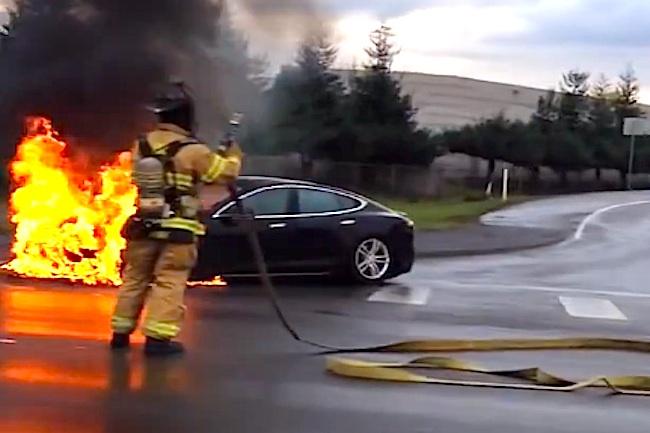
As you can see in the video below – let me warn our more sensitive readers of foul language used by the amateur videographer – that the flames never move past the mostly empty, carpeted front section of the car.
This is good news, as even if passengers had for some reason remained in the cabin, they wouldn’t have been directly at risk.
Around 150,000 cars catch fire each year on American roads, so scenes such as this are no surprise. This is, however, the first such fire for Tesla. Musk is quick to emphasize that, statistically, drivers are far safer in a Tesla than in a gasoline-powered car.
“Americans drive about 3 trillion miles per year according to the Department of Transportation. That equates to 1 vehicle fire for every 20 million miles driven, compared to 1 fire in over 100 million miles for Tesla. This means you are 5 times more likely to experience a fire in a conventional gasoline car than a Tesla!”
The car isn’t the only victim of this fire. After the story of the EV fire spread, Tesla stock dropped 6.2 percent, according to USA Today.
Tesla Founder and CEO Elon Musk recently offered advice via Twitter to Boeing when it was experiencing fire issues with lithium-ion batteries onboard its 787 Dreamliner. No word yet on which genius billionaire will tweet unsolicited advice to Musk now that one of his babies has succumb to flames.
Updated: Since the first report of this story, we have updated facts and added official quotes and insight from Tesla CEO Elon Musk.