

Further reading
On paper, BMW and Toyota don’t have much in common. The former is a German luxury brand known as the purveyor of the ultimate driving machine, while the latter is a mainstream Japanese firm commonly associated with reliable, value-packed cars. They became unlikely partners when they teamed up to develop a sports car platform that underpins both the 2019 Z4 and the 2020 Supra. Engineers did their best to avoid overlapping in key areas like handling and performance, but the two cars inevitably rub shoulders. Confused? Read on to find out how the Z4 and the Supra are similar, and how they’re different.
Design
BMW’s stylists made the Z4 sharp, sporty, and futuristic. It’s considerably more low-slung than its predecessor, the second-generation Z4, and it signals the return of the so-called shark nose to the BMW lineup. Up front, wide kidney grilles with mesh inserts and swept-back headlights bring the Z4 in line with BMW’s current design language. When viewed from the side, it’s characterized by a long hood and a short decklid; it boasts the traditional roadster proportions that get an enthusiast’s heart pumping. Angular rear lights and a spoiler integrated into the trunk lid add a touch of aggressivity to the overall design.
The Supra nameplate made its debut in 1978. Toyota used it on four generations of the coupe until it made the final example in 2002. Designers could have easily gone retro — they certainly had the heritage to back it up — but they didn’t. They preferred looking toward the future. The next Supra instead gets a sleek, modern design inspired by the well-received FT-1 concept introduced at the 2014 Detroit Auto Show. Its front end is characterized by a long hood, horizontal headlights, a pronounced nose cone, and large air dams integrated into the bumper. The roofline peaks right above the driver and gently slopes down into a ducktail spoiler, a styling cue that gives the model an almost fastback-like look. The rear bumper receives an oversized air diffuser flanked by a pair of round exhaust outlets. And, like the original Supra, the fifth-generation model boasts a hatch that enhances practicality.
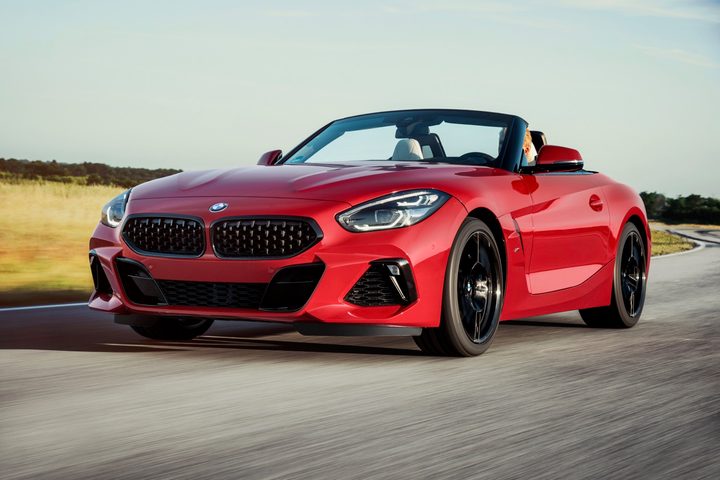
Contract manufacturer Magna-Steyr will build both cars on the same assembly line in Graz, Austria. It’s the same plant the Mercedes-Benz G-Class calls home. The Supra stretches 172.5 inches long, 73 inches wide, and 50.9 inches tall. It weighs 3,397 pounds. The Z4 measures in at 170.7, 73.4, and 51.4 inches, and it tips the scale at 3,287 or 3,443 pounds depending on whether it’s powered by a four- or six-cylinder engine. Both cars ride on a 97.2-inch wheelbase.
Performance
BMW will ultimately offer two variants of the Z4 named sDrive30i and M40i, respectively. The sDrive30i occupies the bottom rung in the Z4 hierarchy with a turbocharged, 2.0-liter four-cylinder engine rated at 255 horsepower and 295 pound-feet of torque. The more expensive M40i variant benefits from a turbocharged, 3.0-liter straight-six that provides 382 hp and 269 lb-ft. of torque. Both engines spin the rear wheels through an eight-speed automatic transmission. BMW doesn’t plan on making a manual gearbox available, and it won’t release a full-blown, M-tuned version of the Z4.
At launch, the Supra’s only available engine will be a variant of the Z4’s turbocharged, 3.0-liter six tuned to send 335 hp and 365 lb-ft. of torque to the rear wheels through the same eight-speed automatic transmission as the Z4. Neither company has explained the nearly 50-horse gap. Though Toyota hasn’t confirmed additional engine options for the American market, unconfirmed rumors indicate the lineup will grow sooner or later with the addition of a gasoline-electric hybrid model. The Supra could get a manual transmission, too, but Toyota confirmed the four-cylinder engine offered on the Japanese market won’t make the trip across the Pacific.
The four- and six-cylinder versions of the Z4 take 5.2 and 3.9 seconds, respectively, to reach 60 miles per hour from a stop. Toyota claims a zero-to-60-mph time of 4.1 seconds. Realistically, motorists won’t notice the three-tenth-of-a-second difference between the Supra and the six-cylinder Z4 in real-world conditions. Both cars are electronically limited to 155 mph.
Interior and tech
The differences between the Z4 and the Supra continue in the cabin. Both cars are two-seaters, and they feature a familiar layout; you’ll find the touch screen and the HVAC controls in the same place, for example. The BMW boasts a more upscale interior built with better materials, and it comes standard with a 10.25-inch touchscreen for the infotainment system. The driver faces a familiar three-spoke steering wheel, and a configurable digital instrument cluster.
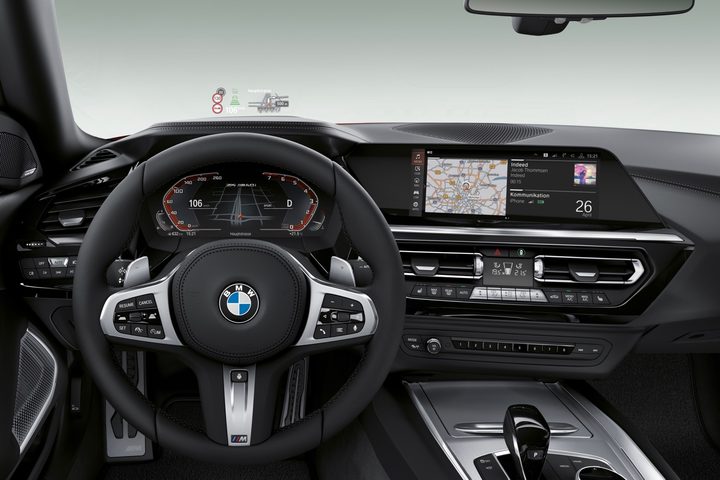
The Toyota is considerably cheaper, so its interior doesn’t look or feel as upmarket as the BMW’s. The price difference shows on the list of standard features, too. Buyers who settle for the basic Supra receive a car with a 6.5-inch touchscreen, and they need to pay about $2,500 for a package that adds navigation, while the 3.0 Premium trim boasts an 8.8-inch unit. Toyota hasn’t released the full list of equipment yet so we’ll have to wait until closer to the Supra’s delivery date to find out exactly what it comes — and doesn’t come — with.
Pricing and availability
The 2019 BMW Z4 sDrive30i is on sale now across the nation. Pricing starts at $49,700 for the four-cylinder-powered model, though, buyers need to add a mandatory $995 destination charge. The M Sport model retails for $52,650 before the same destination charge enters the equation. The M40i model will arrive in showrooms in time for the 2020 model year. Pricing will be announced closer to its on-sale date, but it’s expected to land in the vicinity of $65,000.
Toyota charges $49,990 for the entry-level Supra, and $53,990 for the 3.0 Premium model. Neither will be available until Toyota sells out of the 3.0 Launch Edition it priced at $55,520, however. Production is limited to 1,500 examples. Clearly, the Supra offers more performance for the money than the Z4.
Enthusiasts not interested in either model can look at a diverse selection of comparably-priced performance cars, including the Porsche 718 Cayman, the BMW M2, and even upmarket variants of the Ford Mustang and the Dodge Challenger.


