  1. Home
  2. Cars
  3. Emerging Tech
  4. News

Volkswagen plans 8 new affordable EVs by 2027, report says

Add as a preferred source on Google
volkswagen affordable evs 2027 id 2all
Image used with permission by copyright holder

Back in the early 1970s, when soaring oil prices stifled consumer demand for gas-powered vehicles, Volkswagen took a bet on a battery system that would power its first-ever electric concept vehicle, the Elektro Bus.

Now that the German automaker is facing a huge slump in sales in Europe and China, it’s again turning to affordable electric vehicles to save the day.

Volkswagen brand chief Thomas Schaefer told German media that the company plans to bring eight new affordable EVs to market by 2027.

“We have to produce our vehicles profitably and put them on the road at affordable prices,” he is quoted as saying.

Recommended Videos

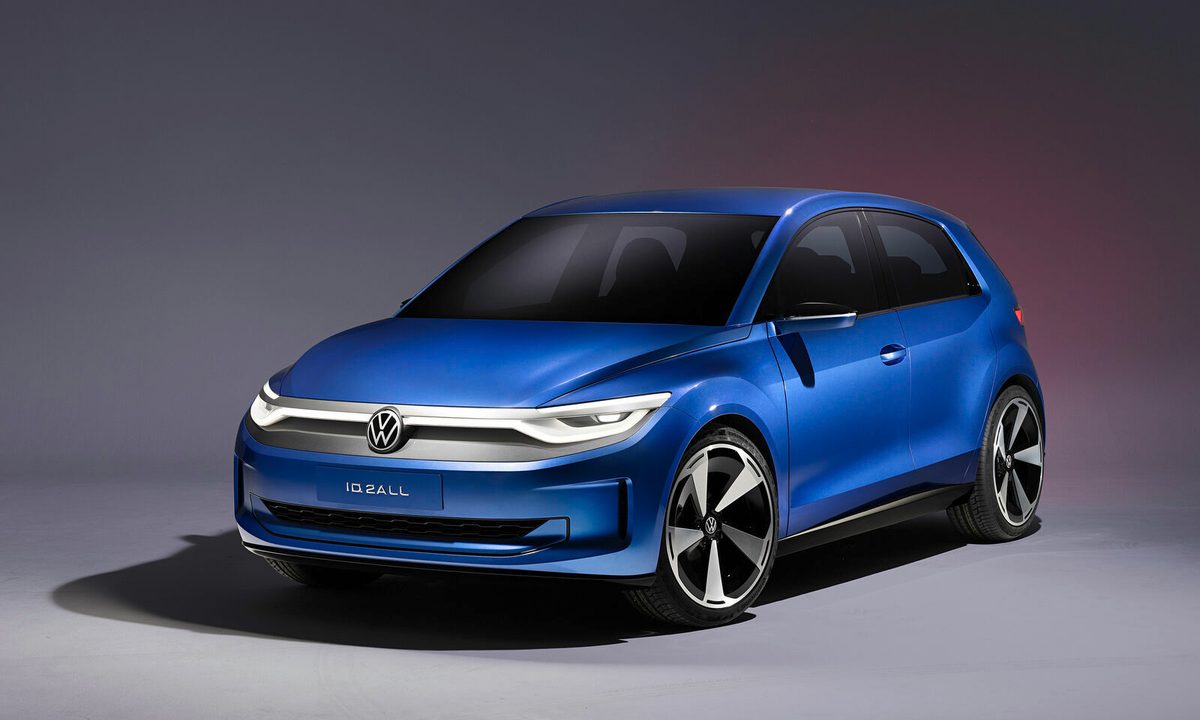
One of the models will be the ID.2all hatchback, the development of which is currently being expedited to 36 months from its previous 50-month schedule. Last year, VW unveiled the ID.2all concept, promising to give it a price tag of under 25,000 euros ($27,000) for its planned release in 2025.

VW CEO Larry Blume has also hinted at a sub-$22,000 EV to be released after 2025.

It’s unclear which models would reach U.S. shores. Last year, VW America said it planned to release an under-$35,000 EV in the U.S. by 2027.

The price of batteries is one of the main hurdles to reduced EV’s production costs and lower sale prices. VW is developing its own unified battery cell in several European plants, as well as one plant in Ontario, Canada.

But in order for would-be U.S. buyers to obtain the Inflation Reduction Act’s $7,500 tax credit on the purchase of an EV, the vehicle and its components, including the battery, must be produced at least in part domestically.

VW already has a plant in Chattanooga, Tennesse, and is planning a new plant in South Carolina. But it’s unclear whether its new unified battery cells would be built or assembled there.

Nick Godt
Former Freelance reporter
Nick Godt has covered global business news on three continents for over 25 years.
Porsche’s 2027 Taycan gets virtual E-Shift gears hooked to real paddle shifters
Porsche’s is trying to solve one of the most prominent EV hardware problems with software.
Car, Coupe, Sports Car

While electric performance cars have gotten quite fast, especially when it comes to driving in a straight line, they still struggle to replicate the engaging feel of a regular sports car. Missing are the gear changes, the rev build, and the physical feedback that make a sports car feel alive.

Porsche thinks it can fix this with software, and the 2027 Taycan update is its most serious attempt yet. The car comes with something called E-Shift, a system that adds eight virtual gears operated using the paddle shifters behind the steering wheel.

Read more
China has new EV safety rules ready. The US needs to follow in its footsteps
Mandatory battery fire protections and hard power cutoffs show what a tougher EV safety playbook could look like in the U.S.
EV

China's EV safety rules are about to make automakers prove their cars can fail safely, not merely warn people before trouble spreads.

Starting July 1, 2026, two mandatory national standards will require stronger battery safeguards and a physical one-touch way to cut high-voltage power during an emergency. The pressure points are the ones drivers, firefighters, insurers, and regulators can't brush aside for much longer, including battery fires, crash damage, smoke exposure, and rescue access after a severe incident.

Read more
Mercedes’s Chinese partner made an EV that costs under $10,000 and looks deceptively stylish
At around $10,000, the Arcfox Beta T1 has a feature list that embarrasses several $30,000 US EVs.
Car, Transportation, Vehicle

BAIC, the Beijing-based automaker that produces Mercedes-Benz vehicles in China, has launched the refreshed Arcfox Beta T1 on June 16, a compact EV priced roughly between $9,200 and $11,700, depending on the trim.

It's not coming to the United States, but the fact that its most affordable version undercuts the cheapest new car sold here by roughly $13,000 and the cheapest EV by almost $20,000 deserves some attention. What BAIC has built here is a direct indictment of the higher EV costs here in America.

Read more