  1. Home
  2. Cars
  3. News

Drivers wanted: Audi says its self-driving cars will put the ‘me’ in autonomy

Add as a preferred source on Google
Audi autonomous TT
Image used with permission by copyright holder

Sorry Doc Brown, but where we’re going we’re still gonna need roads – just maybe not drivers. After Lexus highlighted its autonomous vehicle strategy yesterday, Audi announced today at its CES 2013 press conference its own plans for the future of driverless vehicles.

Ricky Hudi, Audi’s Head of Electronics Development, was eager to announce the company’s pack-leading position as the first automaker granted license in the state of Nevada to test self-driving cars. Nevada passed a law last year making it legal to test autonomous vehicles in the state. And since then, other companies, including Google and Continental, have acquired their licenses as well.

Recommended Videos

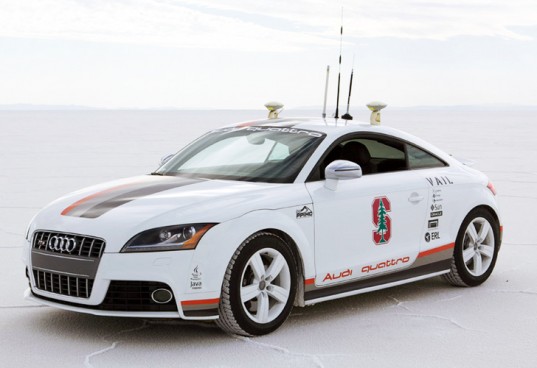
Of course, Audi isn’t green to the self-driving scene. Audi’s parent company, Volkswagen, collaborated with Stanford University not long ago to develope an autonomous TTS for the Pike’s Peak Hill Climb outside Denver, Colorado.

Nevertheless, building cars that can drive themselves is no small endeavor. From Lexus to Google, the current crop of self-driving cars feature trunks full of gear and roof racks loaded with laser sensors. That bulky reality simply won’t compute for consumers, though, and companies like Audi, Google, and Lexus will need to find ways to shrink down the hulking masses attached to their cars of the future.

Audi 2013 CES Press Conference
Image used with permission by copyright holder

Audi seems to be further along than others in this endeavor; during the press conference, Hudi demonstrated its ongoing research by holding up prototype versions of small laser sensor array and a slightly larger than a normal motherboard that houses all the controls for a self-driven vehicle’s onboard electronics.

The mission to bring self-driving cars to the masses isn’t just a race; instead it’s a war of words – or definitions, in this case. Lexus’s advanced active safety research vehicle, itself on display at CES, places drivers firmly in the equation, acting more as a co-pilot auxiliary to the driver. Google is taking a more hands-off approach (no pun intended) with driving responsibility, as it’s the company’s onboard systems that are ultimately responsibility for driving. Audi, on the other hand, seems to be taking the middle road, defining its self-driving technology as “piloted driving”, one in which drivers will still be able to control the vehicle when desired, but also need to be active and engaged while being driven.

Amir Iliaifar
Former Associate Automotive Editor
Associate Automotive Section Editor for Digital Trends, Amir Iliaifar covers the ever increasing cross-section between tech…
Volkswagen is bringing back the electric ID.Buzz bus with some cool upgrades for 2027
Until pricing and range are addressed, the upgrades feel like progress on everything except the things that actually held buyers back.
VW ID.Buzz exterior.

Volkswagen skipped the 2026 model year for the ID.Buzz entirely, a move that raised eyebrows and triggered the predictable “is the electric bus dead?” conversation. Well, it isn’t dead after all. The automaker has officially confirmed the 2027 ID.Buzz.

It’s arriving with the kind of updates that suggest Volkswagen actually listened to what early owners and reviewers were saying. The headline addition is the Tourer 4Motion, a new trim that turns the electric bus into a legitimate electric camper. 

Read more
After acing range and charging, Chinese EV brands flaunt three-wheel driving on SUVs
BYD, Aito, and Li Auto are making active suspension the new battleground after range and charging
Machine, Wheel, Transportation

Chinese EV brands have spent years trying to win on range, charging speed, and screens. Now the fight is getting stranger, with premium SUVs showing off three-wheel driving as the next battleground.

According to Car News China, BYD’s Denza B8 Flash Charge Edition, Huawei-backed Aito M9, and Li Auto L9 are all being used to show how active suspension can lift a wheel while the vehicle keeps moving at low speed. The demos look theatrical, and the intended uses are practical, including tire changes, off-road recovery, and crossing uneven ground without getting stuck.

Read more
This Android Auto update is trying to change how you drive and use your car
Road, Electronics, Credit Card

I use Android Auto every day, and at this point, it feels like a quiet co-driver sitting on my dashboard. That’s exactly why this upcoming refresh from Google actually matters. It is not just a visual tweak; it is a proper overhaul of how Android Auto should feel inside a modern car. The biggest change is the design. Google is bringing its Material 3 Expressive design language from phones into cars. That means Android Auto is getting a more modern, more fluid look with expressive fonts, smoother animations, and even support for wallpapers. This should really make the entire interface feel less rigid and more alive while you are driving.

Widgets finally make Android Auto feel useful at a glance

Read more