  1. Home
  2. Computing
  3. News

Alienware is playing coy with its two new QD-OLED monitors

Add as a preferred source on Google
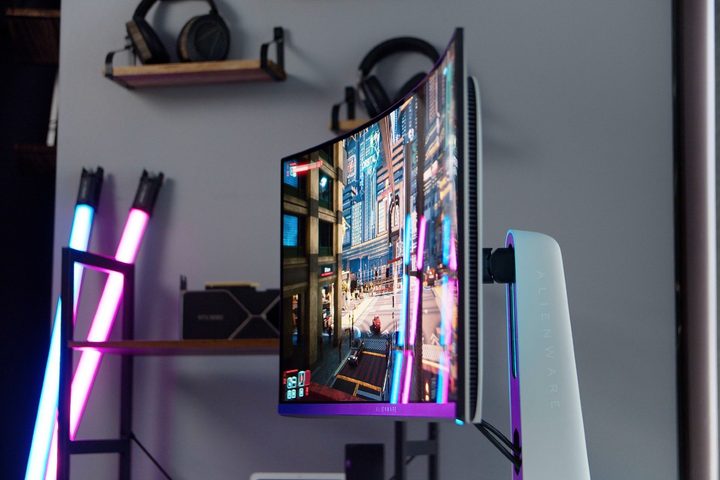
The ultrawide Alienware 34 QD-OLED against a backdrop.
Digital Trends

Alienware is playing coy with two new QD-OLED gaming monitors that are expected to launch soon. During a livestream for TwitchCon, the company provided a brief look at the two new displays, which will be available in January of next year.

We only know some basic details. One of the displays is a 32-inch 4K QD-OLED display. This is the easier one to speculate about, as we’ve seen a few other 4K QD-OLED monitors already announced. The Dough Spectrum Black is a 32-inch OLED monitor with a 4K resolution and a refresh rate of up to 240Hz. Asus announced an identical monitor as well. If Alienware is using the same panel, its 32-inch monitor should reach 240Hz.

Recommended Videos

The other monitor is something new. All we know right now is that it’s the first QD-OLED monitor with a 360Hz refresh rate. Given that we’re expecting 4K QD-OLED monitors in the first part of next year with a 240Hz refresh rate, there’s a good chance this is a 1440p display. That’s pure speculation at this point, though. We haven’t seen other QD-OLED monitors touting a 360Hz refresh rate, so we’ll just have to wait until Alienware has more to share.

Regardless, both monitors look like they’re worth getting excited about, especially since Alienware’s 34 QD-OLED still tops of the list of the best gaming monitors, and it’s among the best OLED monitors you can buy.

We’ve seen some competitors since, most notably the Samsung Odyssey OLED G8. But no monitor has been able to match the high-end value with Alienware’s first QD-OLED display. Hopefully, that trend continues with Alienware’s two new QD-OLED displays, as it’s an area mostly dominated by expensive monitors like the Asus ROG Swift PG27AQDM.

Alienware confirmed that the monitors will release in January of next year, so we’ll likely get a much closer look at them at CES 2024. We also expect to see similar QD-OLED monitors on display from brands like MSI and Asus. There’s a good chance other brands will have their versions of the 32-inch 4K monitor, at least, but Alienware might exclusively offer the 360Hz display. For now, all we can do is wait until Alienware has more to share.

Jacob Roach
Former Lead Reporter, PC Hardware
Jacob Roach is the lead reporter for PC hardware at Digital Trends. In addition to covering the latest PC components, from…
Your Windows 11 PC can now natively run AI workloads, even if it lacks the Copilot+ badge
Windows 11 laptop on a table

For the better part of a year, Microsoft has been telling us that the future of AI on Windows belongs to Copilot+ PCs. If you wanted Microsoft’s most advanced local AI features, you needed a machine with a dedicated Neural Processing Unit (NPU). That was the deal. Now, Microsoft appears to be rewriting the rules.

According to updated documentation, Windows 11’s local Language Model APIs can now run on non-Copilot+ PCs, provided they have an Nvidia GeForce RTX 30-series GPU (or newer) with at least 6GB of VRAM. On the surface, this sounds like a developer-focused update. In reality, it could be one of the most significant shifts in Microsoft’s AI PC strategy since Copilot+ PCs launched last year. More importantly, it raises a question that has been lingering ever since the AI PC era began: Did we really need NPUs for all of this in the first place?

Read more
The Windows 11 June update makes your Start menu and Search feel much more snappier
Low Latency Profile is the first targeted fix Microsoft has shipped for shell responsiveness, and the June update brings it to every eligible PC rather than just Insider preview testers.
Windows 11 Laptop

If you’ve ever clicked on the Start button and watched the menu appear after a second or two, you already understand the problem Microsoft is trying to solve with its June 2026 Windows 11 update. 

The update (KB5094126) rolled out on June 9, 2026, for WIndows 11 24H2 and 25H2, and targets the shell responsiveness issues that have quietly frustrated users since its launch in 2021. The headline change is the broad rollout of the Low Latency Profile.

Read more
OpenAI teams up with Visa to enable secure payments through AI agents
ChatGPT could soon buy things on your behalf thanks to OpenAI's new Visa partnership
openai-chatgpt-visa-payment

Imagine telling ChatGPT to reorder your paper towels or find the best wireless headphones in your budget, and it just handles the purchase without you lifting a finger. That is exactly what OpenAI and Visa are now building toward.

The two companies announced a strategic partnership at the Visa Payments Forum, with plans to bring Visa's global payment infrastructure directly into OpenAI's AI agent experiences, including ChatGPT and the Atlas browser.

Read more