  1. Home
  2. Computing
  3. Features

Are dual-spec panels the future of gaming displays? I certainly hope so

Add as a preferred source on Google

Amid the innovation around higher resolutions and refresh rates announced at CES 2022, one smaller display announcement caught my eye that might be even more important.

Asus announced an update to its popular ROG Zephyrus Duo 16, which is already quite an unconventional gaming laptop. But this year’s update makes it even more interesting by offering what Asus calls a “dual-spec” monitor.

A woman using the ROG Zephyrus Duo 16 at a desk.
Image used with permission by copyright holder

What’s a dual-spec monitor? Well, quite literally, it’s a display that can run at two different specifications — or more specifically, at two different refresh rates. That means a gaming laptop that could, for example, provide the option to adjust the display to a higher resolution with a slower refresh rate — or a lower resolution with a faster refresh rate.

Recommended Videos

That’s exactly what the new ROG Zephyrus Duo 16 can do. It can display UHD at 120Hz or FHD at 240Hz. Presumably, switching between the two is just as easy as switching resolution in a game.

Until now, the maximum refresh rate of a panel in gaming laptops has been set in stone. Buy a 4K 60Hz panel? Well, that means your 1440p and 1080p gaming is also going to be stuck at 60Hz. That made slower 4K panels out of the question for PC gamers, even if you’d appreciate that 4K panel outside of gaming.

But if a panel could support two different refresh rates, you wouldn’t be restricted by that single refresh rate.
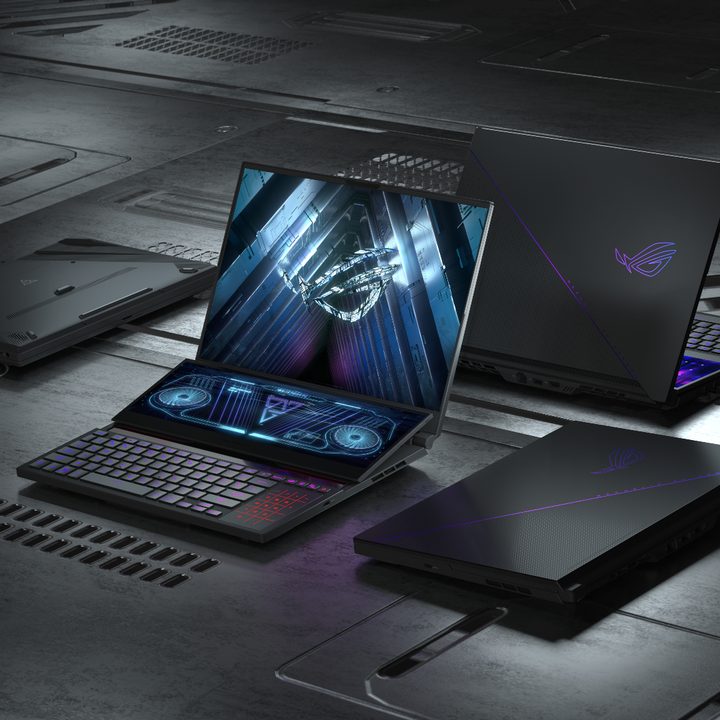
Asus announced the Zephyrus Duo 16 laptop.
Image used with permission by copyright holder

The reason this is so advantageous? Well, different games call for different specifications. You’ll be more competitive in a fast-paced shooter on a lower resolution with a higher refresh rate. Meanwhile, you’d appreciate the higher resolution of a slower-paced adventure title that has an emphasis on immersion and fidelity.

A dual-spec panel, like the one on the new ROG Zephyrus Duo 16, would allow the player to adapt their screen to the game they’re playing beyond just resolution.

Asus only offers the dual-spec panel as one of the display options for its Zephyrus Duo 16. The other is a more conventional QHD mini-LED display. And while there’s no reason it couldn’t offer a gaming monitor with the same feature, we haven’t seen one announced yet.

Suffice to say, the dual-spec panel is still very much an experiment. But I, for one, am hoping that it catches on.

Luke Larsen
Former Senior Editor, Computing
Luke Larsen is the Senior Editor of Computing, managing all content covering laptops, monitors, PC hardware, Macs, and more.
TSMC’s latest chip packaging breakthrough promises lower costs and better performance
Analyst Ming-Chi Kuo says the new CoPoS technology could make AI chips cheaper and more powerful.
TSMC Silicon wafer

Making chips smaller has dominated the semiconductor conversation for years, but TSMC's next big leap may come from how those chips are packaged instead. According to analyst Ming-Chi Kuo, the company is developing a new Chip-on-Panel-on-Substrate, or CoPoS, technology that promises lower manufacturing costs while delivering better performance for future AI processors.

TSMC's CoPoS packaging could make future AI chips both cheaper and faster

Read more
Best laptops coming in 2026 after Computex
From RTX Spark powerhouses to next-gen ultrabooks, these laptops are truly worth waiting for.
ASUS ROG Strix Scar 18 Computex 2026 Other

Every Computex promises the next big thing, but only a handful of laptops actually feel worthy of the hype. After spending time exploring the show floor and seeing these devices up close, one thing became abundantly clear: 2026 isn't just about faster processors. It's about smarter laptops, better portability, and AI features that are finally starting to feel useful instead of being another sticker on the palm rest.

A big part of that shift is NVIDIA's new RTX Spark platform, which made its way into several premium creator machines this year. Rather than diving into its technical details yet again, let's focus on the laptops themselves, because each manufacturer has taken the platform in a very different direction.

Read more
The Biggest PC hardware trends from Computex 2026
These six trends could define the next chapter of PC computing.
MSI MAG Gaming setup at Computex 2026

Every Computex has its headline-grabbing announcements. There's always a faster processor, a shinier graphics card, or a laptop that's somehow even thinner than last year's model. But after spending several days wandering the halls of Computex 2026, talking to engineers, trying products, and occasionally getting lost between exhibition booths, I came away with a very different takeaway. That said, this year's show wasn't really about individual products. Rather, it was about the direction the industry is heading. Instead of chasing flashy specifications for the sake of marketing slides, manufacturers finally seem focused on solving real problems.

The MacBook Neo effect is impossible to ignore

Read more