  1. Home
  2. Computing
  3. Legacy Archives

AMD launches new ‘Richland’ A-Series desktop APUs to combat Haswell

Add as a preferred source on Google
AMD_Richland_A_series
Image used with permission by copyright holder

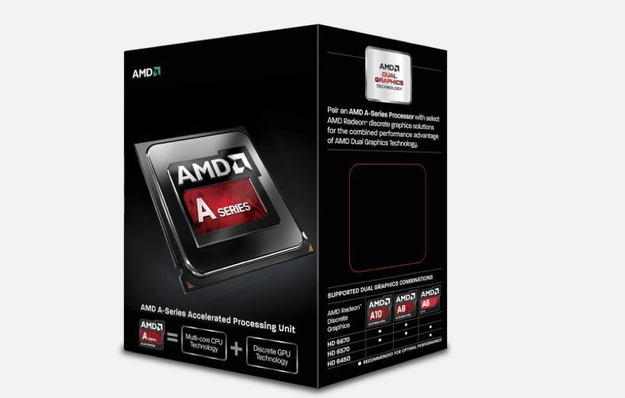
You didn’t think that AMD would take the Intel’s launch of Haswell at Computex sitting down, did you? While Intel worked on its new architecture, engineers at AMD were busy with Richland, a refinement of the Trinity architecture that powered the company’s last generation of A-Series APUs.

Announced today at Computex, Richland, like Intel’s Haswell, is an evolutionary improvement of existing processor technology. The new part upgrades the integrated graphics processor to a Radeon 8000-series part while tweaking the processor to slightly improve performance. AMD claims that this results in a 21 percent improvement in 3DMark Fire Strike and an 8 percent improvement in PC Mark relative to previous A-Series desktop APUs.

amdapurichland
Image used with permission by copyright holder

Graphics performance has always been AMD’s strongest point, so it’s no surprise that the integrated graphics processor is a priority for Richland. The company was quick to point out that its best APUs are still quicker than Intel HD 4600 graphics and score up to 1,104 in the 3D Mark Fire Strike benchmark (HD 4600 scored 843 when we tested a Core i7-4770K processor). AMD also claimed that the A10-6800K, an eight-core APU, can play games like Bioshock Infinite and Tomb Raider at 1080p with a framerate of 30 FPS or above.

Recommended Videos

AMD adds additional value through a plethora of extra features, most of which are graphics related. The new A10 APUs support Eyefinity multi-monitor gaming, improve performance in select applications via Open CL GPU compute, and can be paired with a Radeon discrete graphics card to substantially boost overall performance.

The best argument in favor of AMD, however, is still price.
amdaseries-richland
Image used with permission by copyright holder

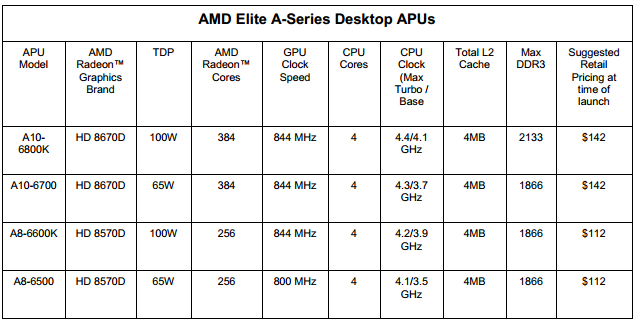
The top-of-the-line A10-6800K will be selling at a retail price of $142, about half the price of high-end Intel Core i5 and i7 quads, which usually retail for $300 or more. Intel’s processors offer much better performance on a per-core and per-clock basis, but AMD’s A-Series is fast enough for some, and the IGP reasonably powerful. Those who don’t need the latest-and-greatest may be enticed by the A8-6500, a quad-core processor priced at $112. The “K” series processors, which have a higher listed thermal design power, are unlocked for maximum overclocking potential. 

Remember, however, that AMD also produces the FX line, which includes its quickest and most expensive processors. The affordable A-Series desktop processors are separate from the FX line and are targeted at mid-range desktops and users who don’t need, or can’t afford, discrete graphics. The FX line is due for an update later this year. 

Matthew S. Smith
Matthew S. Smith is the former Lead Editor, Reviews at Digital Trends. He previously guided the Products Team, which dives…
Topics
Digital Trends Computex 2026 Publisher Awards
Computex 2026 had some wild tech, and these were the best.
Digital Trends Computex 2026 Publisher Awards Featured Image

Computex is always chaotic, and Computex 2026 kept the same pace. This year’s show had the usual parade of powerful laptops, overbuilt gaming rigs, and the fun, if not strange, prototypes. AI was everywhere, handheld gaming got a serious power boost, and even monitor makers came ready with displays that sound like they were pulled from a wishlist.

That’s why we’ve put together our Computex 2026 Publisher Awards, spotlighting the products that pushed the show forward.

Read more
Google Search can now monitor the web for updates on things you care about
AI Mode on Google search now lets users create search agents
Google Search information agents featured

Google has started rolling out AI Search agents that can monitor the web for users and send updates when relevant information changes. The feature was first announced at Google I/O 2026 as part of Google’s wider AI Mode overhaul, which also included a redesigned search box, Gemini 3.5 Flash, personal intelligence features, and new agentic tools for creating mini apps and dashboards.

The new feature is called information agents. It is designed for searches that do not end with a single answer. Instead of checking the same query again and again, users can ask Google to keep tracking a topic in the background.

Read more
Apple made Liquid Glass adjustable, which says plenty about Liquid Glass
The new slider is useful, welcome, and mildly hilarious after a year of Apple acting like transparent everything was the obvious future.
Text, Document, Business Card

Apple’s big glassy software future now comes with a way to make it less glassy. In iOS 27, users can adjust the translucency of the Liquid Glass effect, while macOS Golden Gate adds its own Liquid Glass controls under System Settings.

Liquid Glass is still alive across Apple’s platforms, still shimmering through menus and panels, still doing the elegant UI trick Apple clearly likes. The big visual bet has already earned a dimmer switch. After a year of treating translucency like the obvious next step, WWDC’s most revealing design update may be the one that lets people dial it back.

Read more