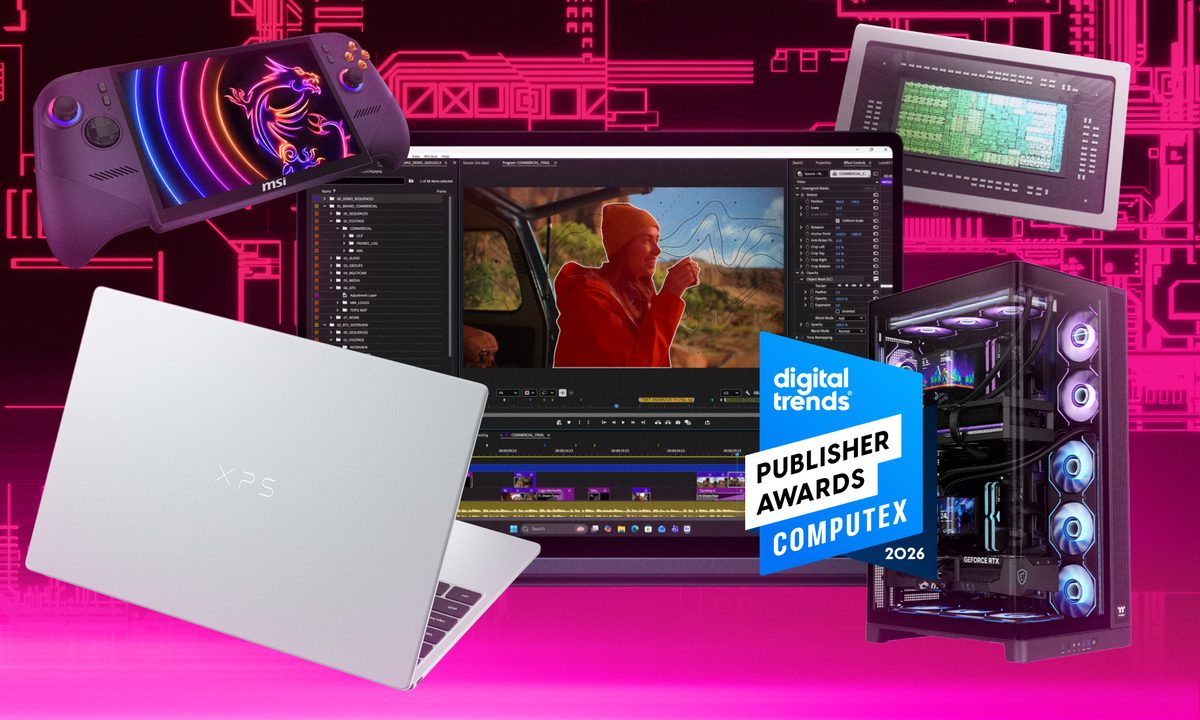

Computex is always chaotic, and Computex 2026 kept the same pace. This year’s show had the usual parade of powerful laptops, overbuilt gaming rigs, and the fun, if not strange, prototypes. AI was everywhere, handheld gaming got a serious power boost, and even monitor makers came ready with displays that sound like they were pulled from a wishlist.
That’s why we’ve put together our Computex 2026 Publisher Awards, spotlighting the products that pushed the show forward.
NVIDIA RTX Spark
The most important announcement at Computex 2026 was NVIDIA RTX Spark. Yes, the AI PC label is starting to sound like a broken record, but this is one of the few examples where the hardware underneath shows impressive potential. NVIDIA is calling this a new superchip for Windows PCs, built around a 20-core Grace CPU, a Blackwell RTX GPU with 6,144 CUDA cores, up to 128GB of unified memory, and up to 1 petaflop of AI performance.

The company has designed the Spark for local AI agents, improved creative workflows, and AAA gaming in slim laptops and compact desktops. We’ve seen plenty of powerful chip announcements, but what makes the RTX Spark a bit different is the scale of its impact. It is Nvidia making a proper play for the future of Windows PCs, bringing CUDA, RTX, DLSS, Reflex, G-Sync, and local AI acceleration into a single platform. With systems expected from brands including Dell, HP, Microsoft Surface, and more, RTX Spark could shape the next wave of premium PCs.
Microsoft Surface Laptop Ultra
Windows is one of the biggest operating systems in the world, so one would naturally expect Microsoft’s own Surface laptops to be the best way to experience it. Microsoft’s Surface Laptop Ultra feels like the answer many people have wanted: a powerful and premium Windows laptop built around genuinely cutting-edge hardware.

Leveraging NVIDIA’s new silicon to deliver up to a petaflop of AI compute, along with 128GB of unified memory, this notebook was built for larger local models and datasets. It also looks like Microsoft is finally taking ports seriously. The Surface Laptop Ultra includes USB-C, USB-A, HDMI, a headphone jack, and a full-size SD card reader, which makes it feel far more creator-friendly than the average thin flagship. Add in a new thermal system rated for up to 2.5 times the thermal capacity of the Surface Laptop 15-inch, and this easily becomes what a true Windows flagship should’ve been all along.
MSI Claw 8 EX AI+
The MSI Claw 8 EX AI+ is the handheld that really showcased Intel’s portable gaming handheld push. MSI says it is the world’s first gaming handheld powered by Intel Arc G3 Extreme processors, which also makes it one of the most powerful of its kind. Coupled with an 8-inch 120Hz VRR display, upgraded ergonomic grips, Hall-effect triggers and sticks, and a refined D-pad, you have a powerful and well-built handheld gaming PC.

In recent years, the handheld PC space has become crowded, but the Claw 8 EX AI+ is carving its spot by chasing a higher-end AAA gaming experience in a portable form factor, with XeSS 3 Multi-Frame Generation, and Xbox Mode support helping round out the software side.
Thermaltake CAPO X
Thermaltake’s CAPO X is exactly what you’d expect to see at an exhibition like Computex, where you typically find absolutely unhinged PC hardware. CAPO X is a dual-system Micro-ATX chassis that supports up to two M-ATX motherboards in one case. That is basically two computers in one tower.

You also get two independent I/O panels for the upper and lower systems. Thermaltake built it for AI agent workspaces and streaming, where one system can run the game while the other handles broadcast duties. It is niche, sure, but it is also clever and useful.
Dell Alienware AW3926QW
After a quick glance at Alienware AW3926QW’s spec sheet, I had to do a double-take. Dell’s latest curved gaming monitor is the world’s first 39-inch 5K OLED gaming monitor with RGB stripe technology, using RGB stripe tandem OLED to hit up to 1,300 nits of peak brightness while improving text clarity.

OLED monitors have always been incredible for contrast and motion, so adding a 1500R curved screen, VESA DisplayHDR True Black 500, Dolby Vision, and a dual-mode setup that can run at 5K 165Hz or 1080p 330Hz just makes the gaming experience even more immersive and smooth. After getting a short first-hand experience with this gaming monitor, I am definitely looking forward to this one.
Dell XPS 13
Despite seeing some wacky and cool things during Computex 2026, the Dell XPS 13 was a surprising favorite of ours. It brings the premium XPS lineup back to a far more accessible place. It starts at $699 in the US, with a $599 price for eligible buyers, while still offering features such as a 2.5K touch display, a lightweight all-aluminum body, a backlit keyboard, and quad speakers.

Powered by Intel’s Wildcat processors, the Dell XPS 13 is expected to hit the market on June 16, 2026. For many, this laptop is a whole package: premium enough to feel special, but priced low enough to make sense. The ongoing memory crunch has hit the PC segment hard, so having more premium yet affordable laptops is always a win for consumers.