
AMD’s Ryzen 5000-series looks set to compete with Intel’s best CPUs like never before. Building on the strong pedigree of the Zen and Zen 2 architectures, the Zen 3 design makes great strides in performance and efficiency. If AMD’s claims about the 5900X prove true, it could be a new performance king in the making.
In Intel’s 10900K, though, it faces stiff competition. With 10 cores and a clock speed in excess of 5GHz, the 10900K is nothing to laugh at. Until now, it has proven itself the king of high-end gaming in many recent games.
One of these chips will be the best CPU for the next six months, at least, but which will it be? The AMD Ryzen 5900X, or the Intel Core i9-10900K?
Pricing and availability
The Intel Core i9 10900K debuted in April 2020 alongside the rest of the 10th-generation Comet Lake series of Intel CPUs. Its suggested retail price is $488, but it regularly sells for much more than that — over $700 at some retailers. The graphics-free Core i9-10900KF is often cheaper, at around $650.
AMD debuted the Ryzen 9 5900X at its Zen 3 showcase on October 8, and it will go on sale on November 5. Its suggested retail price is a more modest $549. Due to AMD’s solid relationship with external foundry operator TSMC, supply issues are less common for AMD than they are for Intel. It’s possible that extreme demand for Ryzen 5000 CPUs could lead to supply issues, but we’ll need to wait and see for the chips to release before we can say what effect that may have on pricing.
Performance
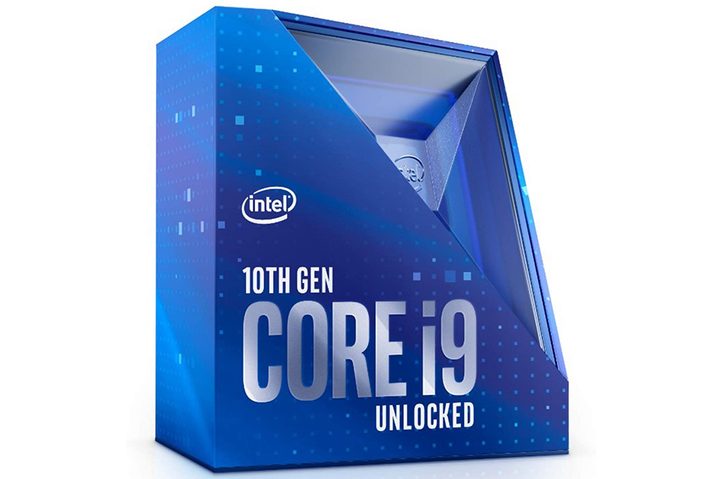
AMD made bold claims with the debut of the Ryzen 5900X, suggesting that, at long last, AMD may have reclaimed the gaming performance crown Intel has held on to for almost 15 years. Although we must await third-party benchmarks to confirm these claims, the specifications and AMD’s own first-party benchmarks suggest that the Ryzen 5900X may be able to beat the Core i9-10900K just about everywhere.
| Intel Core i9-10900K | AMD Ryzen 5900X | |
| Architecture | Comet Lake | Zen 3 |
| Process node | 14nm+ | 7nm+ |
| Cores | 10 | 12 |
| Threads | 20 | 24 |
| Base clock | 3.7GHz | 3.7GHz |
| Max single-core boost clock | 5.3GHz | TBD |
| Max all-core boost clock | 4.9GHz | 4.8GHz |
| Cache | 20MB | 70MB |
| Max memory speed support | 2,933MHz | TBD |
| TDP | 125W | 105W |
| CPU socket | LGA1200 | AM4 |
An advantage in core and thread counts gives the Ryzen 5900X an immediate edge in multithreaded workloads. That won’t make much of a difference in most games, but will help it maintain the now-typical AMD productivity performance lead, especially in intensive tasks like video editing and transcoding.
Where AMD made significant gains with this generation of CPUs, though, is in IPC and clock speed. The Ryzen 3000-series of Zen 2 CPUs already offered a greater IPC than Intel’s Comet Lake processors, but lost out significantly on clock speed, making Intel CPUs better at tasks with more limited thread counts and where per-core performance is more desirable — like gaming.
AMD says that will change with Zen 3. With another large uptick in IPC — AMD claims as high as 19% — the performance gap could be all but eliminated at the single-thread level. Combine that with a small, but not insignificant, clock speed increase over its predecessor, and the 5900X appears to have enough single-threaded grunt to take on Intel’s best in gaming.
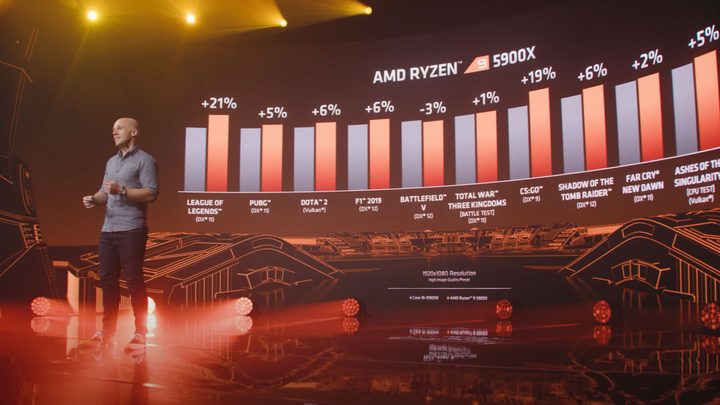
AMD claims that its 5900X can beat the 10900K by up to 21 percent in some games, though more modest gains are more typical, and it’s far from uniform. It also showed the 5900X dominating the 10900K in Cinebench 1T, showing its strength in single-threaded tasks, though AMD hardware is known to run better on Cinebench benchmarks than Intel’s.
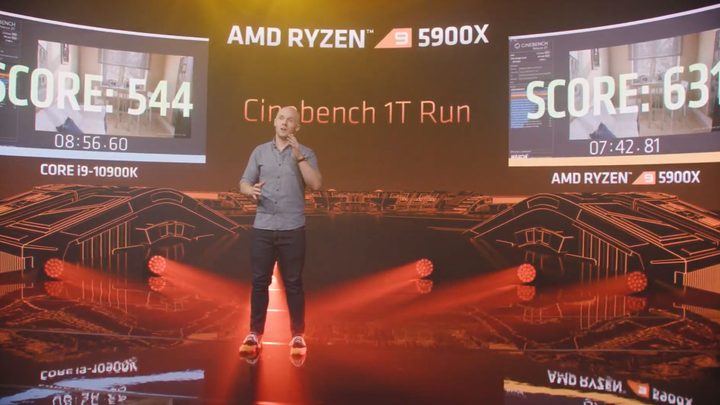
Productivity results should be even more impressive — that’s AMD’s wheelhouse, after all. We’ll have to wait to test final hardware to be sure, but AMD’s Ryzen 5900X looks promising on paper.
Power, cooling, and overclocking
A notable aspect of Intel’s Comet Lake series is the greater thermal design power (TDP) demands of its CPUs. That’s led to increased power draw, especially for the more capable K-series processors, though the CPU’s refined internal heat spreader typically allows the chips to run at comfortable temperatures without an overwrought cooling solution.
AMD’s process node advantage (7nm versus 14nm) and further architectural refinements of the 5000-series means that its CPUs not only run at speeds similar to Intel’s, but do so at a slimmer TDP of 105 watts. That should mean they run cooler in general, and require a less strenuous cooling solution to retain comfortable temperatures, as well as demand less power from the PSU, making them more viable for efficient, smaller form factor PCs.
Overclocking is one region where Intel may enjoy more of an advantage for those who like to tweak their hardware.
Chipset support
Intel’s Core i9-10900K is supported by a wide range of 400-series chipsets, including the Z490, B470, B460, and H410. That might make buying the right motherboard a little confusing, but it does give you plenty of options. Most should also be socket-compatible with the next-generation Rocket Lake CPU.
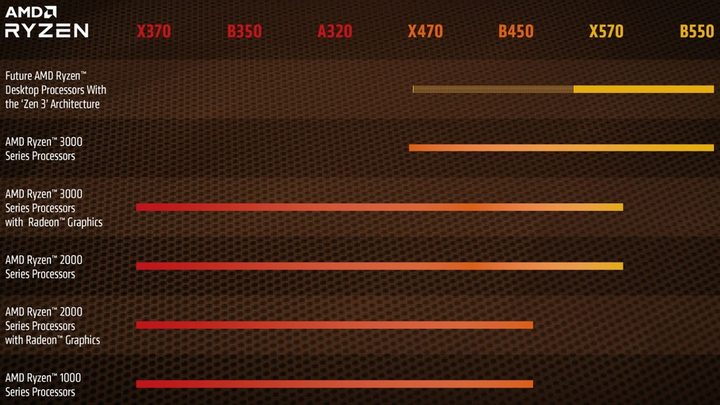
AMD’s 5900X is compatible with existing X570 and B550 motherboards after a BIOS update, as well as some B450 and x470 motherboards, depending on the manufacturer. AMD has confirmed that it won’t launch a new chipset with its Zen 3 CPUs.
This will be the last generation of AMD CPUs that make use of its AM4 socket, so next-generation Zen 4 CPUs will almost certainly require a motherboard upgrade, making Intel’s Comet lake somewhat more future-proof.
Zen 3 is the AM4 swan song everyone wanted
After Intel took a significant jump forward in terms of their products’ performance, AMD has climbed back to the top of the pack when they released their first-generation Ryzen CPUs. Gaming and single-threaded performance have taken a lot more effort despite AMD managing to take the top spot for productivity with ease. It’s somewhat poetic that on the last AM4 CPU, AMD finally managed to take the crown in just about every category. We think that the Ryzen 9 5900X is worth the expense as it could easily be the most innovative CPU of this generation.
Not only does the Intel Core i9-10900K win our user’s choice award over the 5900X, but it also holds its own over many other competitors on the market today. As multithreading performance becomes ever more critical, the 5900X is only likely to increase its lead. We think that the 11th-generation Rocket Lake CPUs could bring Intel back to the top of the field, but with their release being about six months away, we’ll have to wait and see.
While you still have to hold out for the 5900X release date, you’ll probably have to anyway since your current option to purchase the 10900K may be jeopardized by the fact that it’s ultimately facing scarcity and inflated prices.


